
Helloooooo, Creatives! Let’s get started! If you haven’t practiced mixing your colors yet, let’s start with “Elida’s Fab Five.” You should always begin each lesson by mixing your colors as I’ll be referring to them often within the lesson. Nothing is more frustrating than having to put me on pause while you go back to your palette to mix colors.
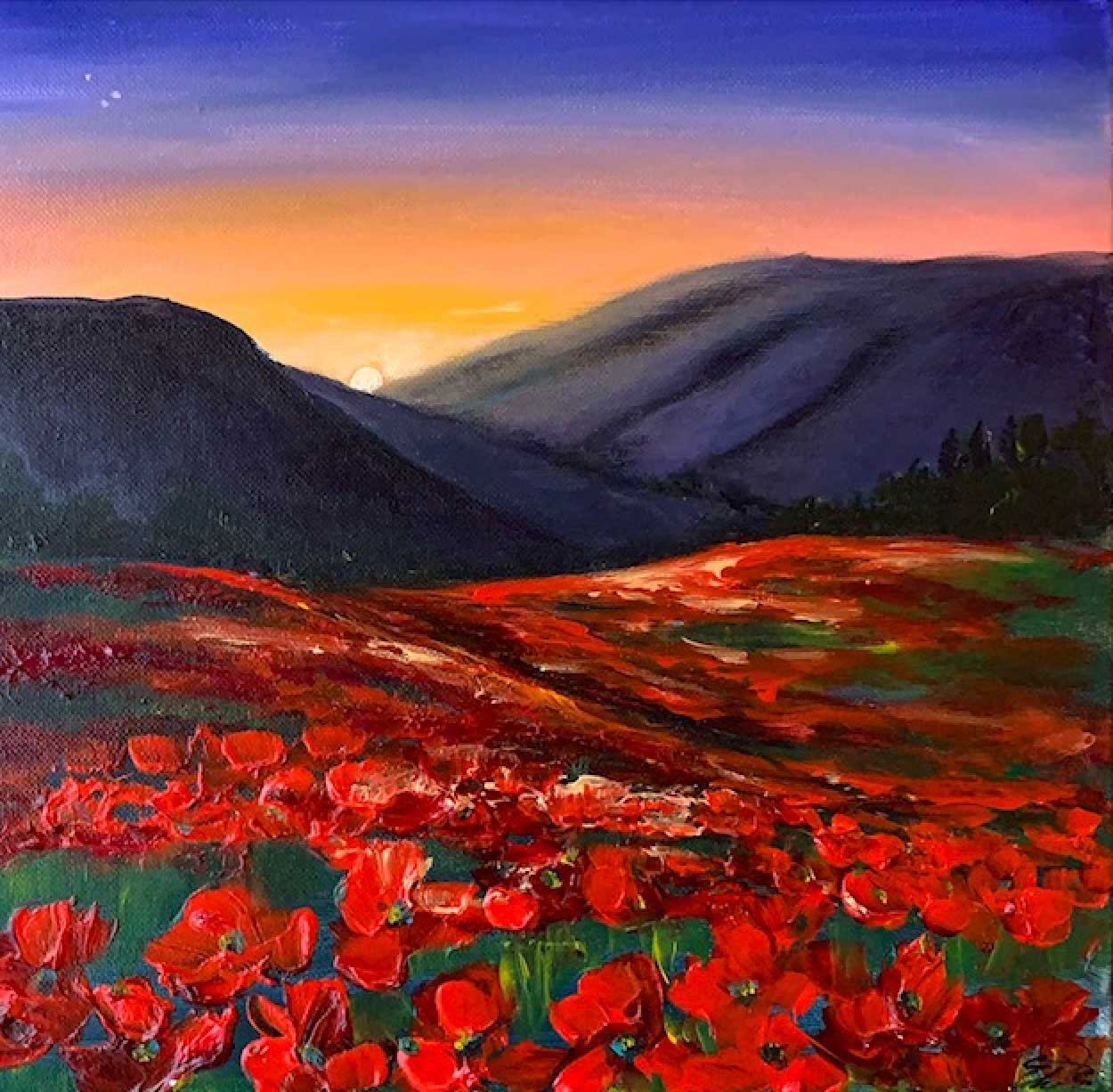
Creating the Sunset: So, for this painting, we will be starting with the sky. When painting with acrylics, I always start with the farthest thing away and move forward. Grab your “big kahuna” brush as we will be making some large strokes and overlapping colors as we move down the canvas. Don’t worry about the bold approach we’re taking. There is nothing you can do to mess this up! When in doubt, you can always add another layer to make things right again. Make sure you have some fresh water and paper towels handy before you get started.
Side note: Start from the top of the canvas and move your way down working your strokes back and forth in a horizontal pattern. When overlapping your colors, remember to start your new color just below the color above, and barely move over the top to blend but be careful not to move up completely so you don’t over blend them.
Sketch and Block: Grab your conte crayon or stabilo pencil as we sketch out the hills and foreground. Make sure you have some of your darker colors mixed up and ready to use when we go back into the piece to block in all of the darkest colors. Don’t panic if you start to feel like you’ve ruined your painting. We are moving into the ugly stage or as I say, “headed into middle school” and things are going to look bad for awhile. I promise we’ll move through this stage quickly, but we can’t skip it. Getting these dark darks in is necessary to create the depth before adding the bright colors on top.
Hills, trees, and flowers: You can breathe a sigh of relief because we are moving out of middle school — the braces and headgear are about to come off! Whoohoooooo! Ok, now we get to the fun stuff and we’ll start by adding in some highlights into the hills.
We’re building the painting as we move forward.Grab your palette knives for this part and make sure that you are using thick-bodied acrylics or mix in some gel medium to thinner acrylics for added texture.
Side note: Different palette knives can do different things. It’s great to try a few different ones to see what is most comfortable for you. In a pinch, you can always use a butter knife or other kitchen tools. The whole idea is to be messy and loose. Don’t try to control it too much. Just let the mess happen and step back to see the progress.
Finishing Touches: Moving into the final stages of our painting, you’ll add the other finishing details, giving it that last little pop of color and interest. Gather your small brush, your angled brush and Elida’s Fab Five mixing chart. When your painting is completed, paint the edges of your painting and sign it. I usually write my name in the bottom right corner with a permanent marker, but you can sign wherever you’d like. You just can’t skip it. It’s important to take ownership of your work.
Bonus: Take a look at my bonus video on how to spray your painting to protect it best against UV light, etc. There are many options out there, but remember that they are just options and not necessary. If you like the sheen on your piece, it’s fine to leave it as is. This is just one more layer of protection for your painting.