Dear creative friends,
I'm home in Cascais, just back from teaching in Italy, with about two weeks before I leave again for Tomar. In between, I got to be a student myself. Early in August I attended an art retreat in Scotland taught by my friend and colleague Susan McCreevy, and I came home with a suitcase full of botanical prints and a head full of ideas. It was one of those weeks that reminds me why I fell in love with this path.
Back in March, I wrote about the Nile and its three seasons, the flood, the growth, the harvest. I didn't plan for this issue to circle back to that. But sitting here between two teaching trips, with a studio full of half finished things, I keep landing on the same question. What actually grew this year? What's ready to be gathered in, and what's just taking up space on the table?
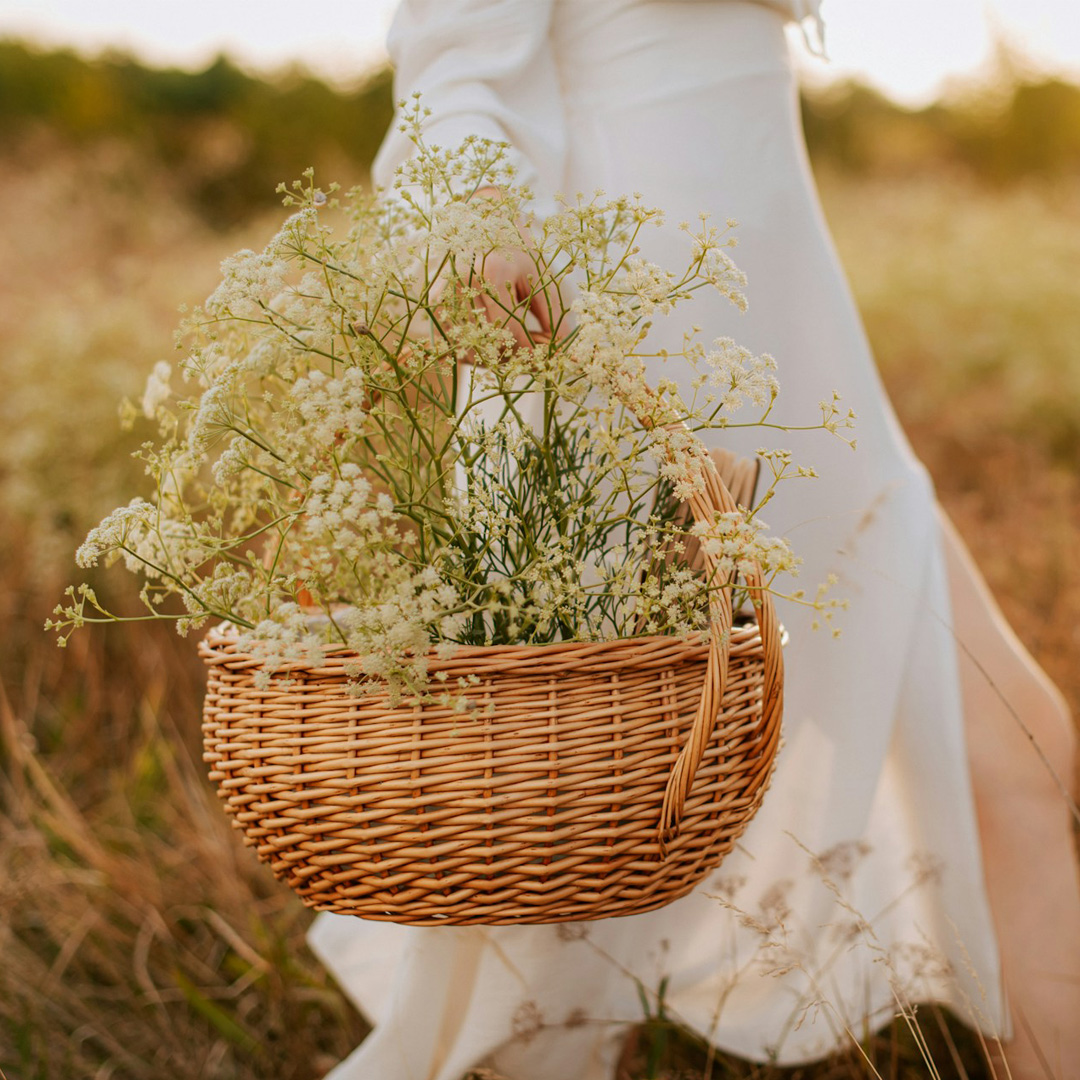
Gathering isn't only about abundance. It's about honesty. Looking at a full basket and being able to say, this is what came, and this didn't, and both of those things are fine.
This issue is about taking that kind of stock. Not with a checklist, just an honest look at what we’ve drawn to us.
I hope it gives you a quiet place to gather your own harvest before the next season asks something new of you.

By the middle of the seventeenth century, a household in Amsterdam or Haarlem could hang a painting on its wall that showed nothing but a table. Bread, a peeled lemon, a bouquet just past its peak. No saints, no battles, no allegorical gods. Just the ordinary residue of a gathered harvest, rendered with a precision that made the varnish itself seem to hold light.
This was still life painting at the height of the Dutch Golden Age, and it became one of the most popular genres of an entire nation's art. What's easy to miss now, looking at these paintings in a museum with soft lighting and a wall label, is how personal they actually were. Someone chose every stem in that vase. Someone arranged that fruit knowing exactly which piece would brown first. These were paintings about what a person gathers, and what they choose to do with it once it's in front of them.
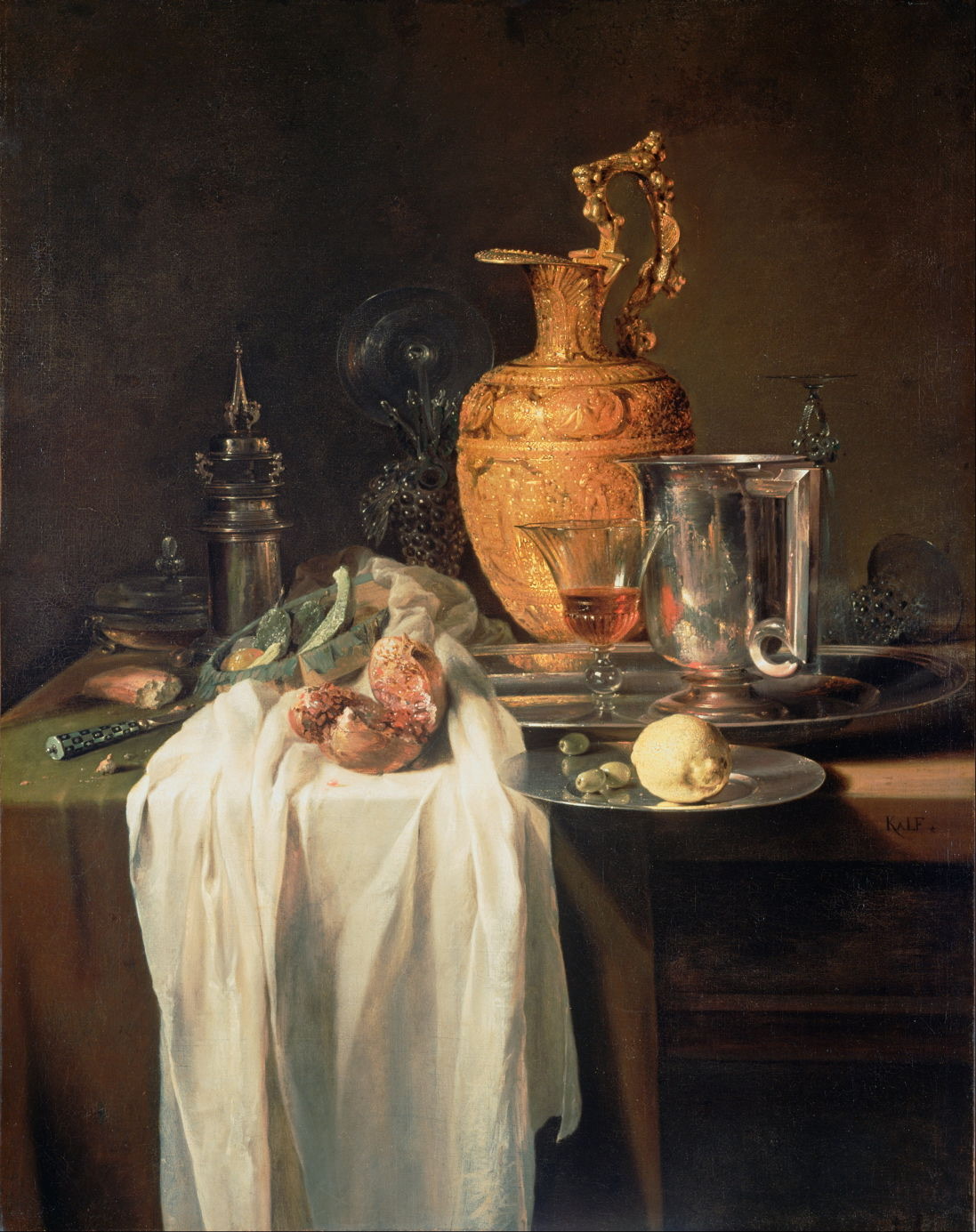
Still Life with Ewer, Vessels and Pomegranate
By Willem Kalf, 1619–1693
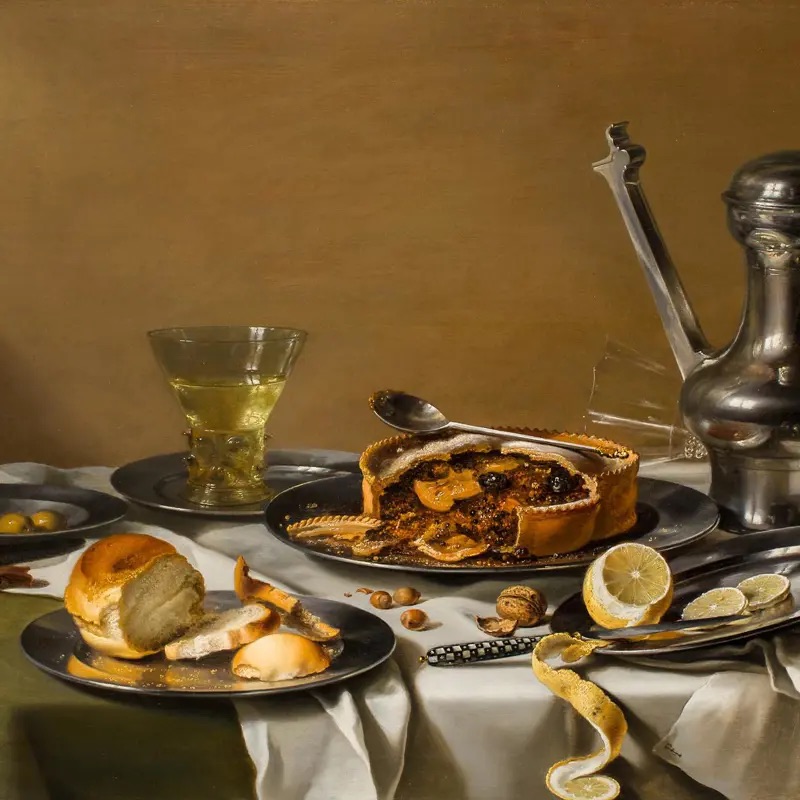
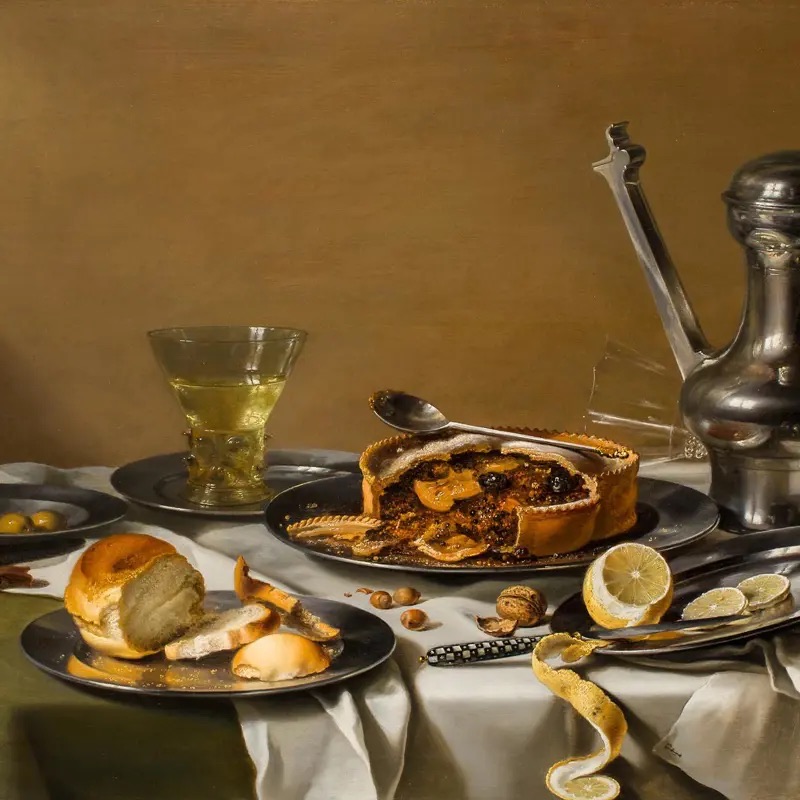
Still Life with Pie, Pewter Jug and Berkemeyer
By Pieter Claesz, 1628
The Dutch Republic in the 1600s was rich in a way most of Europe hadn't seen before, and a new merchant class wanted paintings of their own world rather than distant myths. Still life gave them that. Different cities developed their own specialties. Amsterdam leaned toward flowers, tulips especially, still carrying the memory of the speculative tulip mania of the 1630s. A quieter genre called the ontbijtje, the breakfast painting, spread everywhere too: bread, cheese, a few pieces of fruit, painted so carefully you could tell which apple had a few days left in it.
Pieter Claesz worked in this quieter register, in Haarlem. His tables hold just a handful of objects, a pewter plate, a rolled cloth, one glass catching the light. He painted the same few things for decades, and his restraint has its own kind of fullness. Everything he needed was already there in front of him.
Flower painters worked differently, and the best of them, Rachel Ruysch chief among them, did something that should stop you when you notice it. Her bouquets mix roses with poppies with convolvulus, blossoms that would never actually bloom in the same season sitting together in one vase. These weren't paintings of a single moment in a garden. They were an entire year of flowers gathered and held at once, on one canvas, so nothing had to be left out.
This was a genre where women painters found real standing, and Ruysch became its most celebrated name, working from studies of actual specimens rather than imagination alone. Look closely at her canvases and you'll find the other half of the honesty too. A caterpillar working its way along a stem. A leaf with a hole eaten clean through it. A petal already curling at the edge. The abundance and its undoing, painted with the same close attention.
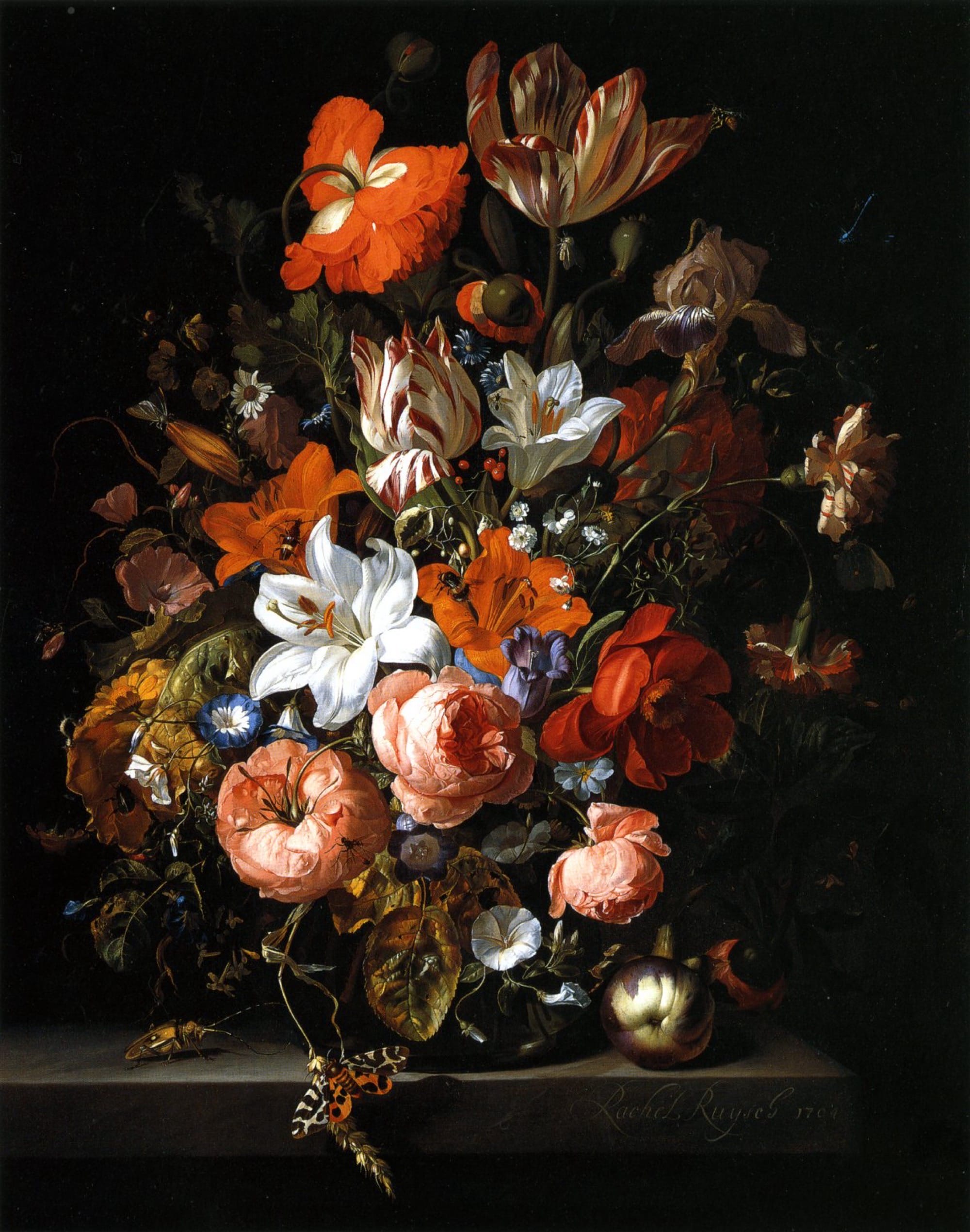
Flowers in a Glass Vase
By Rachel Ruysch, 1704
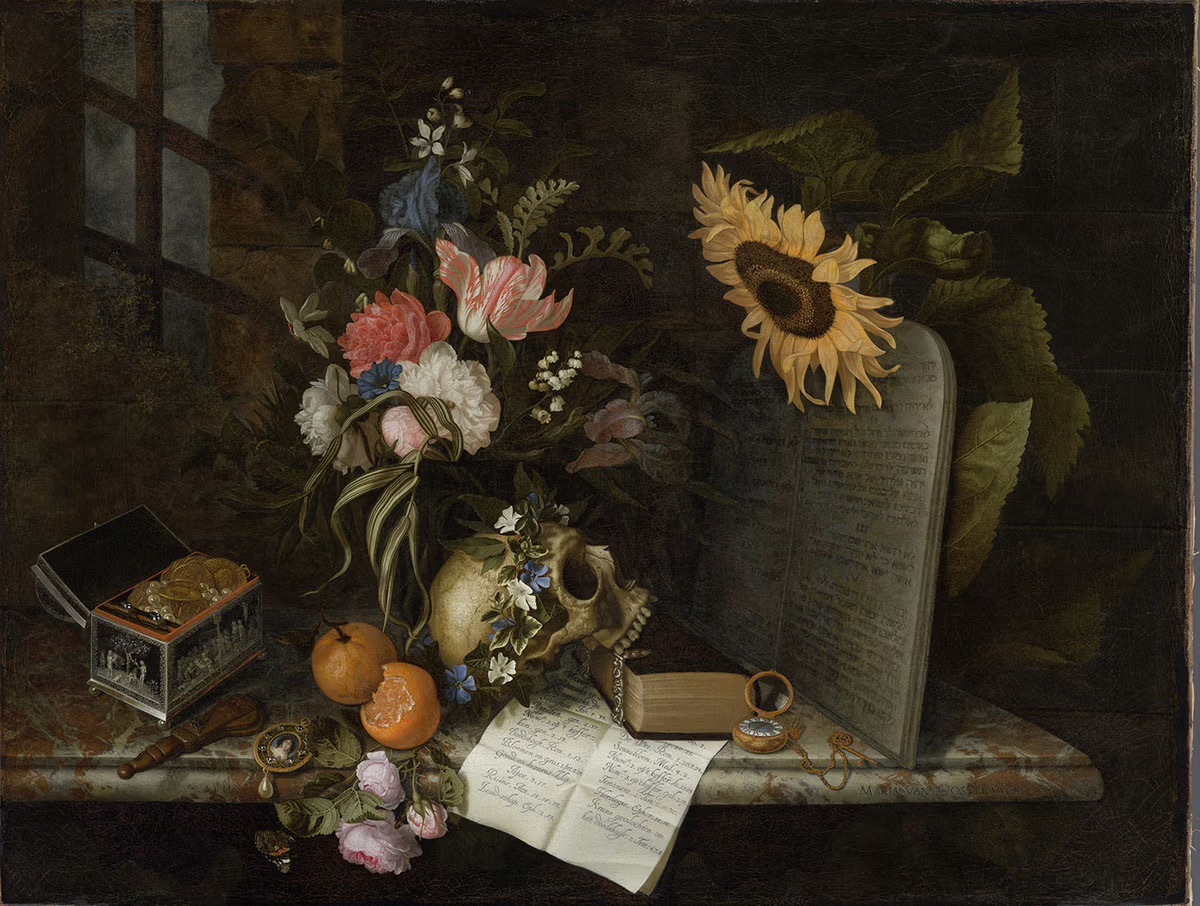
Vanitas Still Life
By Maria van Oosterwijck, 1690
This is where vanitas comes in, that quieter current running under so much Dutch still life. A skull tucked among the fruit. A candle burned low. An hourglass. These were reminders, gentle rather than grim in the best examples, that everything gathered would eventually spoil or fade.
A flower painting carries this without needing a skull at all. The insect, the browning leaf, the bloom past its best day, they say the same thing more tenderly. A full harvest and a fading one can live in the same frame. The point was never to choose between abundance and its passing. The point was to look at both without flinching.
What this tradition understood, painting after painting, is that a gathered harvest is never only the best of what grew. It's the whole vase, the bloom that's still gorgeous and the one starting to drop its petals, sitting side by side because they belong to the same season.
When you take stock of your own year this month, try setting it out the way these painters did. All of it, at once, without editing out what's already fading. That's not a failure of the harvest. That's what a real harvest looks like.
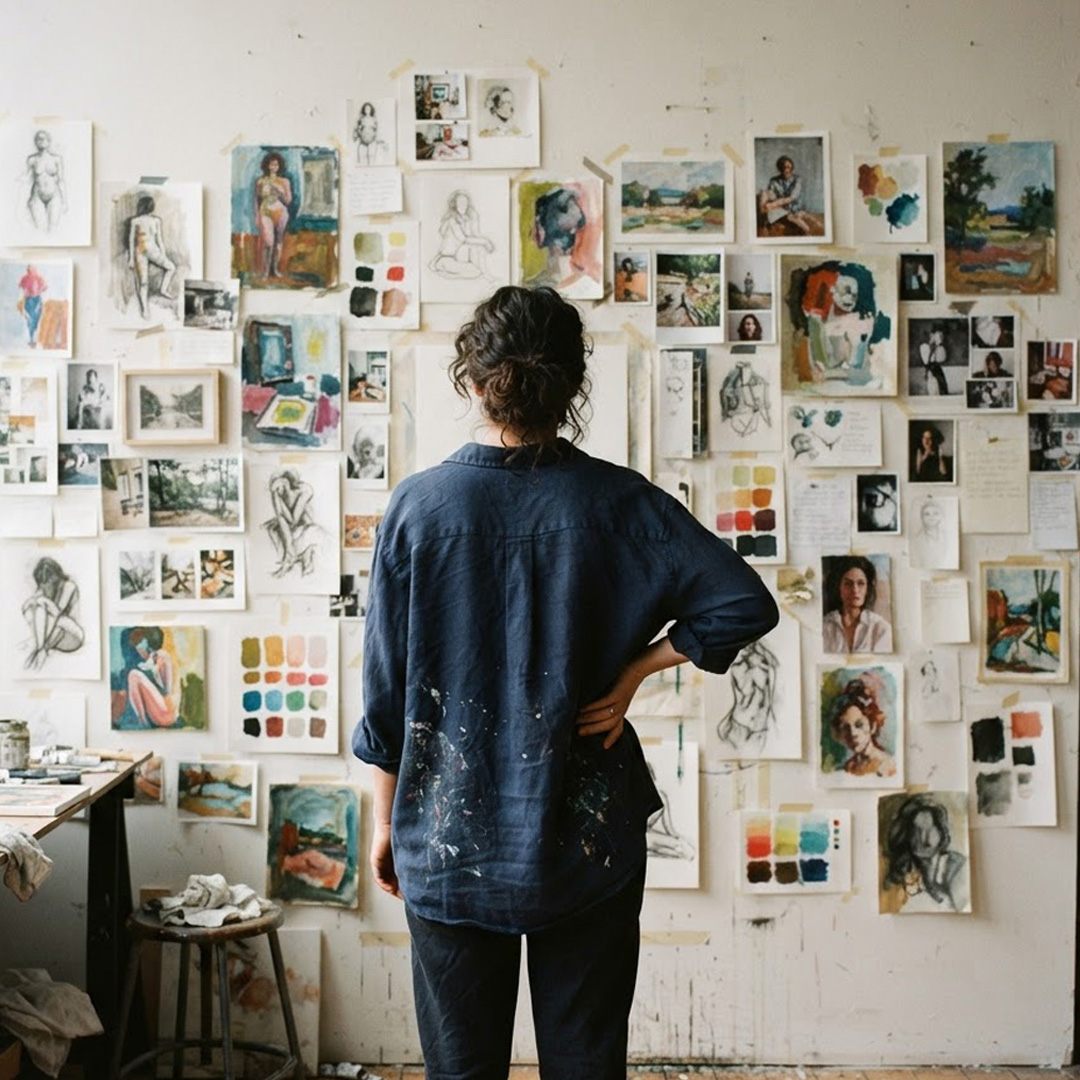
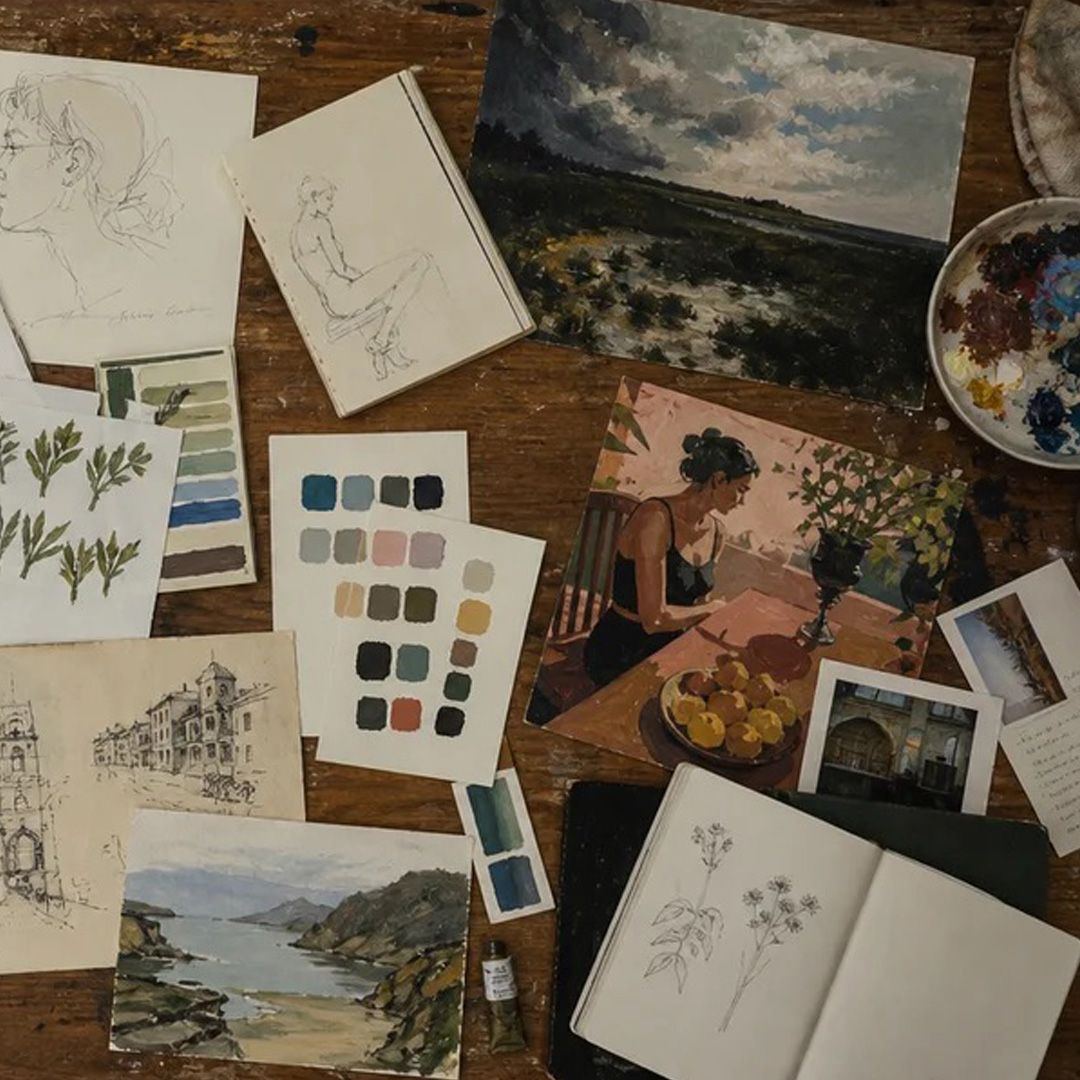
As I look around my studio, I see piles of papers, unfinished pieces, color palettes, torn images from magazines, stacks of sketchbooks. It’s evident I’ve been working but what has actually arrived. What is meant to rise to the top and what should fall away?
Before starting anything new this month, do one simple thing. Pull it all out. Every unfinished piece, every sketch that stalled, every idea scrawled on a napkin and never touched again. Put it where you can actually see it. Not to judge it. Just to look.
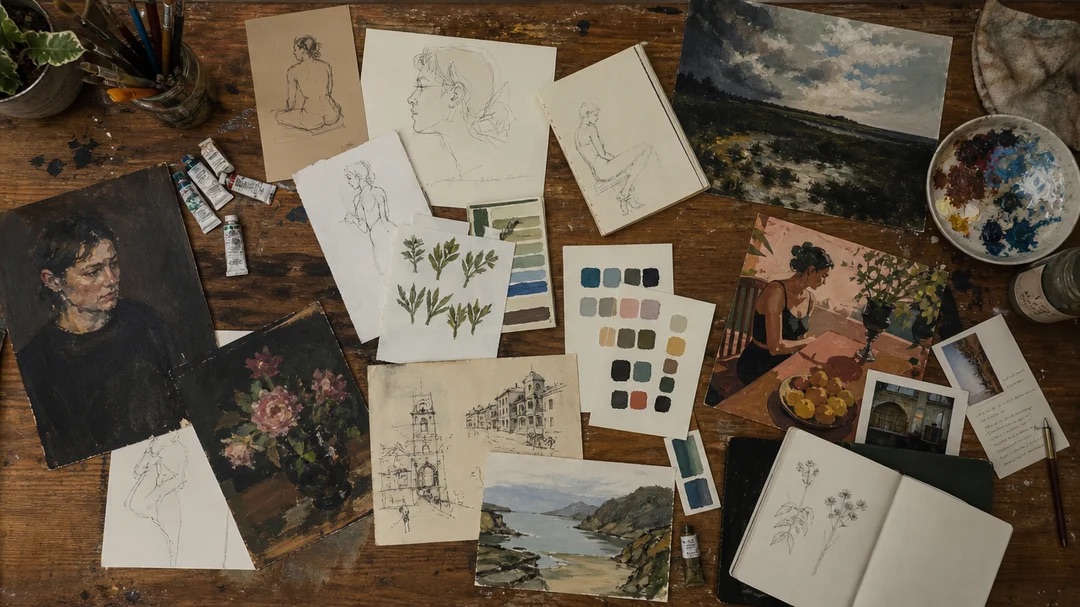
We look at our work one piece at a time, so we rarely see what’s been building over time. A painting from January may not lay next to one from July. This month, let them share a table. Line up the sketches, the studies, the abandoned starts, the finished pieces, and look at the full spread at once.
You'll notice things this way you'd miss otherwise. A color that kept showing up without you planning it. A subject you returned to three times without realizing it was the same pull. Patterns show up stronger when we get a birds eye view and pull back from our work.
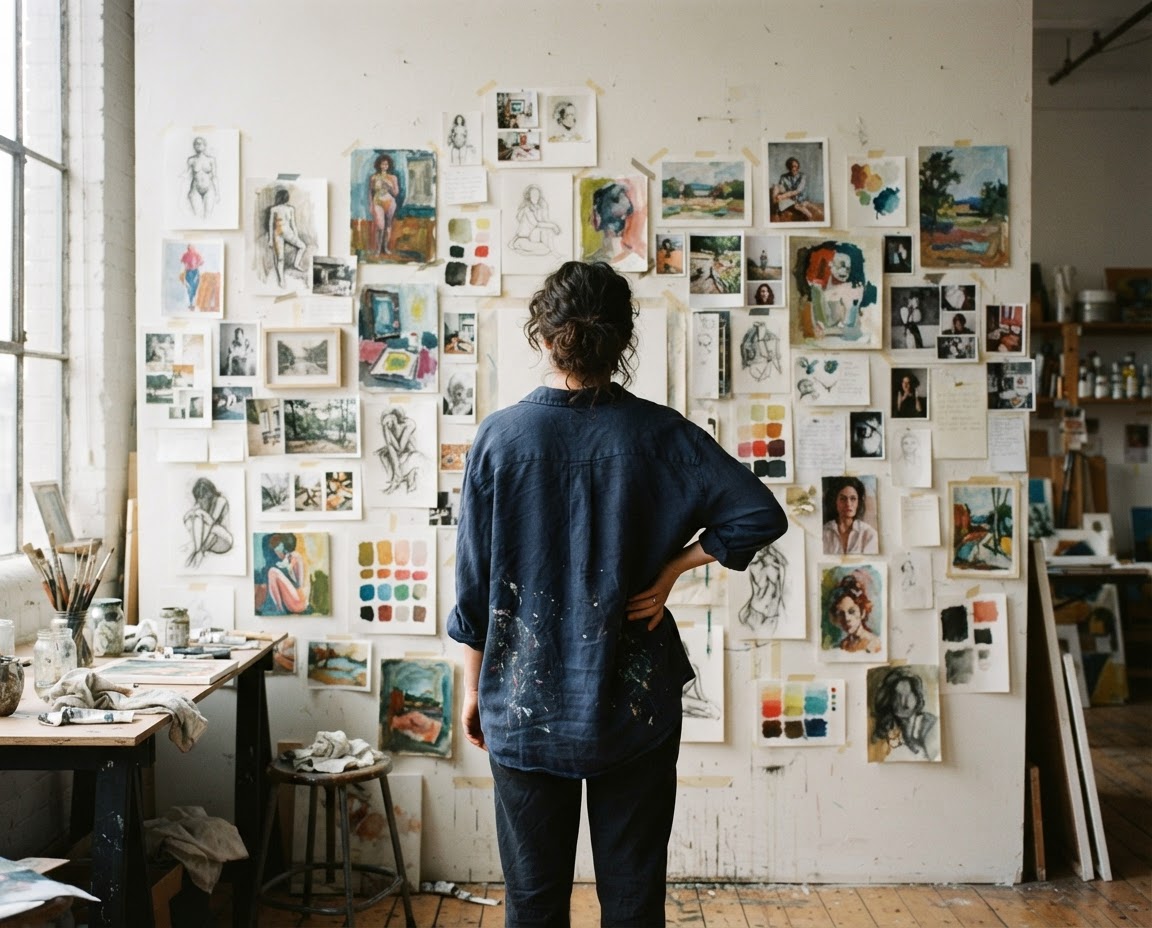
Some of what you find will have gone past its moment. A sketch that you overworked. A canvas you started with real excitement that's sat untouched so long the light has faded. That's normal. Not every seed becomes a finished piece, and treating every unfinished thing as a debt turns the studio into pressure instead of pleasure.
You're allowed to look at something honestly and decide it's done being useful to you. Not every piece of fruit makes it to the table. Some of it was only ever meant to feed the soil.
Then there's the other pile. The pieces genuinely close, or finished, or just needing one more look before you call them done. This is the good part of gathering, the part where you get to say, this one made it.
Don't rush past it. We're quick to chase the next idea and slow to actually acknowledge when something is complete. Sit with the finished pieces for a minute before you file them away. They earned that.
With your work spread before you…ask yourself - What surprises you? What's been calling to you? Why? What needs to be released for now? What needs more time, more attention?
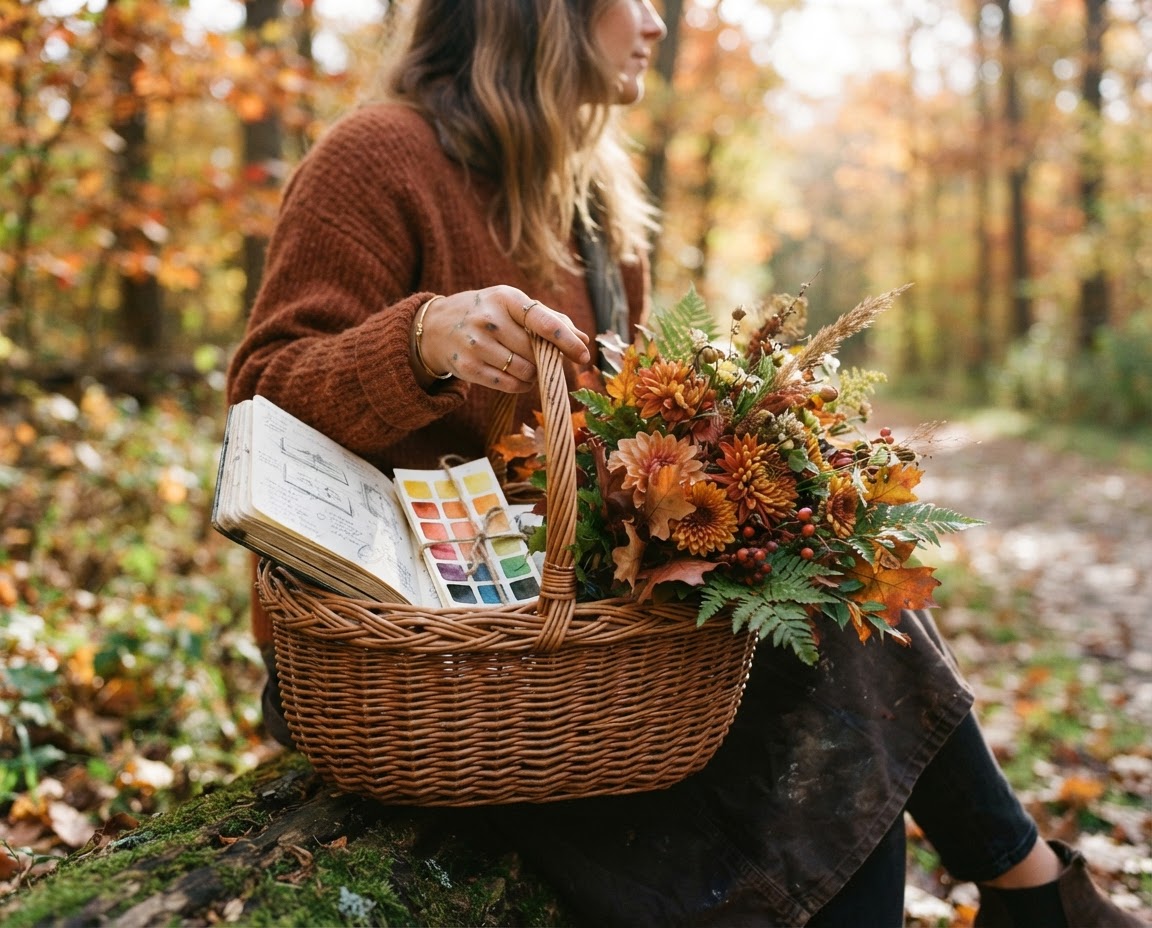
According to the Oxford English Dictionary, gathering means a meeting of people brought together for a particular purpose, and separately, the process of collecting something. Two meanings, but they lean on each other more than you'd think. What we gather often becomes what gathers us.
I love that this word means both things at once. A gathering is a room full of people, and it's also the quiet act of pulling scattered things into one place. This month asks us to hold both.
For most of the year, creative life moves forward. New ideas, new pages, new starts. Gathering asks you to move sideways instead, back through what's already there, and bring it into one place so you can actually see it.
In the studio, this might mean pulling out every sketchbook from the year and setting them side by side. It might mean finally looking at that stack of reference photos you saved and never used. It might mean sitting with a finished piece long enough to notice what it's actually telling you, instead of rushing past it toward the next thing.
Gathering isn't glamorous. It doesn't produce a new painting. But it's how you find out what you actually have, rather than what you assume you have. And more often than not, you'll discover there's more there than you thought. A thread running through months of work that you never named. A color you kept reaching for without noticing. A theme that was quietly organizing itself while you were busy making one thing at a time.
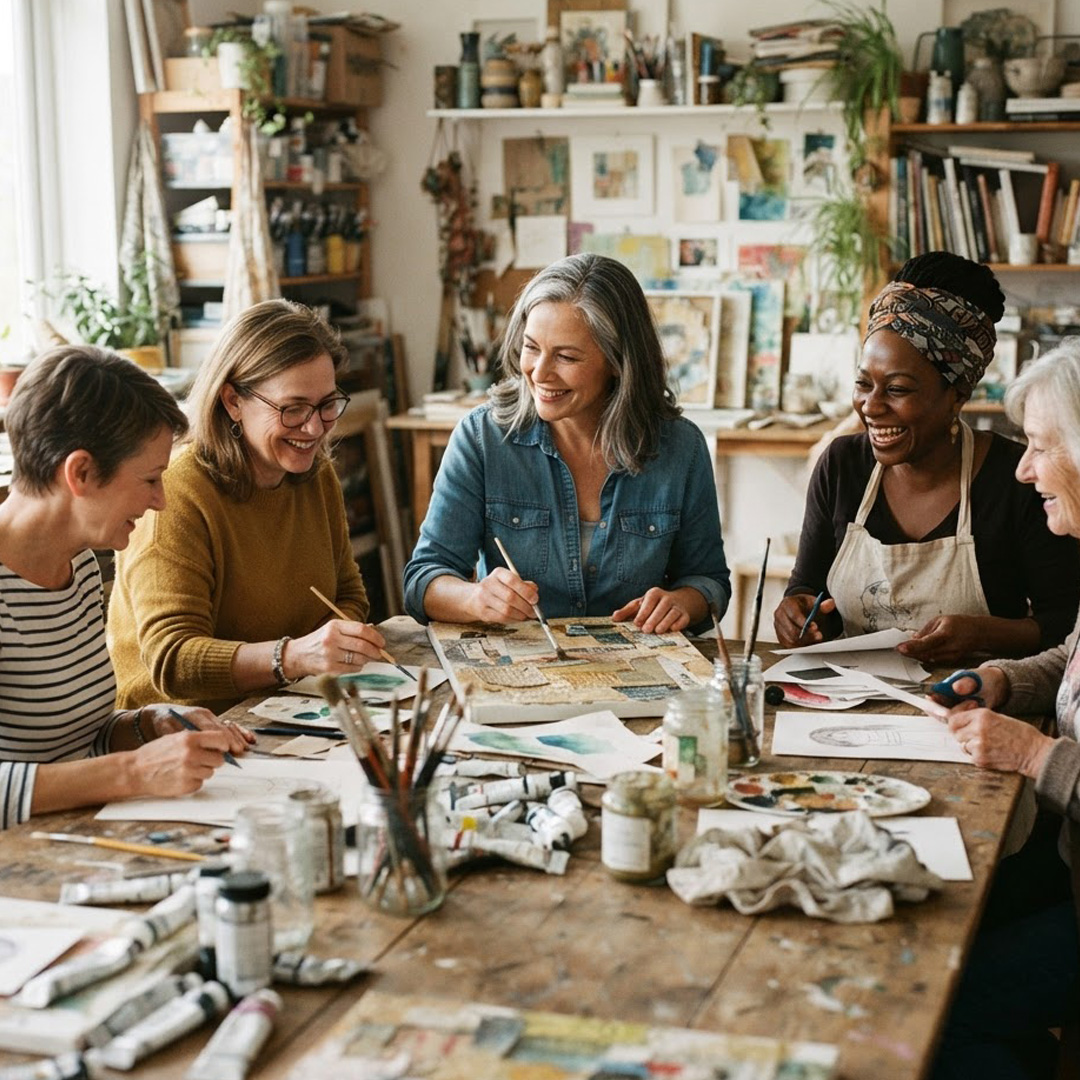
There's a communal side to this too, the older sense of the word, a room full of people gathered for a reason. Creative gathering rarely happens entirely alone. It happens in retreats and classes and conversations with other artists, in the moments someone else notices something in your work that you missed. I can tell you with certainty (after teaching four retreats already this year) that when women gather to create something very powerful happens and it’s truly special. Even if it’s just you and your neighbour, your sister in law, your art friend or whoever you enjoy spending time with - try it! You won’t regret it!
This month, embrace the season of gathering and see what emerges.
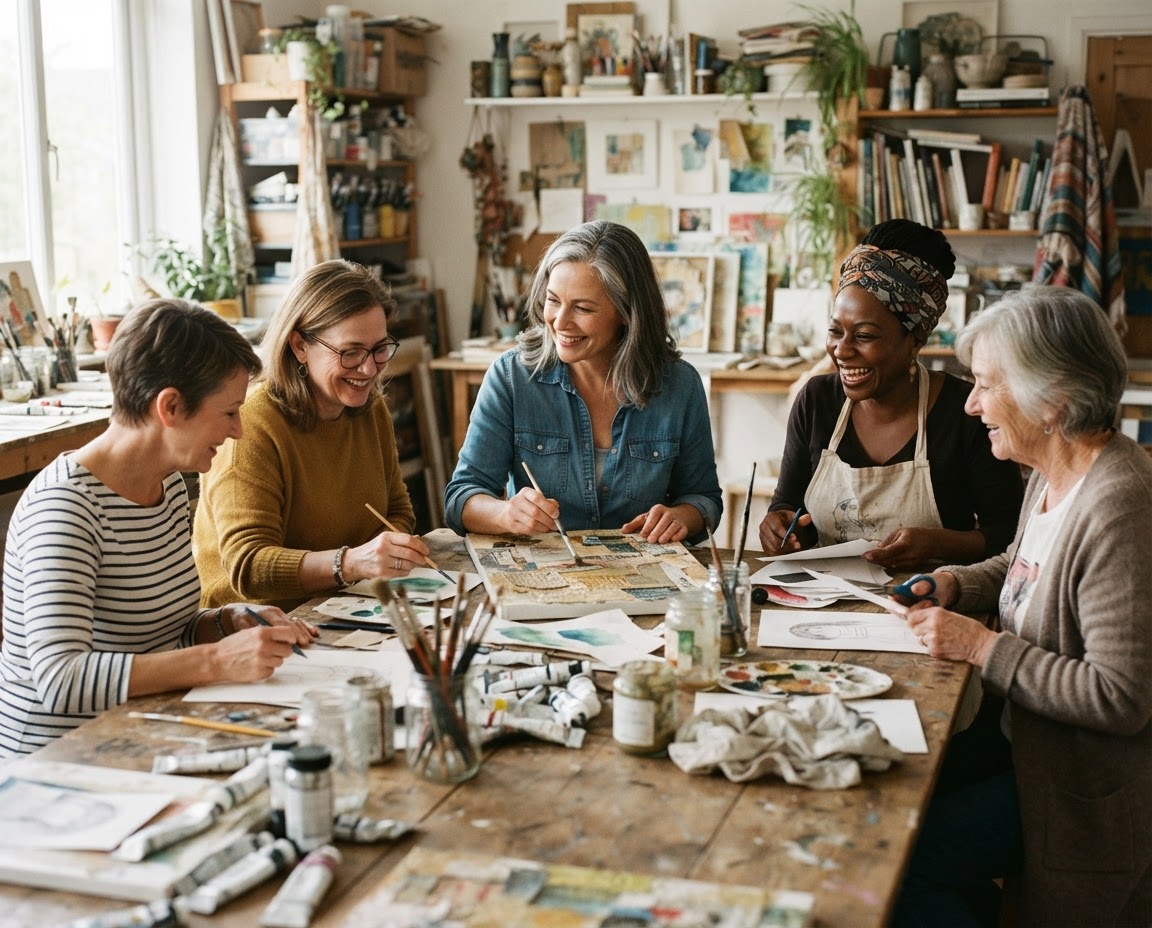
What have you been collecting this year without realizing it, a color, a subject, a feeling that keeps returning?
Where in your practice do you tend to rush past the gathering and go straight to the next thing?
Where, in your community, family or friends, could you gather people together to create in person or online? What would you want from this experience?
Let's tap into our creative intuition and do some self-reflective work inspired by our theme. Below you will see our month's Oracle/Tarot card spread. But fear not, if you are not one drawn to using oracle or tarot cards, no worries, just use the accompanying reflective questions as writing prompts for your journals!
Here's a three-card oracle spread that fits seamlessly with our monthly theme. Take a deep breath, grab a cup of tea and enjoy.
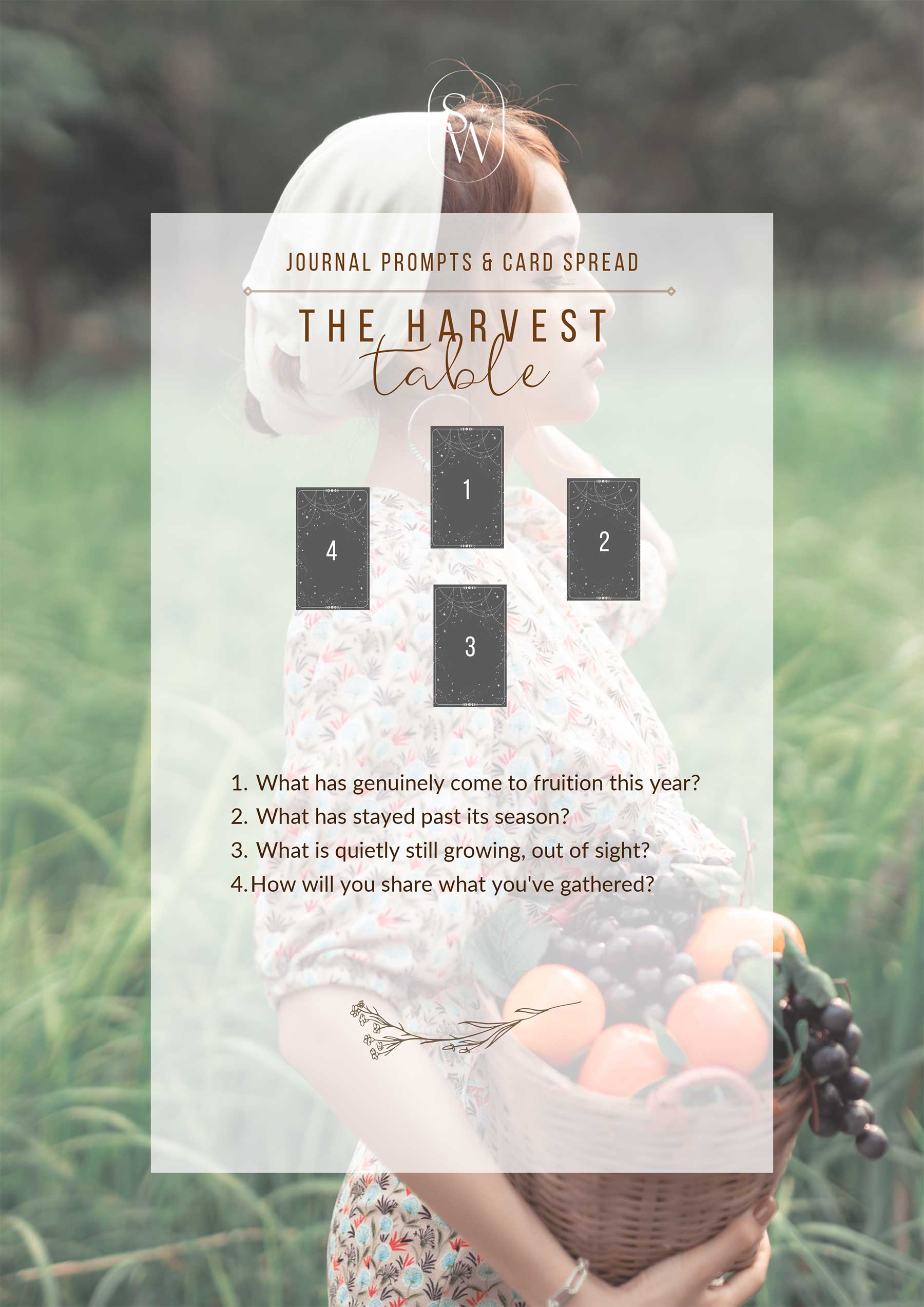
A four-card check-in for the gathering season.
Card 1: The Full Basket
What has genuinely come to fruition this year?
This card names what's actually ready. Not what you wish were finished, but what truly is. It might be a completed body of work, a skill you've built quietly over months, or a piece of yourself that finally feels settled.
Journal Prompt: What am I ready to call finished, and what would it mean to actually let myself feel proud of it?
Card 2: The Overripe
What has stayed past its season?
This card points to what's lingering longer than it should, an unfinished project that no longer excites you, a habit or belief that made sense once but doesn't anymore. It's not a failure. It's just ready to be released back to the soil.
Journal Prompt: What am I still carrying that's actually done with me?
Card 3: The Root
What is quietly still growing, out of sight?
Not everything worth gathering is visible yet. This card represents the parts of your creative life still forming underground, the idea not ready to be spoken, the skill still taking shape. It asks for patience rather than a verdict.
Journal Prompt: What am I tending that isn't ready to be judged yet?
Card 4: The Table
How will you share what you've gathered?
A harvest kept entirely to yourself is only half complete. This card asks how your gathered year wants to move outward, into a finished piece shared with others, a conversation, a teaching moment, an act of generosity.
Find a quiet moment before you draw. Lay your four cards in a row, left to right, so they read like a table being set. Before interpreting, notice your first reaction to each one. Does it feel like relief, resistance, curiosity, or surprise?
This spread works well revisited at the end of any season, not just this one. It's less about prediction and more about honest accounting, a way of asking what's actually on the table in front of you right now.
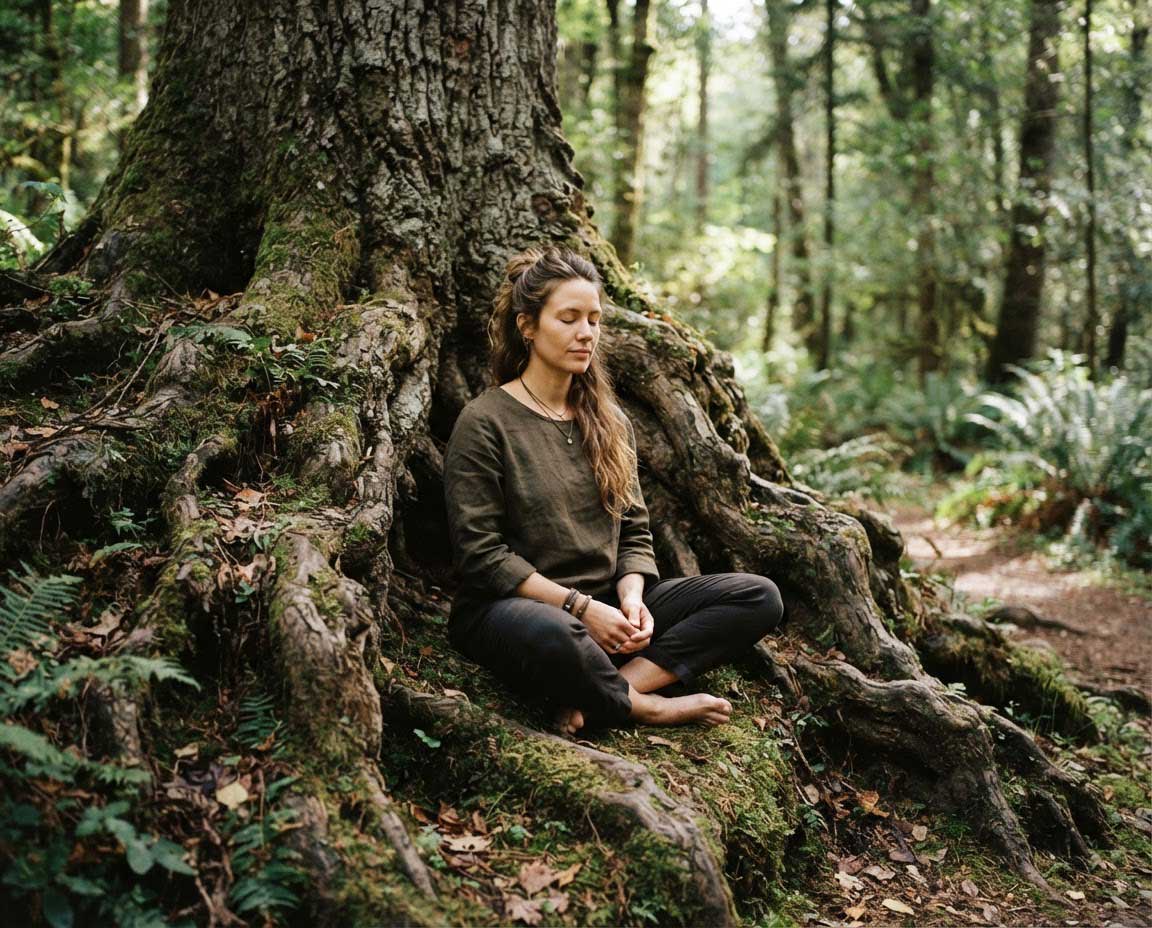
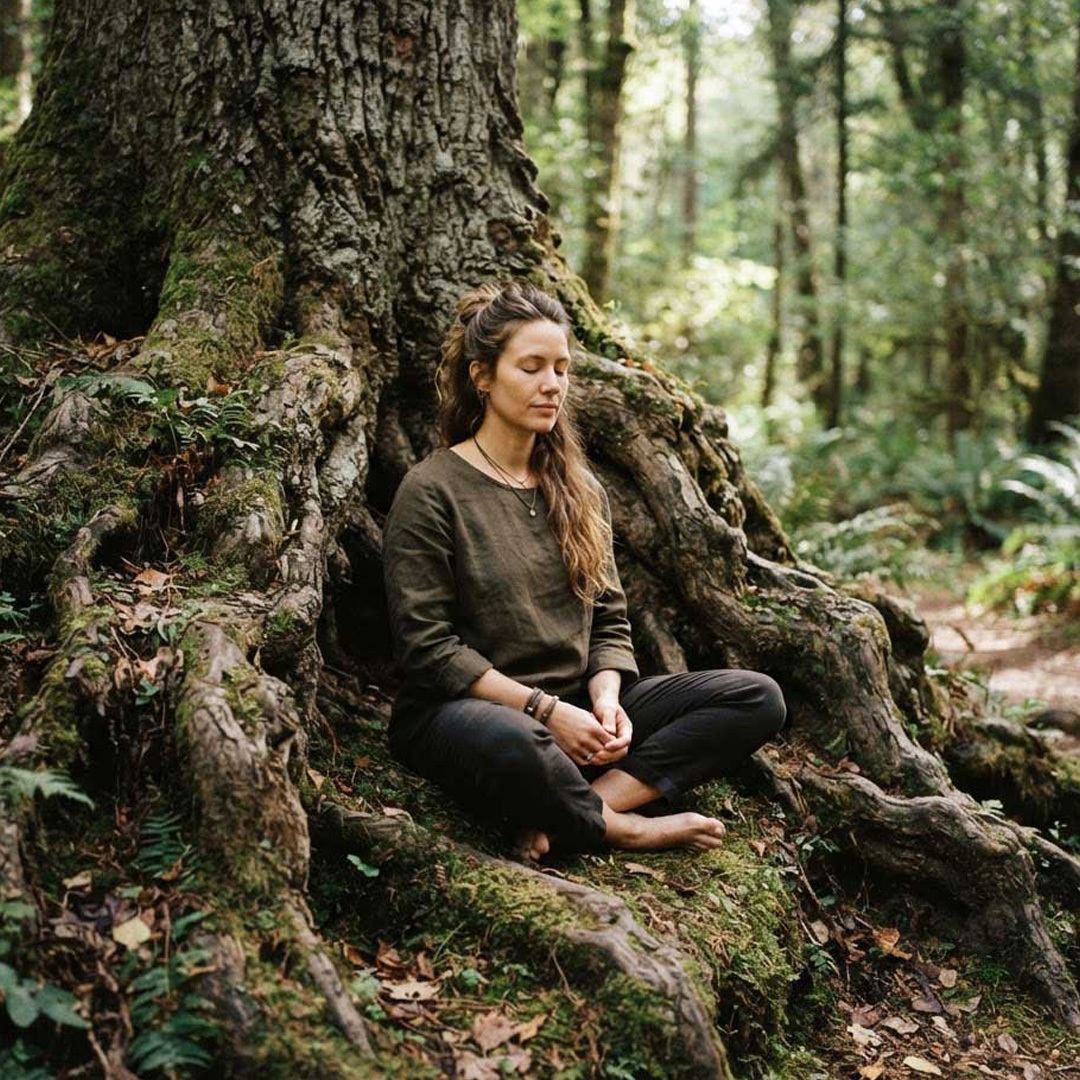
I chose the Root Chakra Radiance Meditation for this issue because gathering, at its core, is a rooted act. You can't take stock of a harvest while standing on shaky ground. This meditation asks you to connect down into the earth the way roots do, receiving what sustains you and offering something back in return, which feels like exactly the right posture for this month. Not just taking inventory of what grew, but recognizing the exchange that made it possible in the first place.
Here's a little more information from Rachel…
This guided visualization leads you to a vibrant and uplifting journey, to connect your roots with the roots of the earth, gaining sustenance, feeling nurtured, activating magic inside of you, and also giving back love to support the earth, and receiving the wealth of the earth in return. This visualization takes place on some beautiful red rocks, warmed by the sun. Immerse yourself in this meditation adventure. There is ample space to continue meditating to the music at the end if you choose.
xo,
Rachel
Each month we will have a positive affirmation. I recommend you print out this affirmation and put it in your sketchbook or somewhere in your studio. Recite the affirmation out loud each time you show up to create. Saying words aloud is powerful and can begin to re-write some of our own limiting beliefs or calm our fears. Try it now…
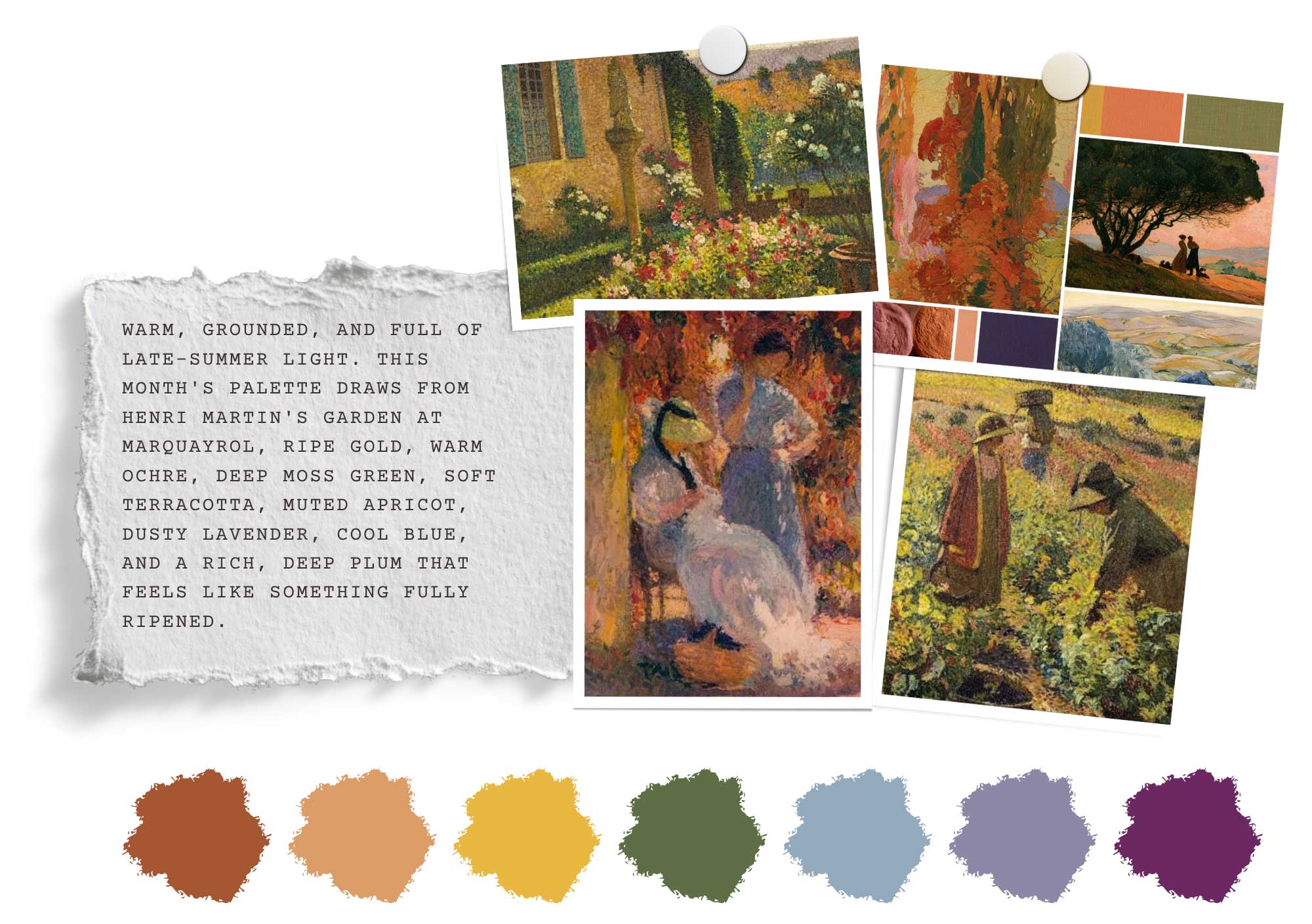
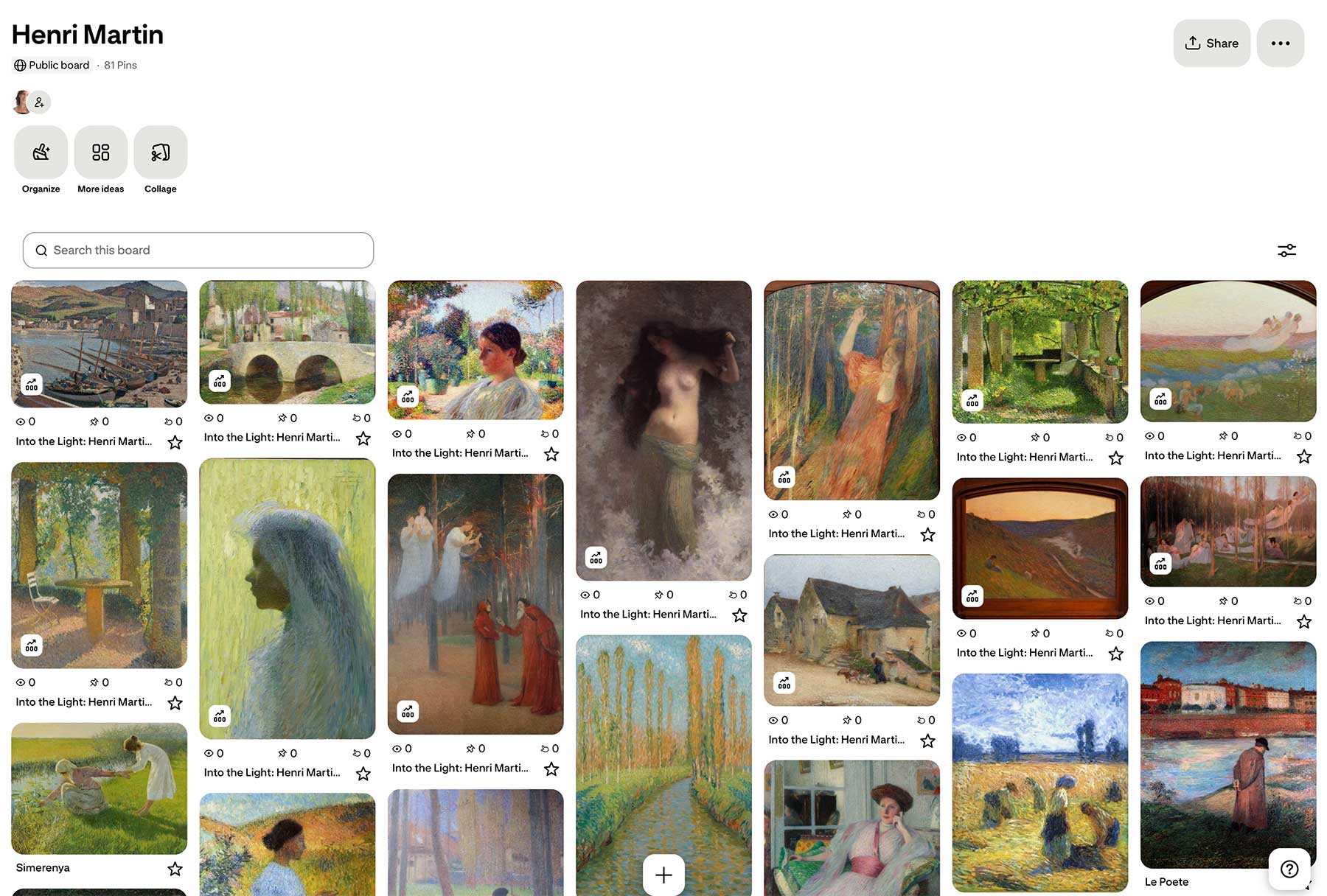
This month's palette draws from the late summer light in Henri Martin's garden paintings, warm, dappled, and full without ever tipping into excess.
Ripe gold and warm ochre form the base, the color of afternoon sun filtering through leaves. Deep moss green grounds the palette with the quiet weight of high summer foliage. A soft terracotta brings in the earth itself, the color of sun-warmed stone and turned soil. Muted apricot adds a touch of ripeness, echoing fruit just at its peak. Dusty lavender and cool blue offer a cool counterpoint, the color of early evening shadow. And a rich, deep plum grounds the whole palette, close to the color of something fully ripened.
This palette rewards patience. It's built for layering, for letting color accumulate the way Martin let small brushstrokes accumulate into something luminous. Nothing here is meant to be applied in a hurry.
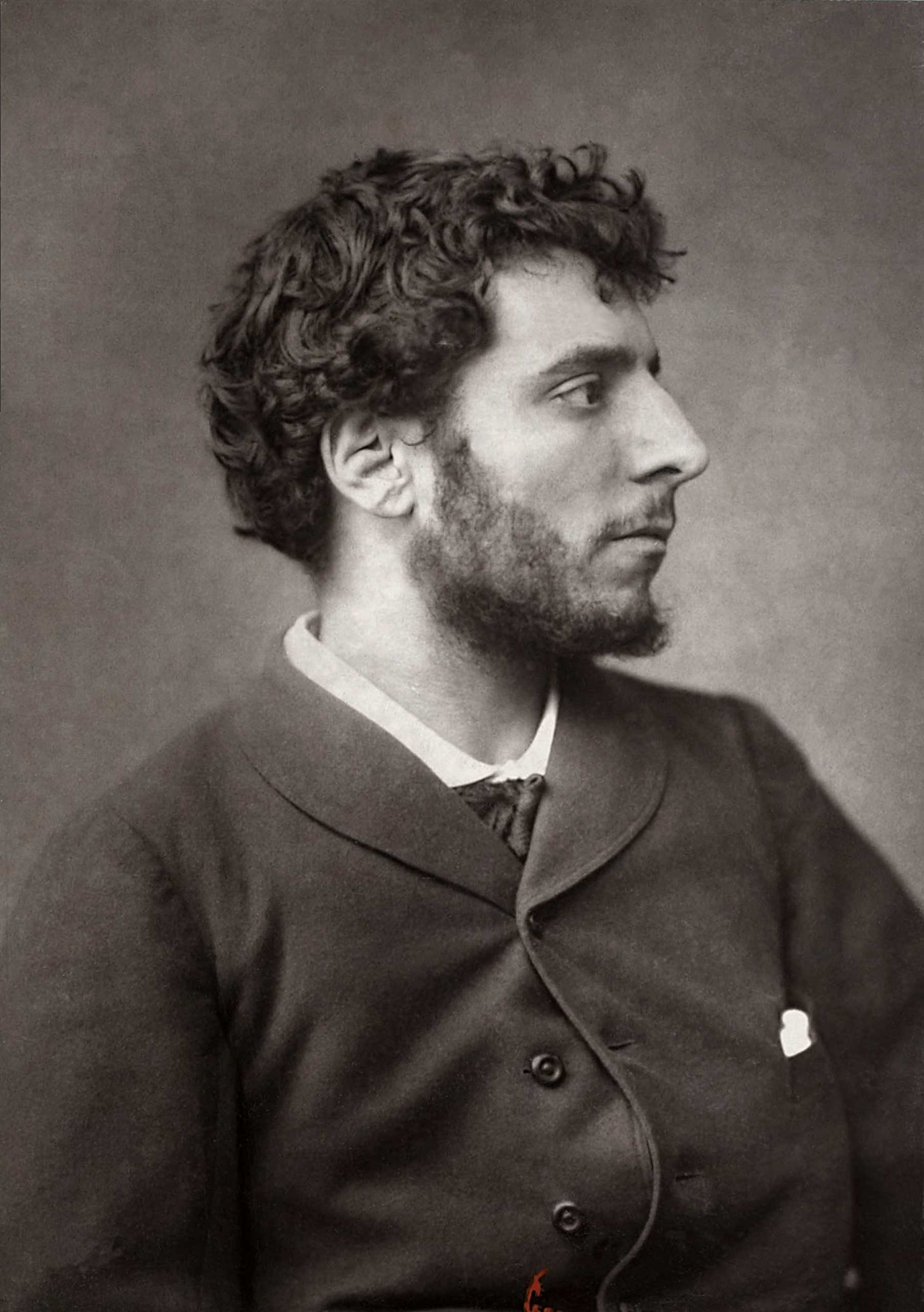
Most years I fly into Toulouse before heading out to teach at Perigord Retreats, and I always give myself a few days there first. I kind of have a love affair with that city - the pink brick, the dusty blues of the shutters, the ornate doorways and the sparkle off the Garonne river - it enchants me each time.
Just this past April, I wandered into the Musée des Augustins and stood in front of a Henri Martin for the first time in person, one of his early symbolist canvases, long before he found the garden that would occupy the rest of his life. I didn't know yet how much that garden would matter to him. I just knew the color stopped me.
Martin was born in that city in 1860, and it turns out Toulouse never quite let go of him either. Decades later, long after he'd left for Paris and then left Paris for good, the Musée des Augustins kept adding his work to their walls. Standing there, you can trace the whole arc of him, the ambitious young history painter and the artist he eventually became.
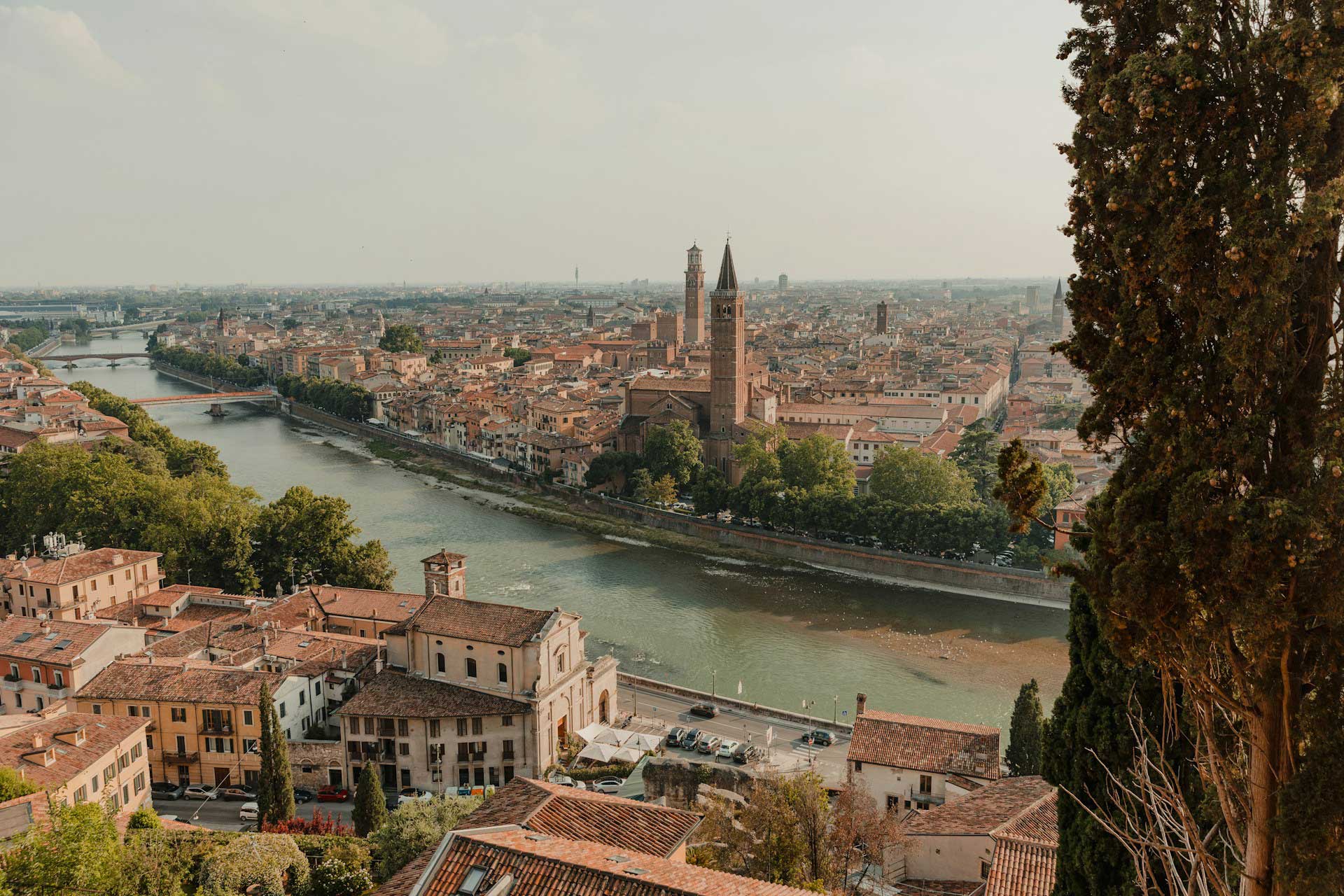
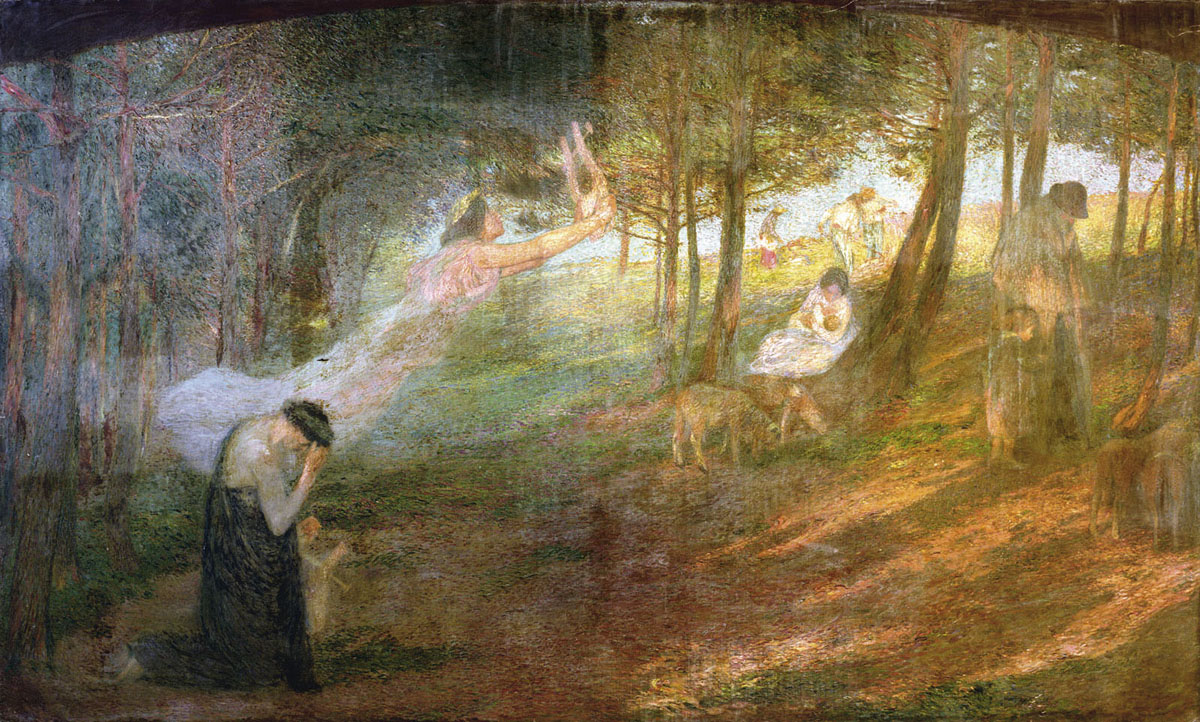
Le Poète
By Henri Martin, 1891
Martin was born in Toulouse in 1860, the son of a cabinet-maker and an Italian mother, and he talked his father into letting him study art rather than a trade. He trained first at the École des Beaux-Arts in Toulouse, then in Paris under Jean-Paul Laurens, one of the last serious history painters, and for his first decade as an artist he painted exactly what that training predicted. Mythological scenes. Dante. Orpheus. Careful, competent, forgettable work.
Then in 1885 a travel scholarship sent him to Italy, and something in him reorganized around Giotto and Masaccio. He wrote about it plainly afterward: "After having seen Italy, I painted with love." Not technique. Love. Whatever he saw in those early Renaissance walls, it gave him permission to want something different from his own painting than the Salon had trained him to want.
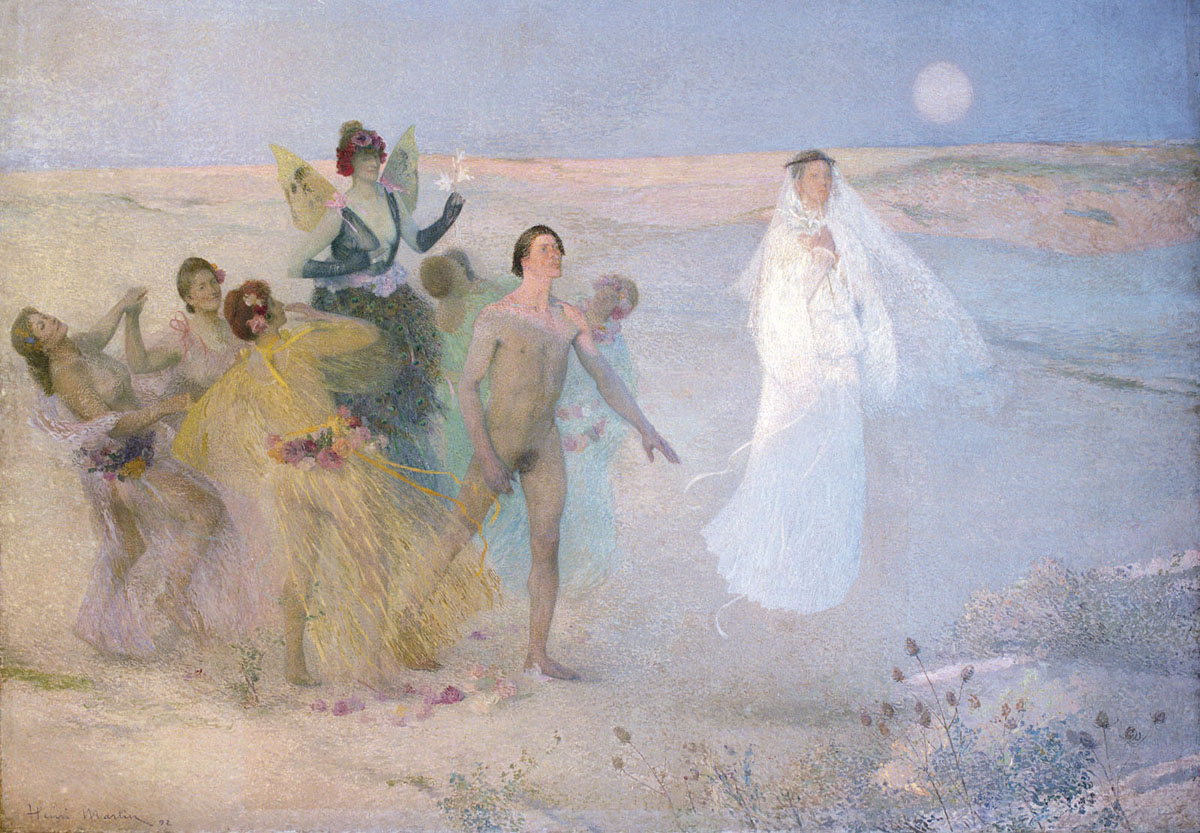
Man Between Vice and Virtue
By Henri Martin, 1892
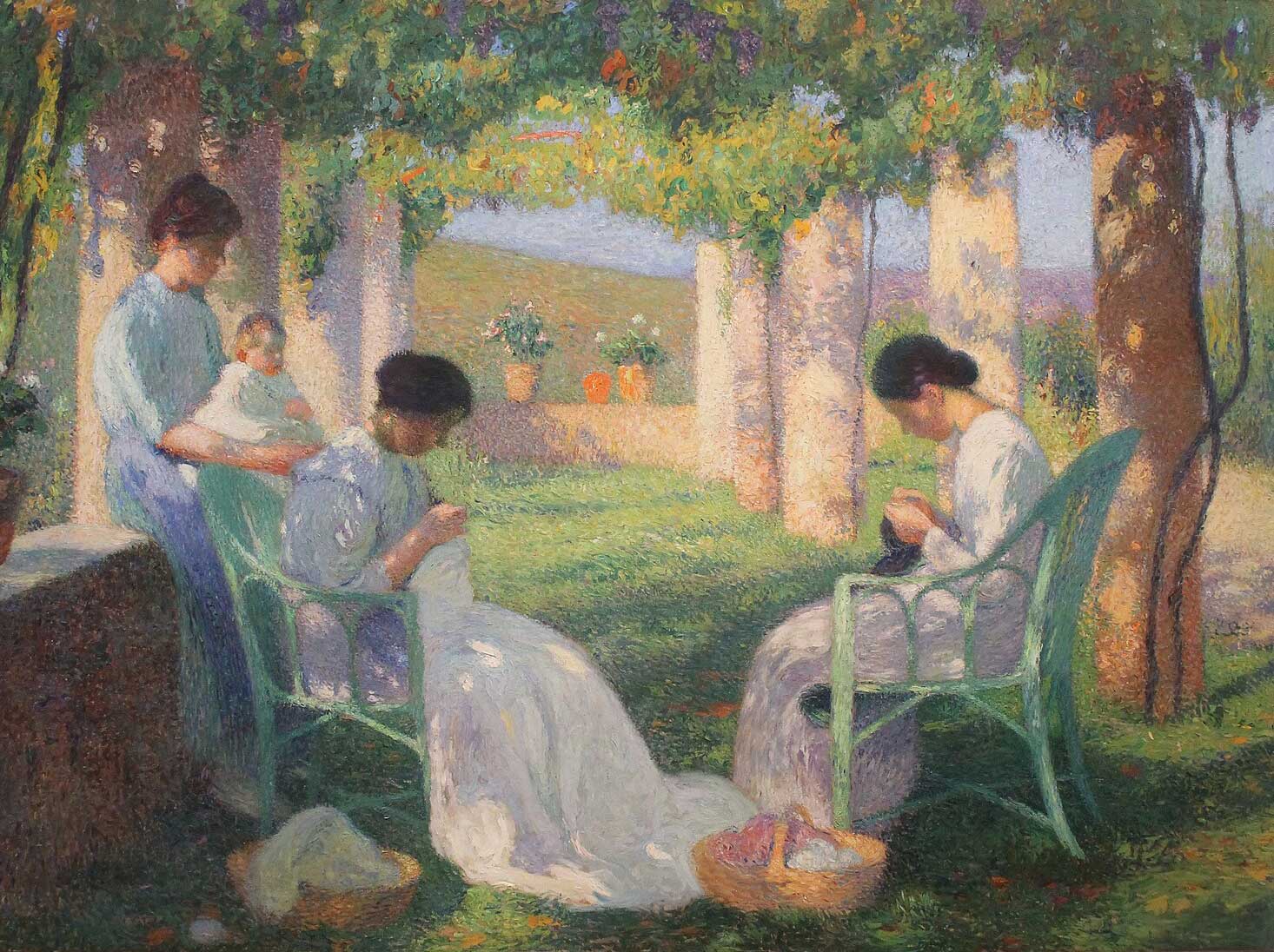
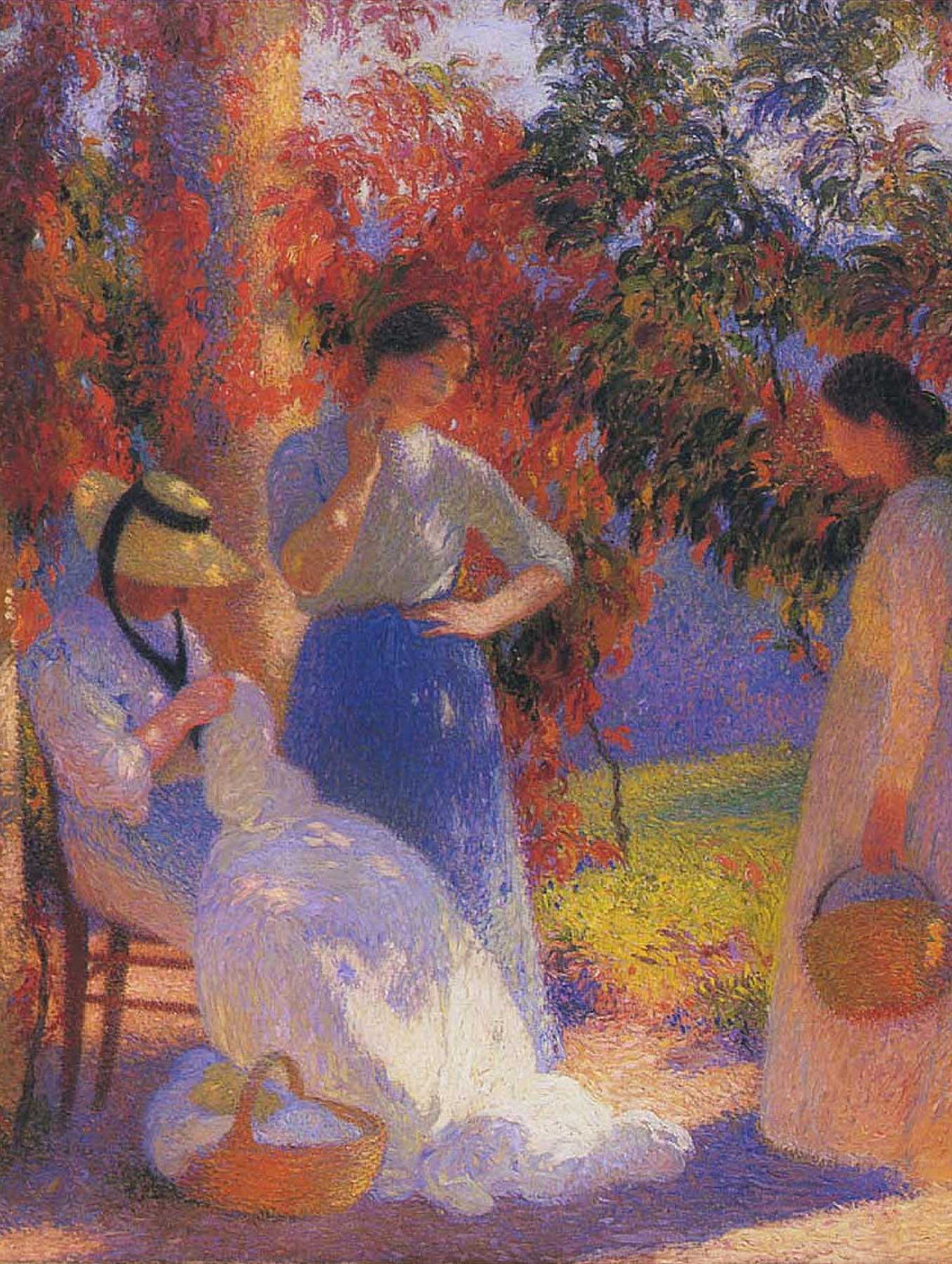
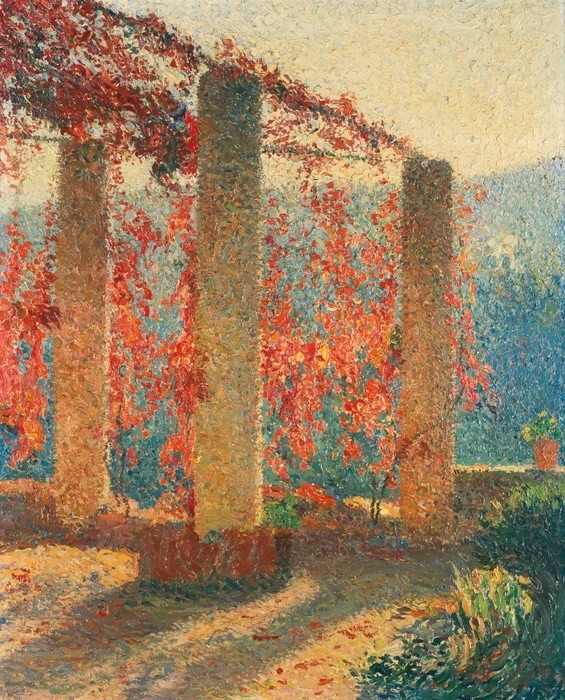
Tricoteuses ou La Pergola
By Henri Martin, 1913
What came next was Martin's version of divisionism, the technique of building an image from small separated strokes of color that blend only in the viewer's eye. Seurat had gotten there first and gotten there more mechanically, dots laid down with something close to scientific precision. Martin's marks are looser. More like short, quick brushstrokes than dots, closer to instinct than formula, and it's part of why his name rarely turns up on the tidy lists of Neo-Impressionists that include Seurat and Signac. He didn't fit the theory as cleanly as the theory wanted.
But the looseness is the point. Each stroke on its own is nothing, a scrap of ochre or violet that means very little. It's only in accumulation, hundreds of small marks gathered onto one canvas, that they resolve into a garden at four in the afternoon, or a figure standing in dappled shade, glowing faintly from within. Martin spent a career learning how to let small things add up to something whole.
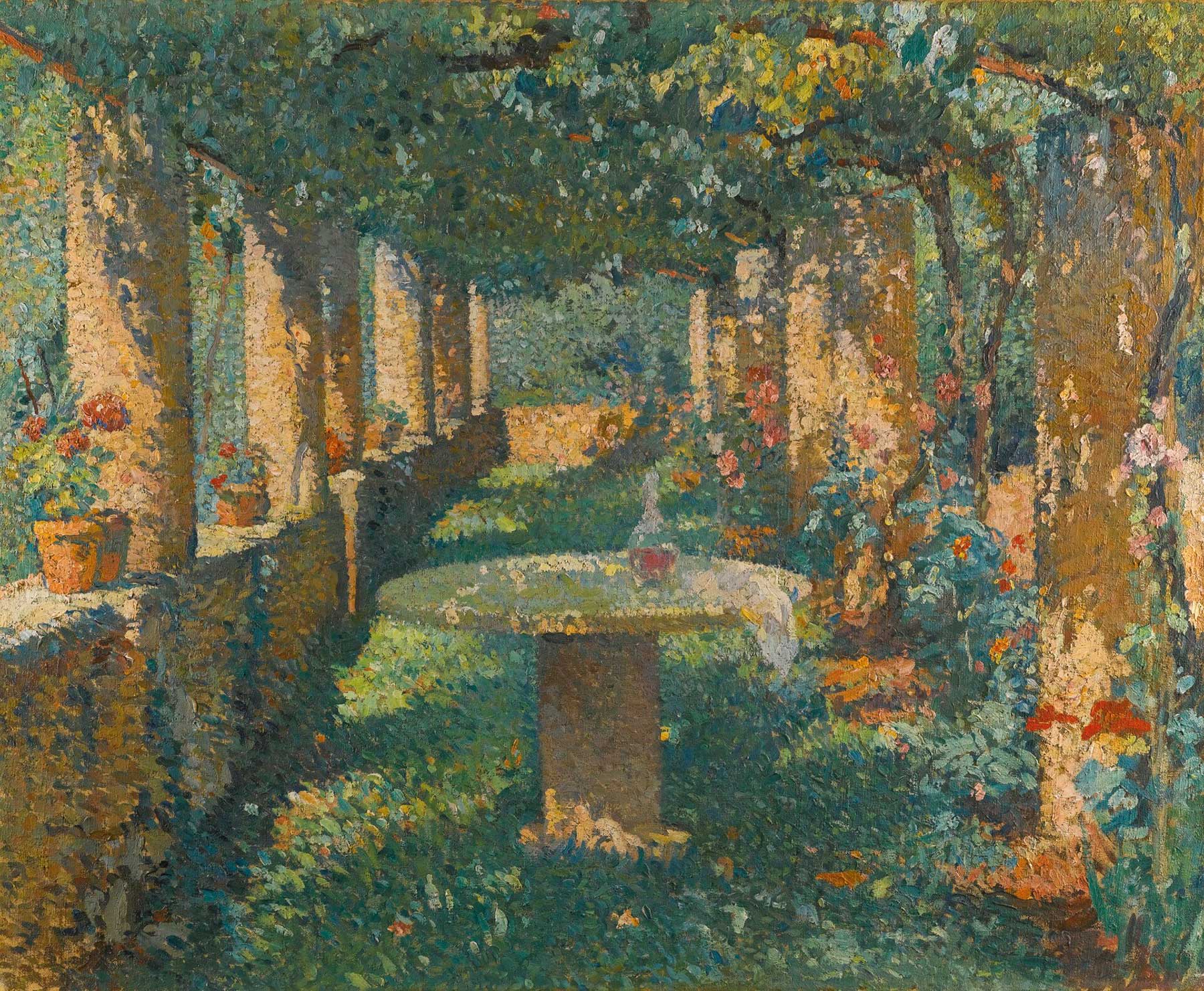
Pergola de la treille de Marquayrol, l'été après le repas
By Henri Martin, 1935
By 1900, Martin had grown tired of Paris, tired enough that he bought a seventeenth-century house called Marquayrol above the village of Labastide-du-Vert, twenty-eight hectares of land in the countryside where he'd grown up. He kept a foot in Paris for another decade and a half, still fulfilling commissions for public buildings, the Capitole de Toulouse among them. But when the First World War broke out in 1914, he left the city for good and settled into Marquayrol, and there he stayed until he died in 1943.
The garden he built there became his subject for the rest of his life. Fountains, arbors, thatched roofs, the river valley below the house at dusk. He wasn't traveling to find new material. He was gathering the same handful of things, over and over, until each one gave up more than it had the time before.
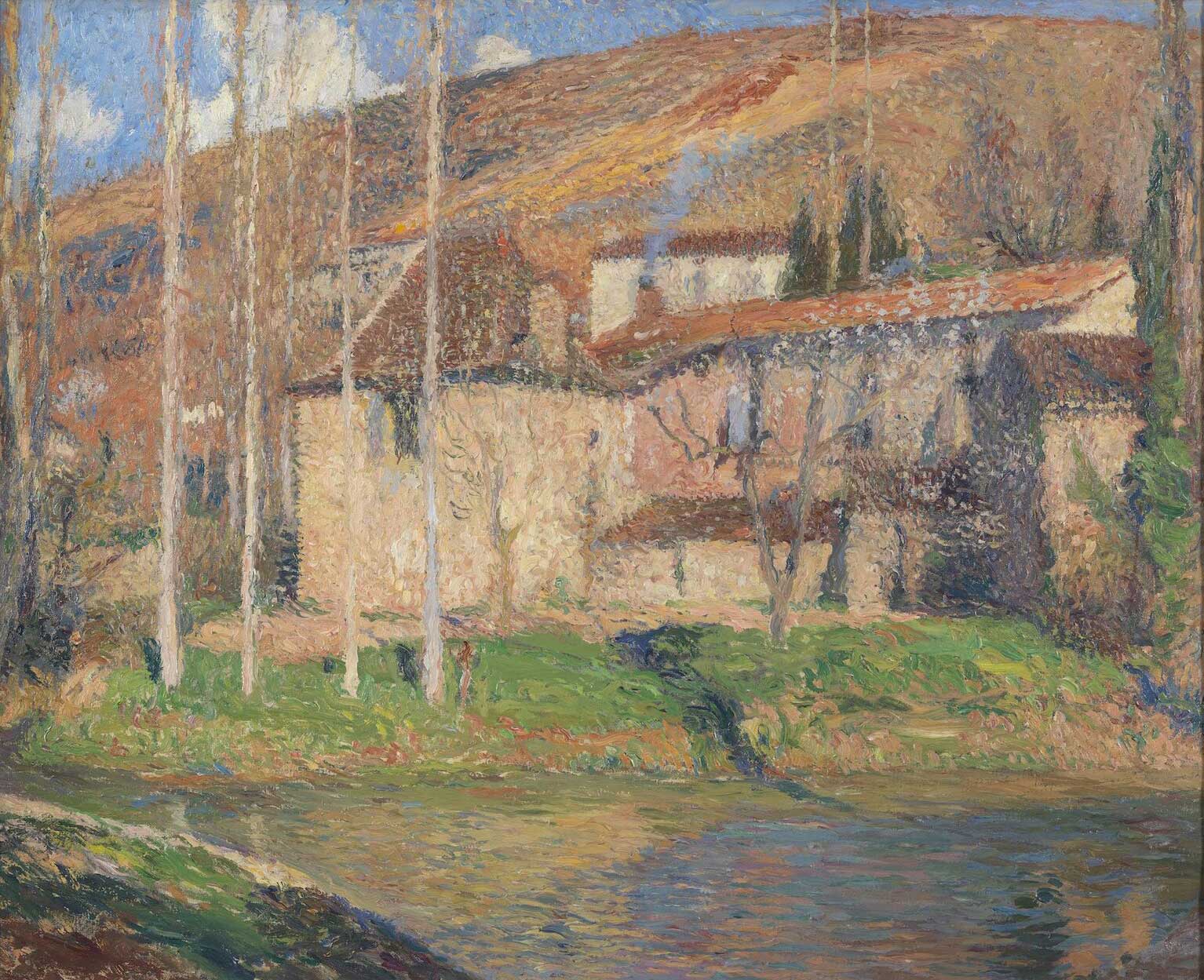
View of Labastide-du-Vert
By Henri Martin, 1910
Martin was, by every account, an introvert, and settling at Marquayrol let him live like one. He'd taken on more Paris commissions than he wanted before he left, and the solitude of the Lot countryside seems to have been less a retreat from failure than a retreat toward the only working conditions he actually preferred.
But solitude sought is still solitude, and it left a mark on how the village remembered him. Decades later, older residents of Labastide-du-Vert would recall that children walking home from school were told not to linger near the artist at his easel. Best to walk past quickly, greet him politely, and keep moving, or the schoolmistress might hear about it. It's a small detail, almost nothing, but it says something true about the cost of the kind of attention his painting demanded. The same devotion that let him see a fountain freshly for thirty years also built a fence around him that a village of children learned to respect before they understood why.
Martin was elected to the Académie des Beaux-Arts in 1917 and made a Commander of the Legion of Honor. His murals still hang in the Sorbonne, the Paris city hall, and the chamber where France's Conseil d'État meets today. His garden paintings hang in the Musée d'Orsay, the Art Institute of Chicago, and half a dozen other collections, quiet company for a man who spent his last thirty years mostly alone with his brushes and a fountain he never tired of looking at.
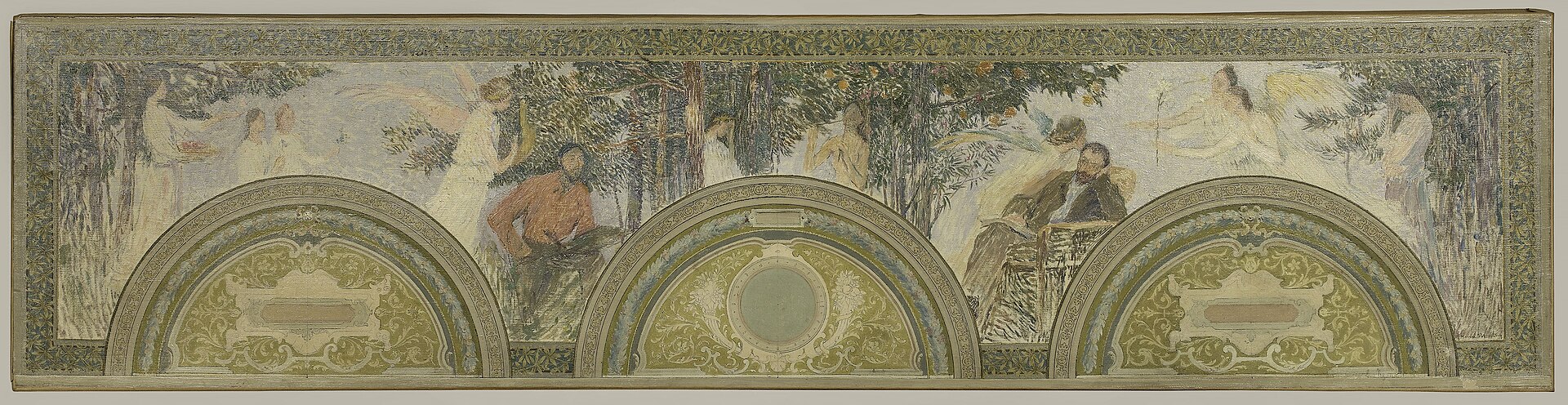
Sketch for the south entrance salon of the Hôtel de Ville, Painting - Literature. Musée des Beaux-Arts de la ville de Paris
By Henri Martin, 1893-1895
There's a temptation, when we think about gathering a full creative life, to imagine it as constant expansion. New subjects, new places, new material always arriving. Martin's life argues for something else. He gathered the same garden, the same light, the same handful of forms, and he kept finding more in them because he kept looking with the same devotion he'd brought the first time.
We don't have to travel to have something worth gathering. Sometimes the fullest harvest comes from standing in one place long enough to see it change.
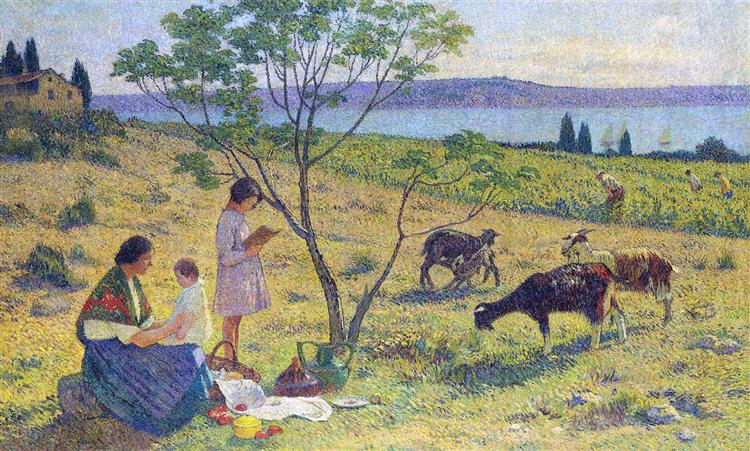
Bucolic
By Henri Martin, 1923
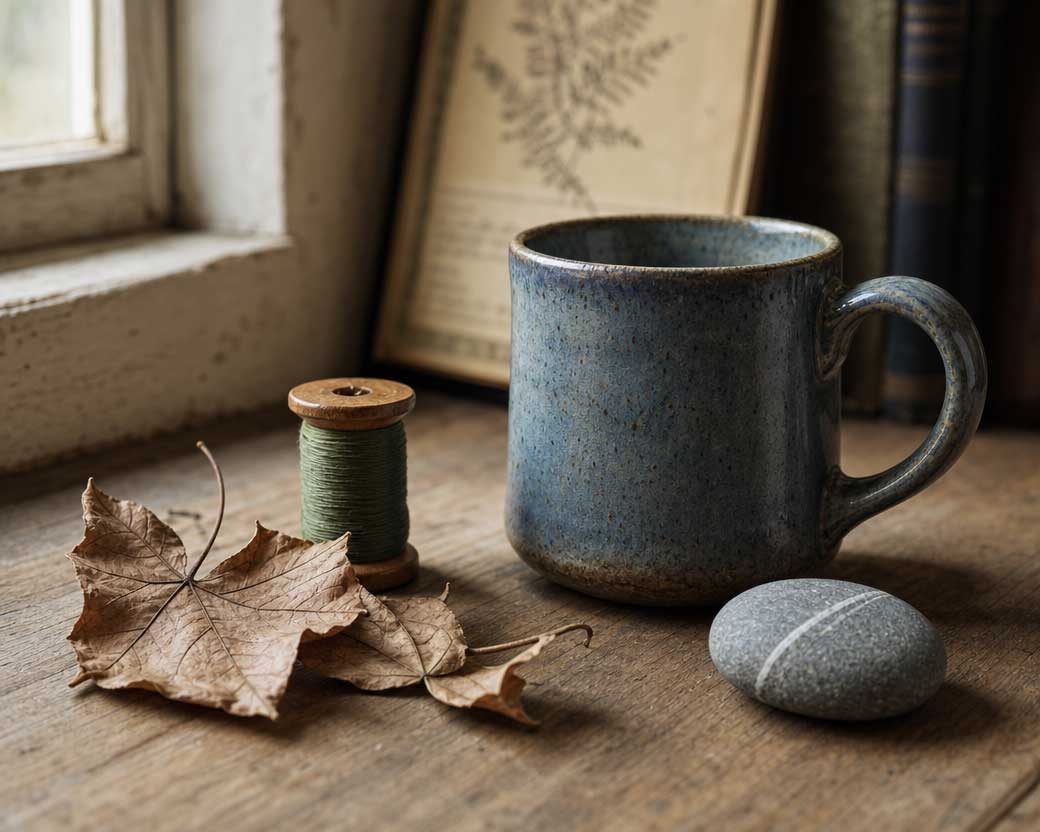
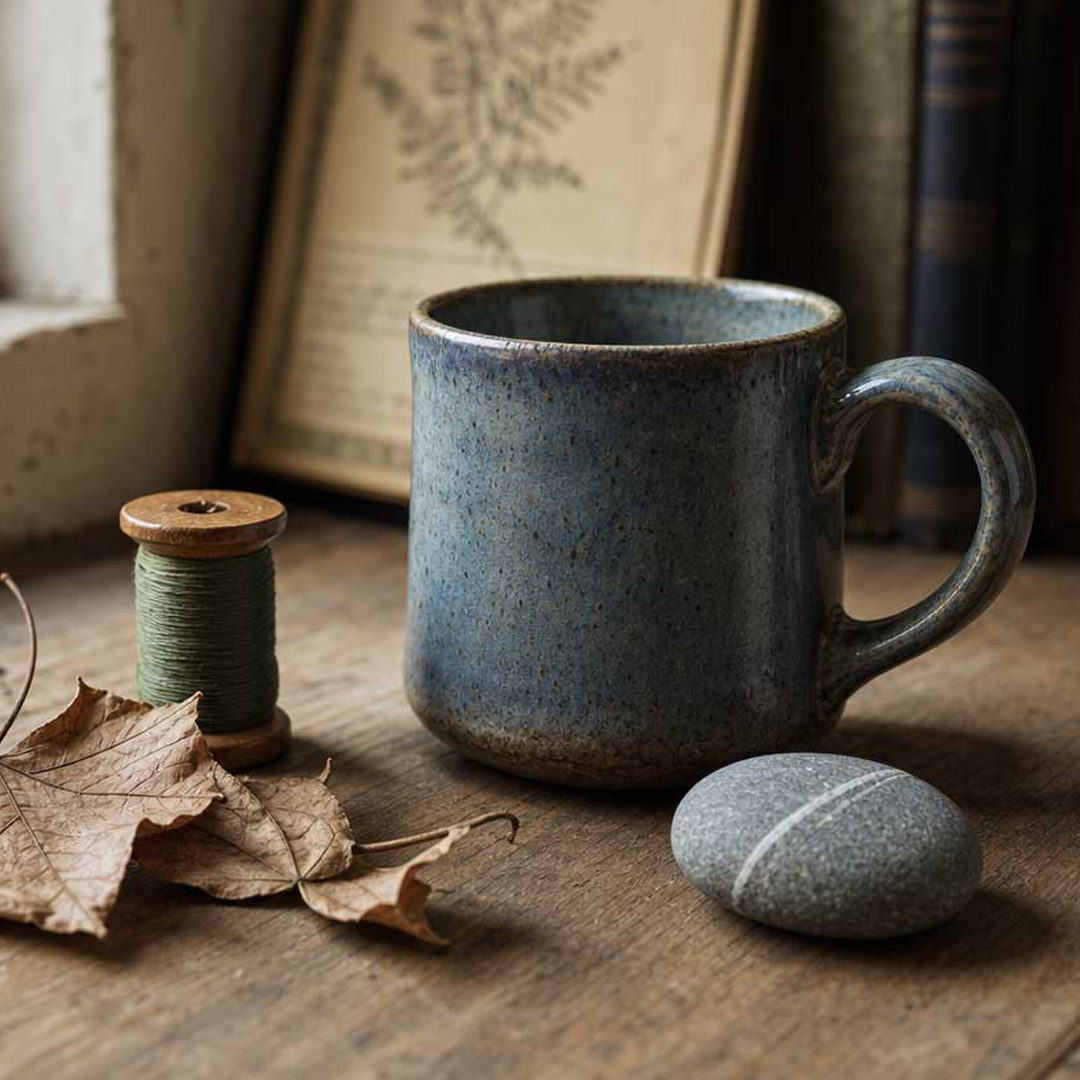
Gather a handful of small objects directly from your studio, things you actually have on hand rather than anything special. A few dried leaves, a spool of thread, a chipped mug, a stone from your windowsill. Arrange them into a simple still life on your table.
Spend time really looking before you begin. Notice which object catches the light, which one feels slightly out of place, which one you almost didn't include. Render the grouping in whatever medium feels honest right now, pencil, ink, watercolor. Don't aim for a polished still life. Aim for an accurate record of what was actually gathered in front of you.
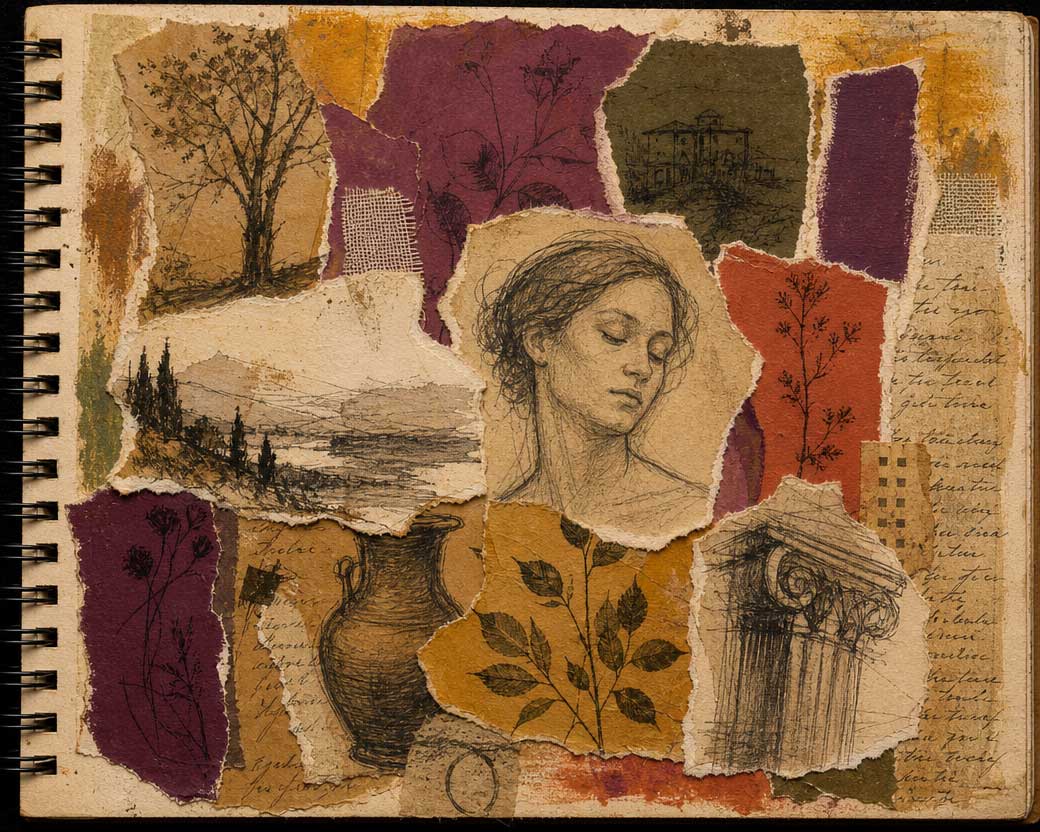
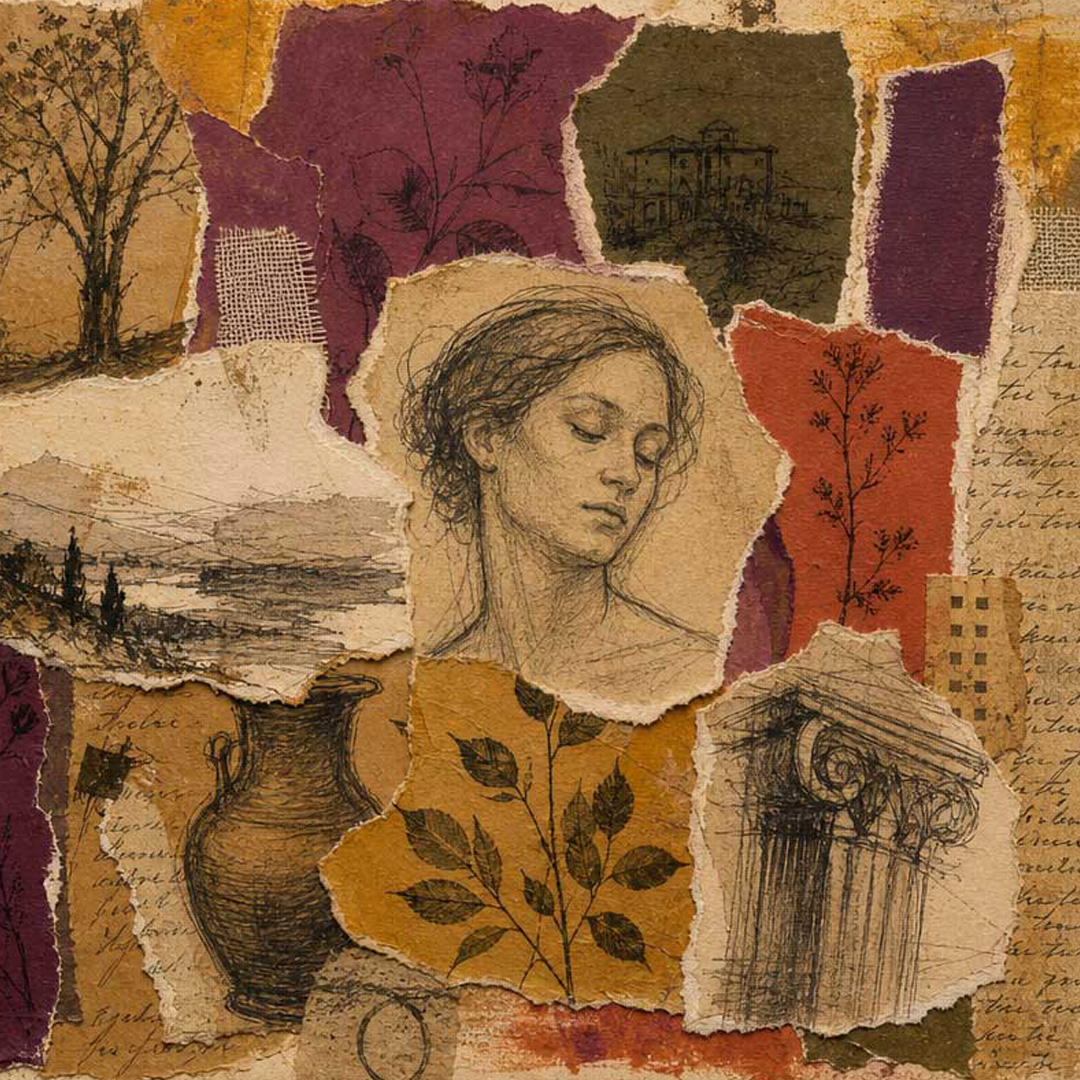
Go through a stack of your own "rejected" sketches or unfinished attempts, pages you'd normally skip past. Instead of starting fresh, cut or tear small usable fragments from three or four of them, a good line, an interesting color mix, a shape that still holds up. Collage those fragments together onto a new page to build something entirely different from what any of them were originally meant to be.
Choose one full Henri Martin garden painting rather than a fragment. Spend time simply looking before you pick up a brush, at how he moves from warm to cool across the canvas, where the densest color sits, where he lets the canvas breathe with lighter touches.
Make a careful color study of the piece, focusing on getting the relationships between colors right rather than achieving a perfect likeness. Work at a small scale so the exercise stays about understanding his light, not about producing a finished copy.
Reflect: Where did his palette surprise you once you looked closely? What did you learn about how he builds warmth into a shaded space?
The expansive sky above us is the same one our ancestors admired centuries ago.
Countless lives have thrived beneath these skies, serving as a bridge between worlds. An abundance of wisdom hangs overhead, with cycles, rhythms, and storms guiding us each day. This serves as a gentle reminder to slow down and gaze upward.
In this class, we will reconnect with our roots and explore the celestial cycles while creating expressive skyscapes. We will examine the movement and illumination of clouds, learning how to capture their essence through paint. Our goal is to portray the ethereal beauty of horizon lines as they merge with the boundless sky above.
With moody palettes and bold, expressive brushstrokes, we will move away from a realistic depiction of the sky, embracing our own artistic flair.

You can also listen to this month’s issue of the Studioworks journal. I find I love listening to books, podcasts and music while I draw, paint or go on a long walk. Enjoy.


One of my favorite things to do is to curate inspiration. From Pinterest boards to books, resources, playlists and more - I love to share anything that might facilitate learning, expansion, and sparks of curiosity! Being an artist, we naturally crave these things so here are some of this month’s picks from me to you.
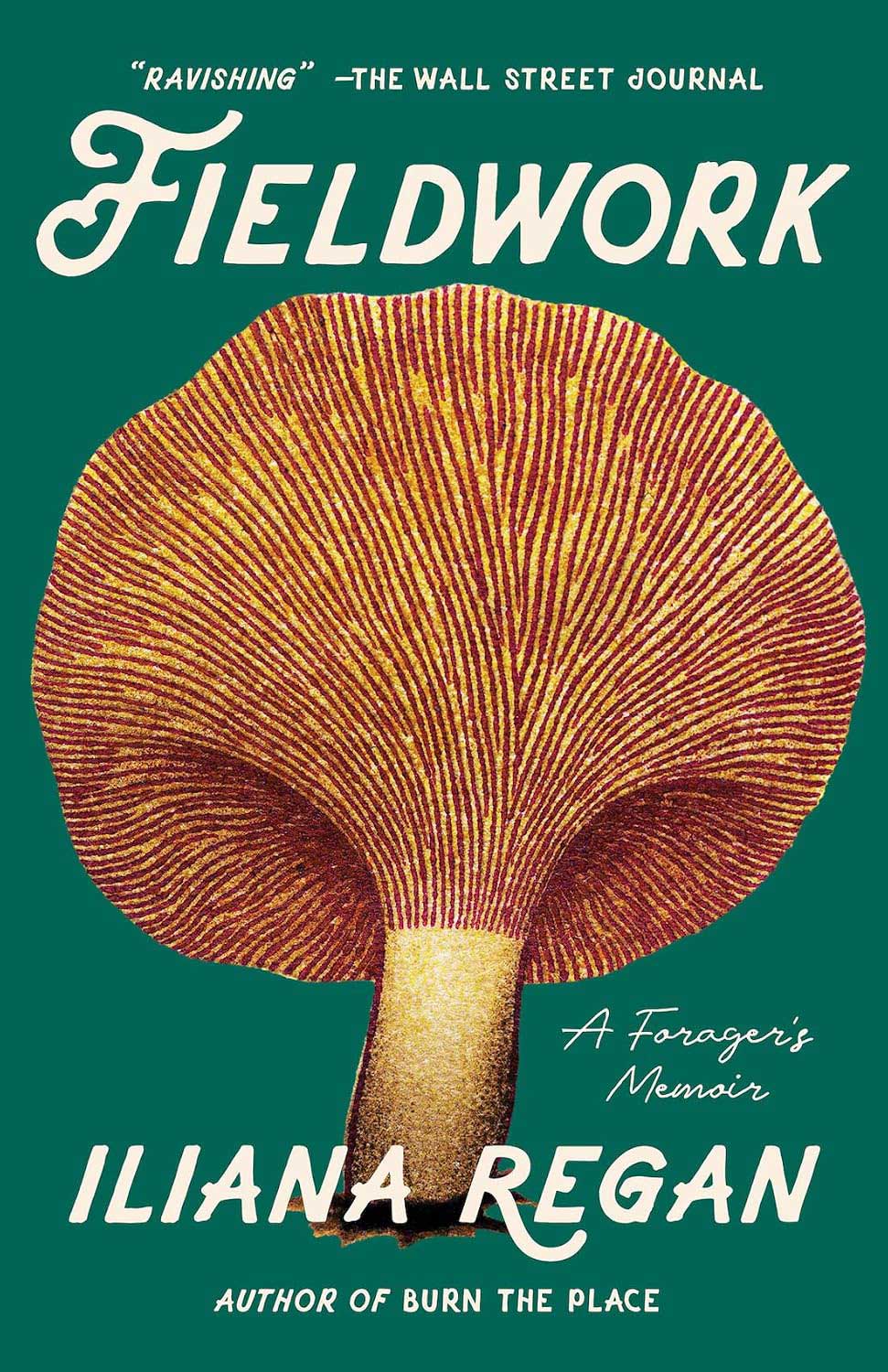
Fieldwork: A Forager's Memoir by Iliana Regan weaves foraging, family history, and the search for meaning into a single beautifully layered book. Regan writes about gathering as both a literal skill passed down through generations and a way of moving through the world, always watching for what's ready to be found. It's a gorgeous companion read for a month about honest, attentive gathering.
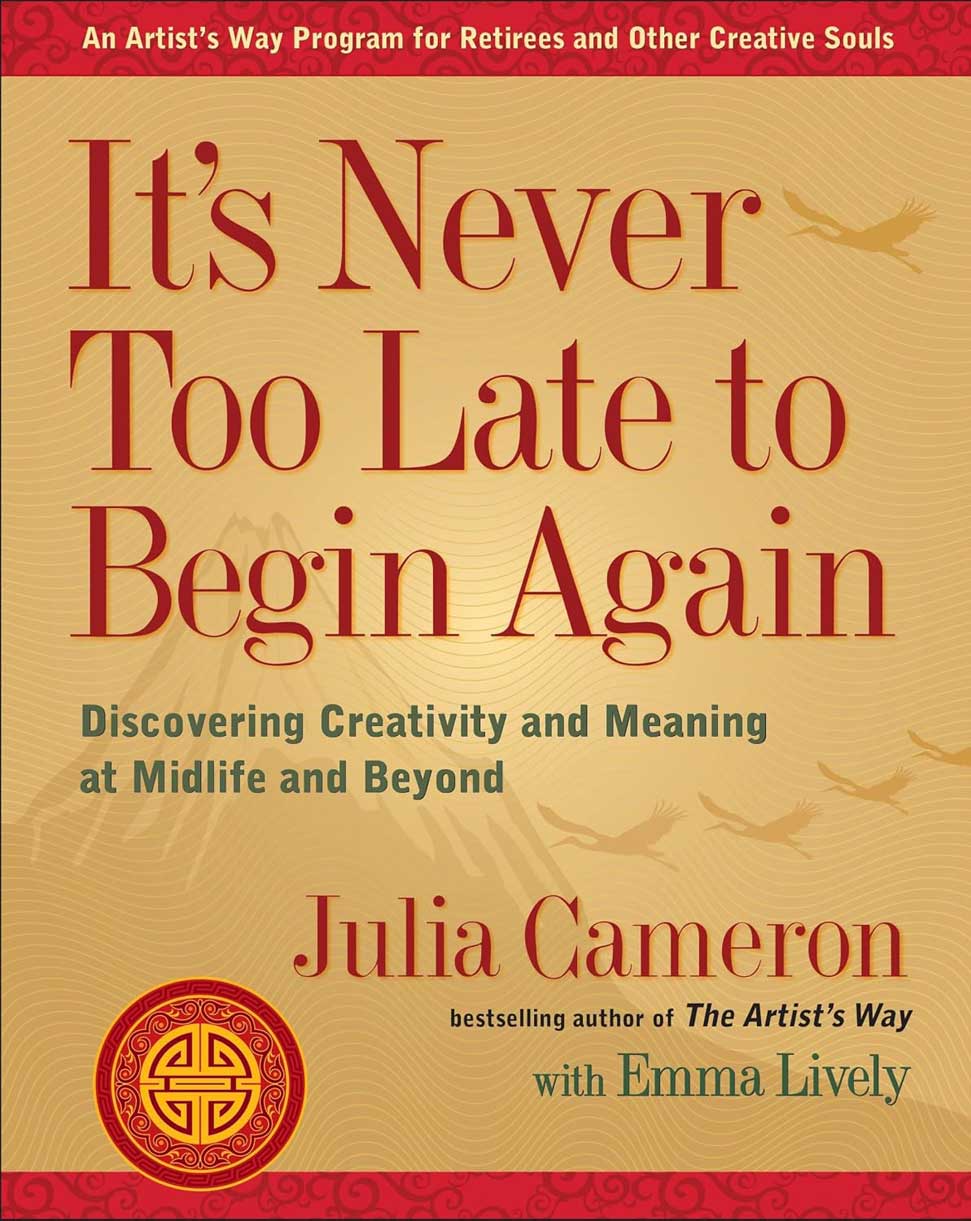
It's Never Too Late to Begin Again by Julia Cameron, author of The Artist's Way, is written specifically for women rediscovering creativity in midlife and beyond. Cameron built her original tools around reclaiming a creative life after loss, and this later book applies that same honest, practical wisdom to the particular gathering that happens later in life, taking stock of what's still there and giving yourself permission to begin again with it.
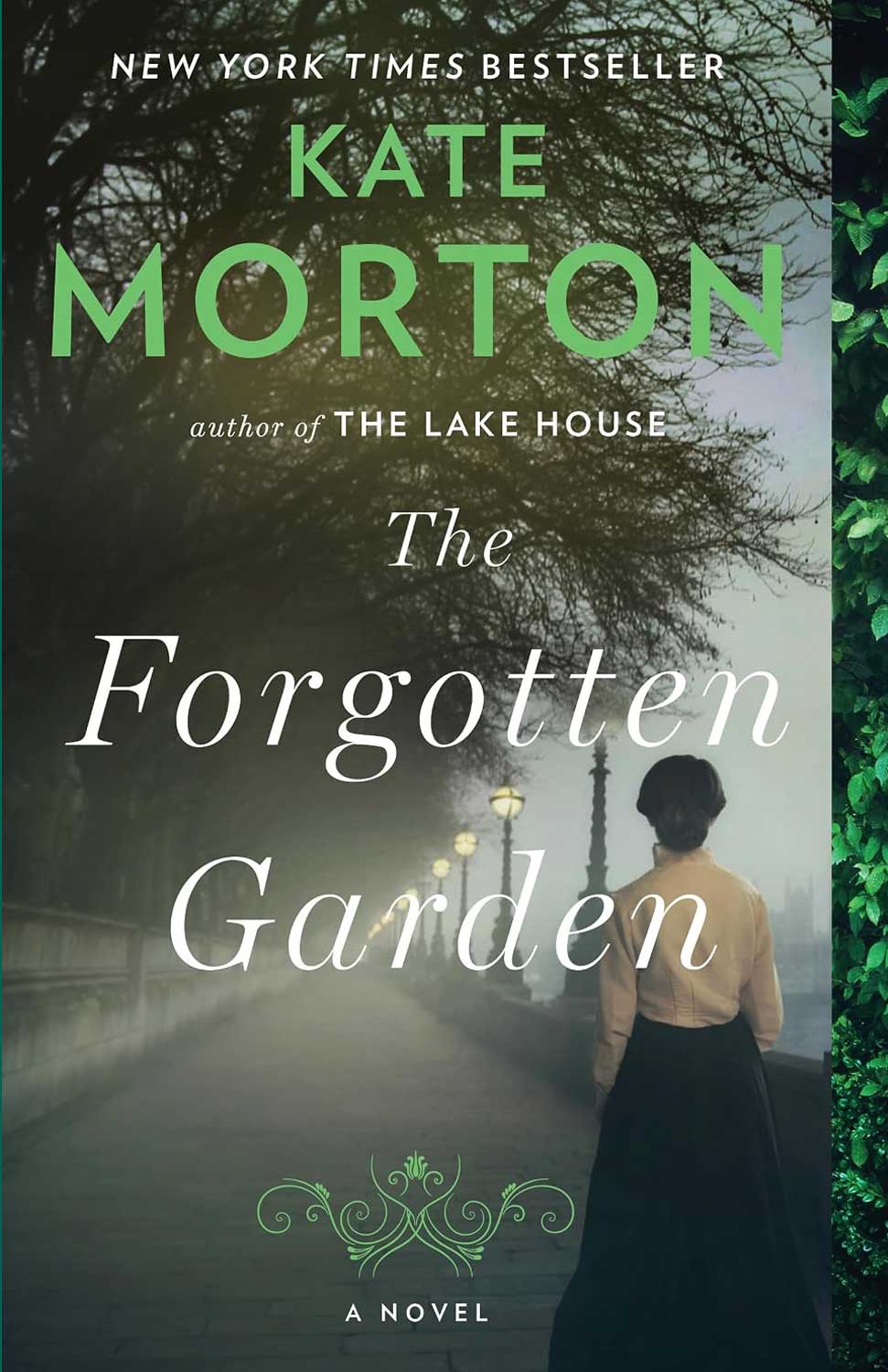
The Forgotten Garden by Kate Morton spans three generations of women piecing together a family's hidden history, with a literal overgrown garden at the center of the mystery. A satisfying, page-turning read about gathering scattered fragments of the past into something whole, which feels right at home with this month's theme.
I had so much fun curating this list. I hope you enjoy!!
Classes that pair well with this month’s theme in your Studioworks Creative Library