Dear creative friends,
Welcome to Issue No. 90 of the Studioworks Journal! I'm so delighted you are here and I can't wait to share this one with you.
Something shifts at the midpoint of a year. June arrives and the world just feels open. More possible. I've always loved this moment in the calendar and this year it feels especially alive.
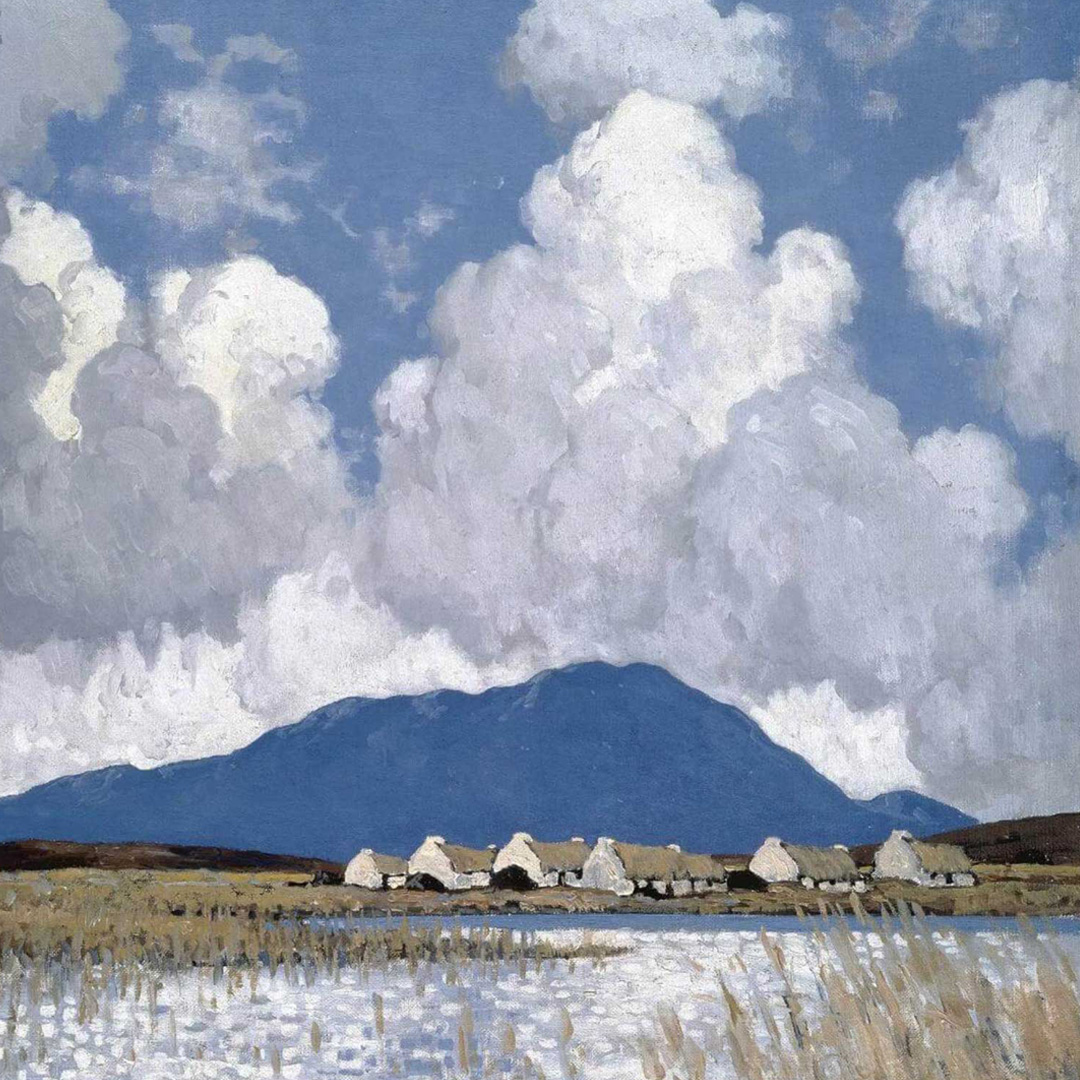
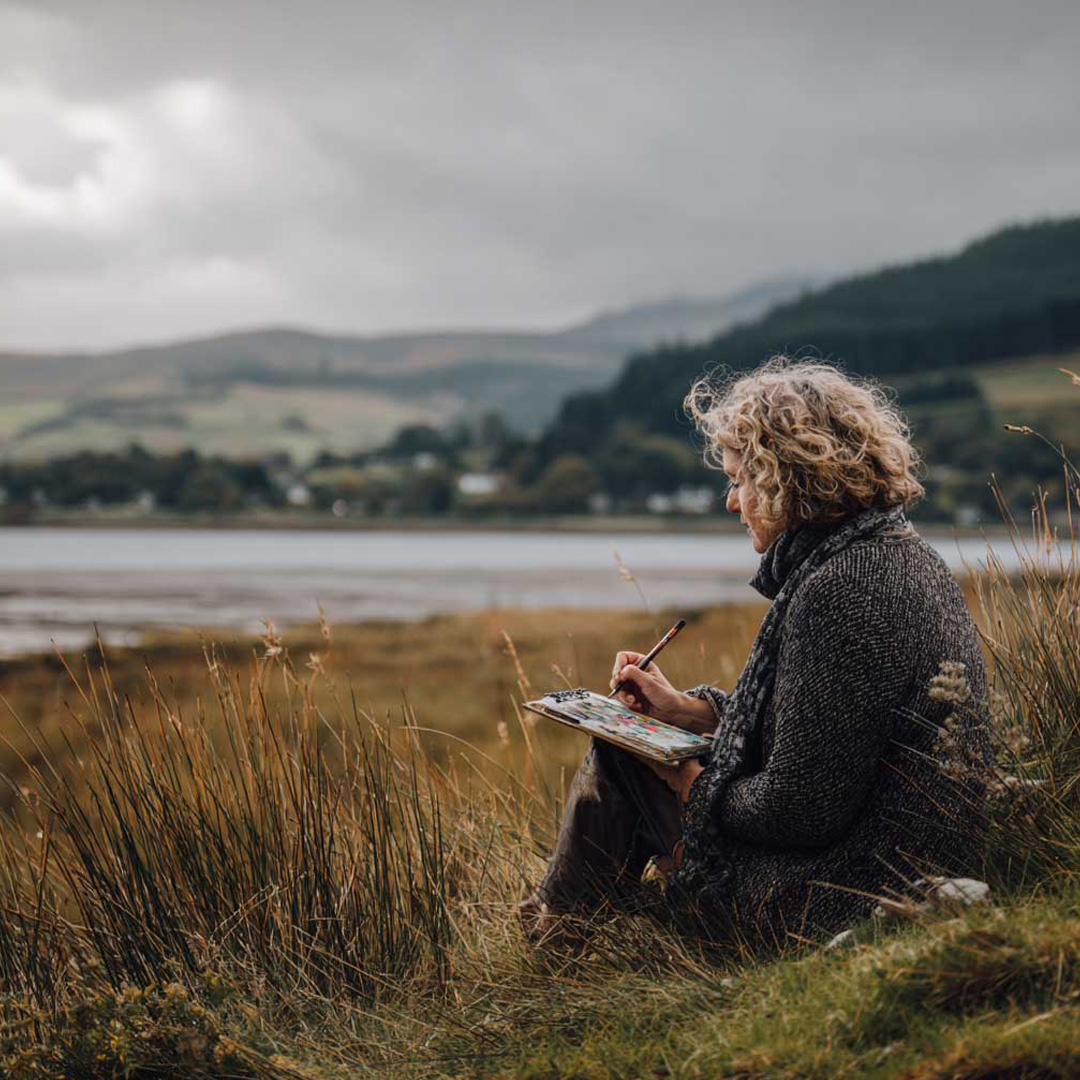
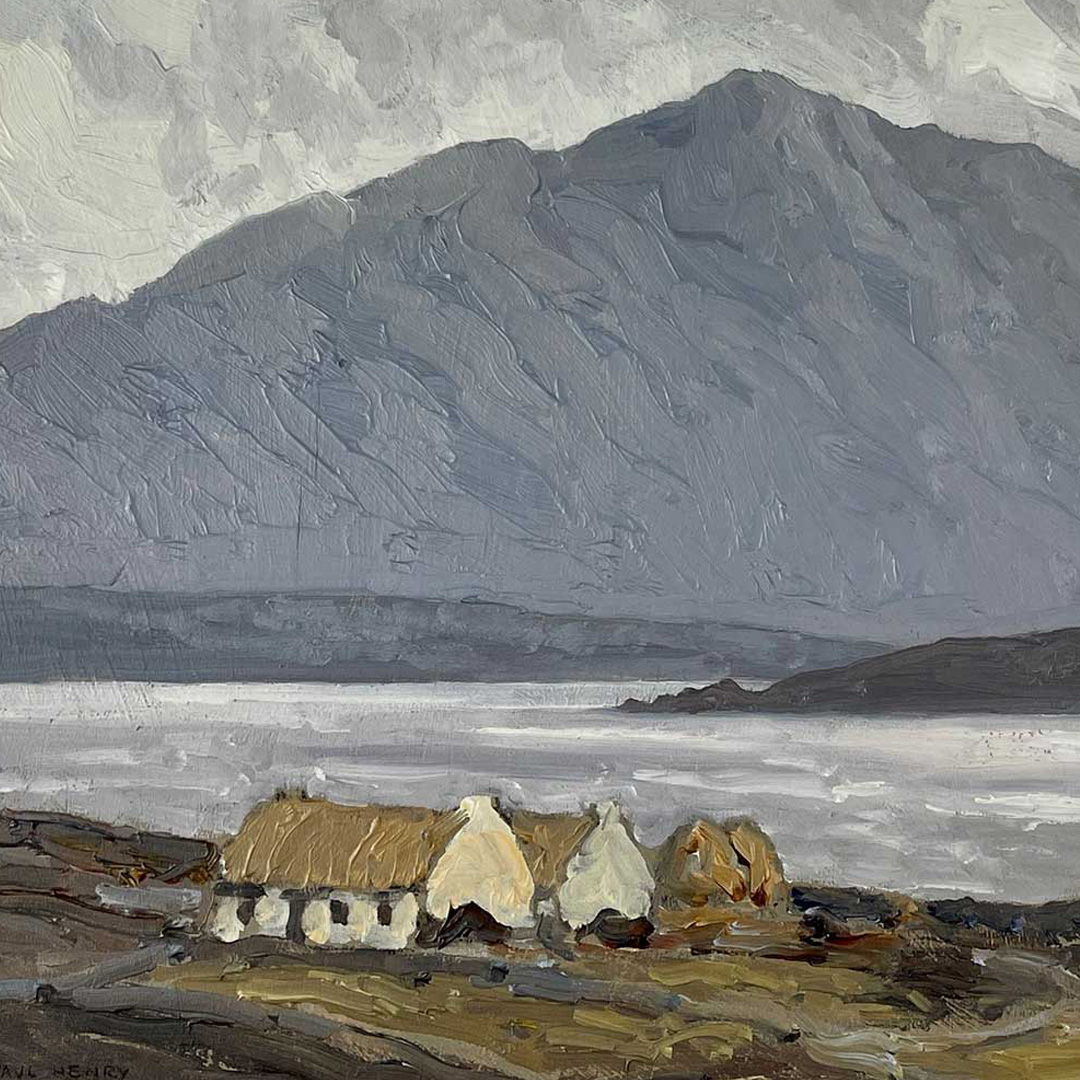
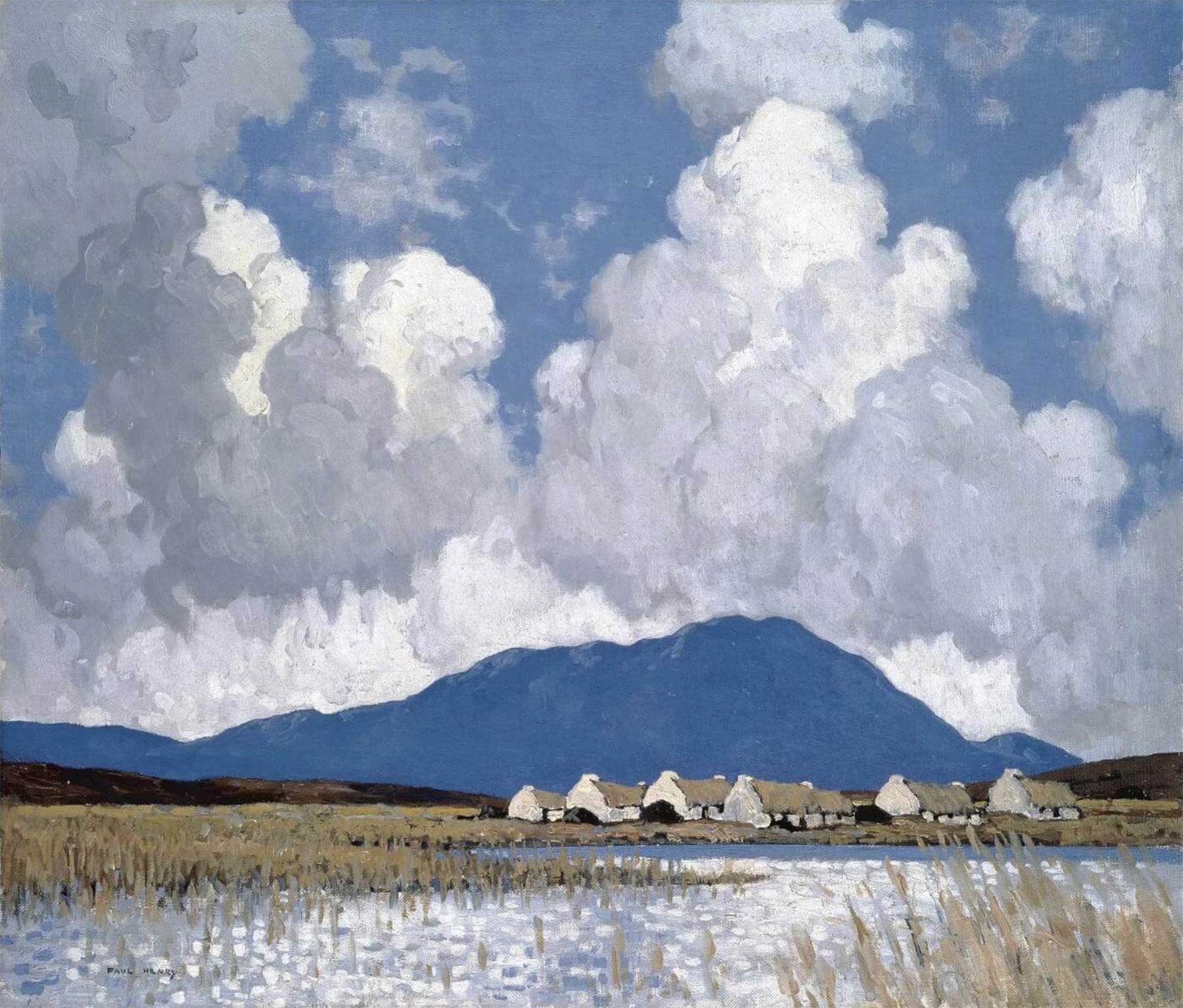
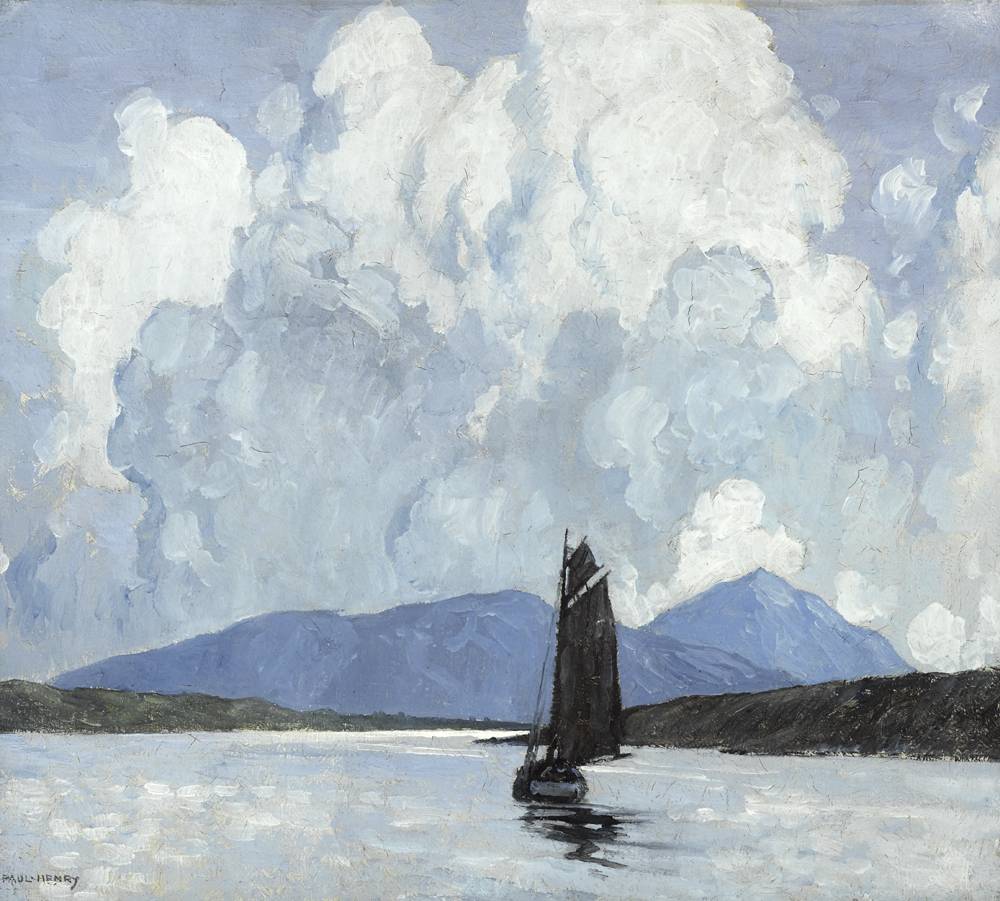
Soon after this issue lands in your inbox, I'm preparing to head to the west of Ireland. County Mayo. I'll be teaching there this month in that extraordinary landscape of rolling moorland and enormous sky, and I've been looking at Paul Henry's paintings in pure anticipation. He painted this coastline the way it feels from the inside. Vast, honest, and luminous. His skies alone could carry a conversation.
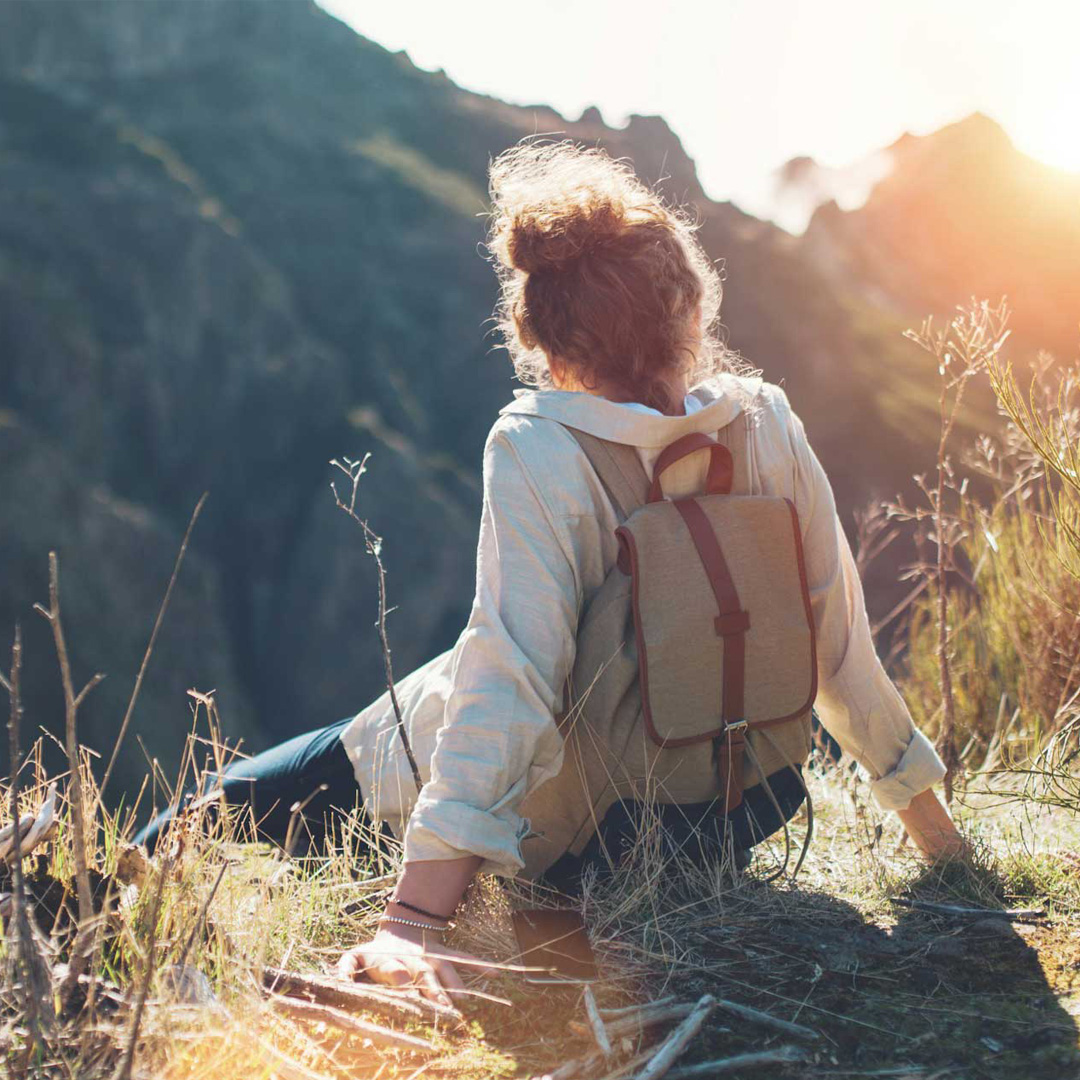
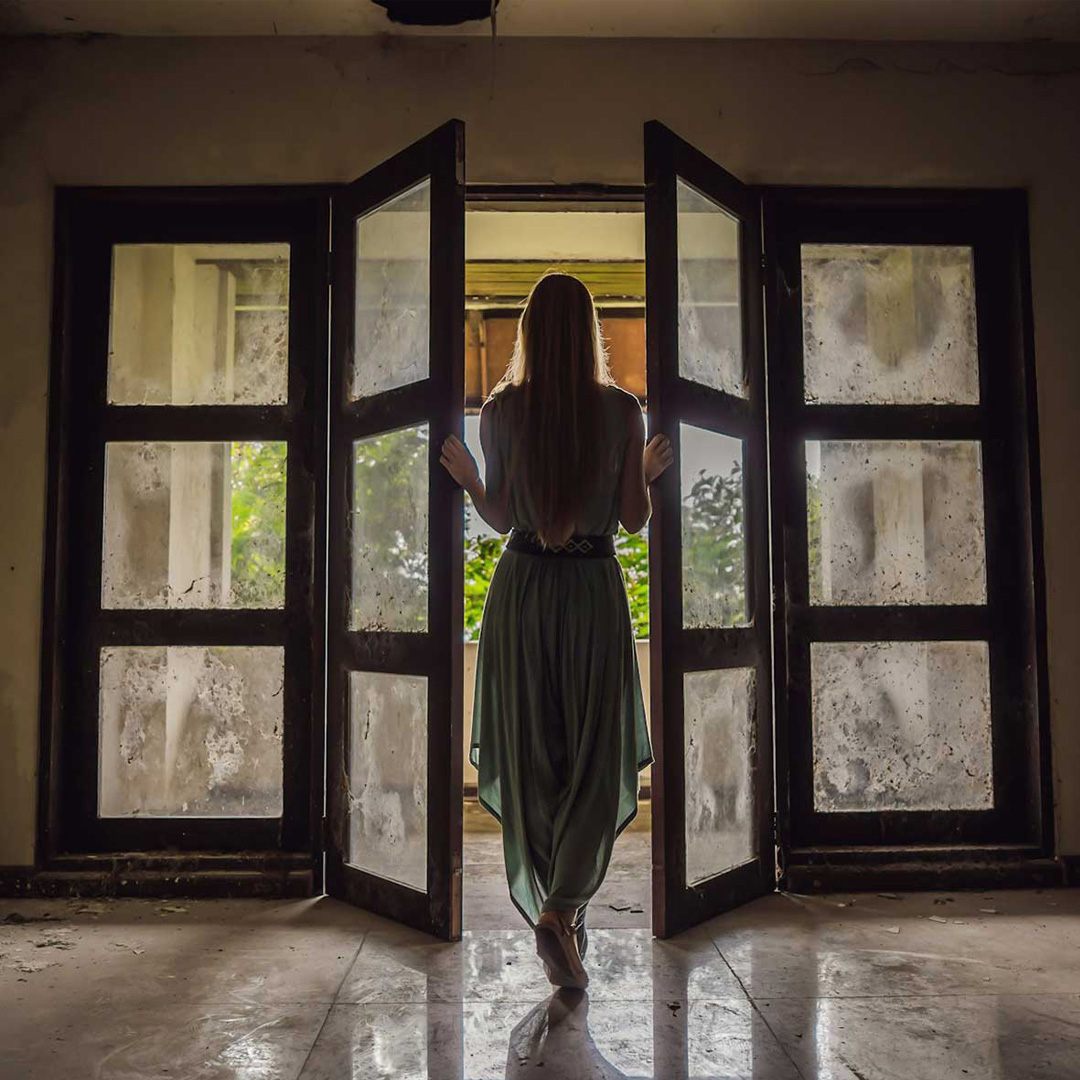
After May's beautiful exploration of belonging and roots, this issue is about what happens next. The door swinging open. The call outward.
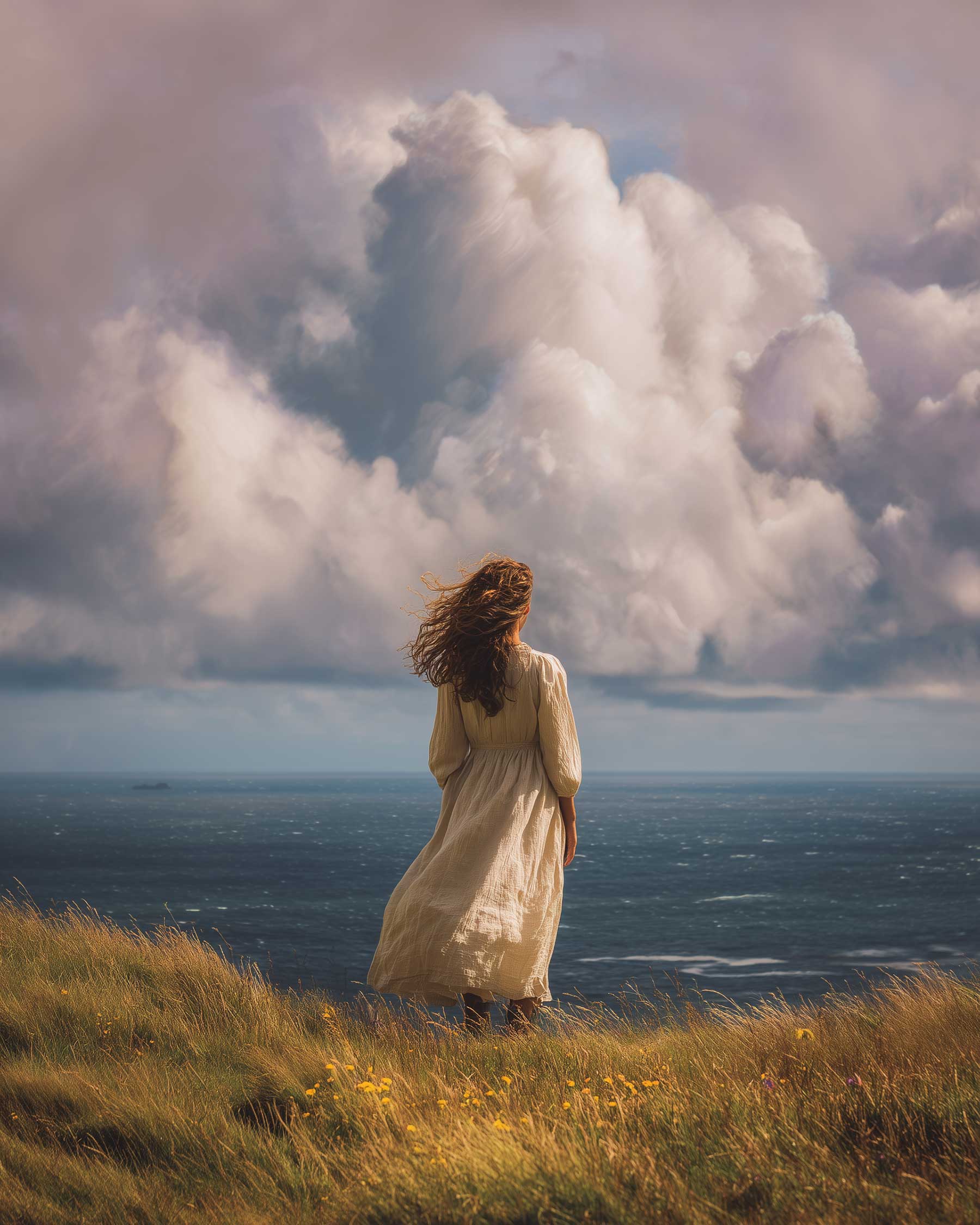
We aligned this with the Year of the Horse back in January. We talked about vitality, momentum, and that innate sense of direction that the Horse carries. Well, this is the moment we've been building toward. Midsummer. The Horse in full stride. If January was about finding our footing and May was about knowing where we belong, June is about running. Freely, boldly, with the wind doing exactly what it likes with our hair.
This issue is an invitation to feel that. To stand at the edge of your own creative horizon and trust what you hear out there.
Let's explore that together.
With love,

By the late nineteenth century, painters across Europe were getting on trains and heading west. They left Paris, London, and the polished comfort of academic studios and traveled toward the coast. Brittany. Cornwall. Eventually, the wild Atlantic shore of Ireland.
What were they looking for? Better light, certainly. They found it. Cheaper rent, which helped. But underneath those practical reasons was something larger. They wanted a landscape that hadn't been tamed. A way of seeing that hadn't been catalogued. The freedom to set up an easel in the open air and paint what was actually in front of them.
This is the story of that movement. About what happens when artists abandon the well-lit interior for the wind-burned coast.
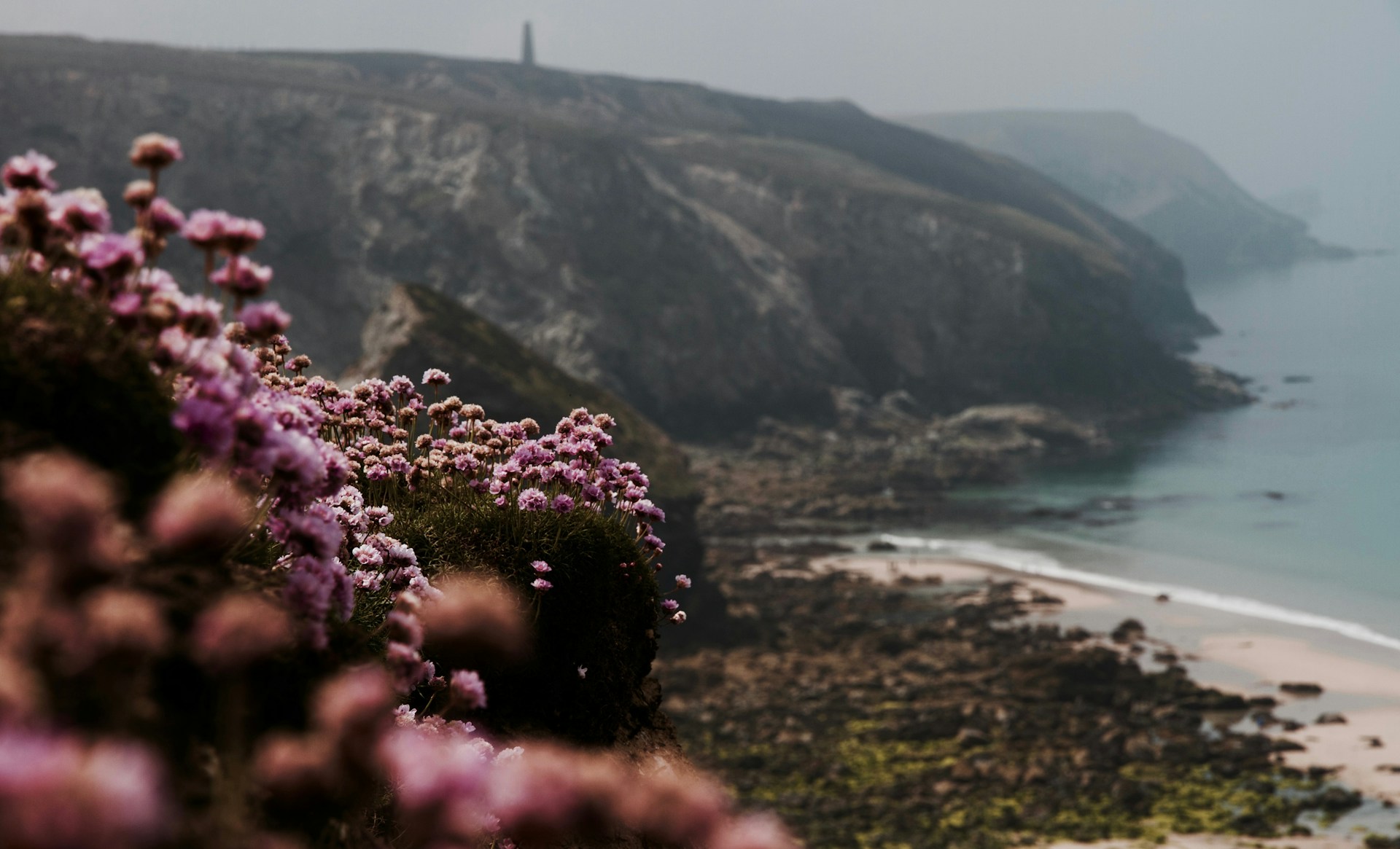
The story really begins in Brittany. By the 1860s and 1870s, the rocky western edge of France had become a kind of magnet for painters tired of the stuffiness of the Paris Salon. The light was extraordinary. The Atlantic weather moved fast and dramatic across the bays and harbors. The villages had retained traditions and dress that felt, to outsiders, like another century entirely.
Among those drawn there was a young French woman named Berthe Morisot (1841 to 1895). Today we remember her as one of the founding members of the Impressionist movement, but at the time she was something far more unusual. She was the only woman who painted regularly outdoors among that famous circle. While her male peers had the run of cafés and boulevards, Morisot's social position as a respectable bourgeois woman placed her under enormous restrictions. And yet she insisted, again and again, on painting in the open air. The harbor at Lorient on the Brittany coast. The Normandy summers. The seaside resorts at Fécamp and Petites Dalles.
She wrote about her ambition with characteristic clarity.
Transient. That word does a lot of work. The painters who went to the Atlantic coast were chasing something that wouldn't hold still. The shift of light on water. The shape of a cloud crossing a bay. A figure walking along the edge of the tide. They needed to be outside, present, fast. The studio could not contain what they were after.
Morisot's now-famous painting The Harbor at Lorient from 1869 captures exactly this kind of fleeting moment. A woman in pale clothing seated on a low wall, water and sailing boats stretching beyond her, the whole scene suspended in soft summery light. The scene is quiet. The act of making it was anything but. A woman, alone, painting outside, claiming that landscape as hers.
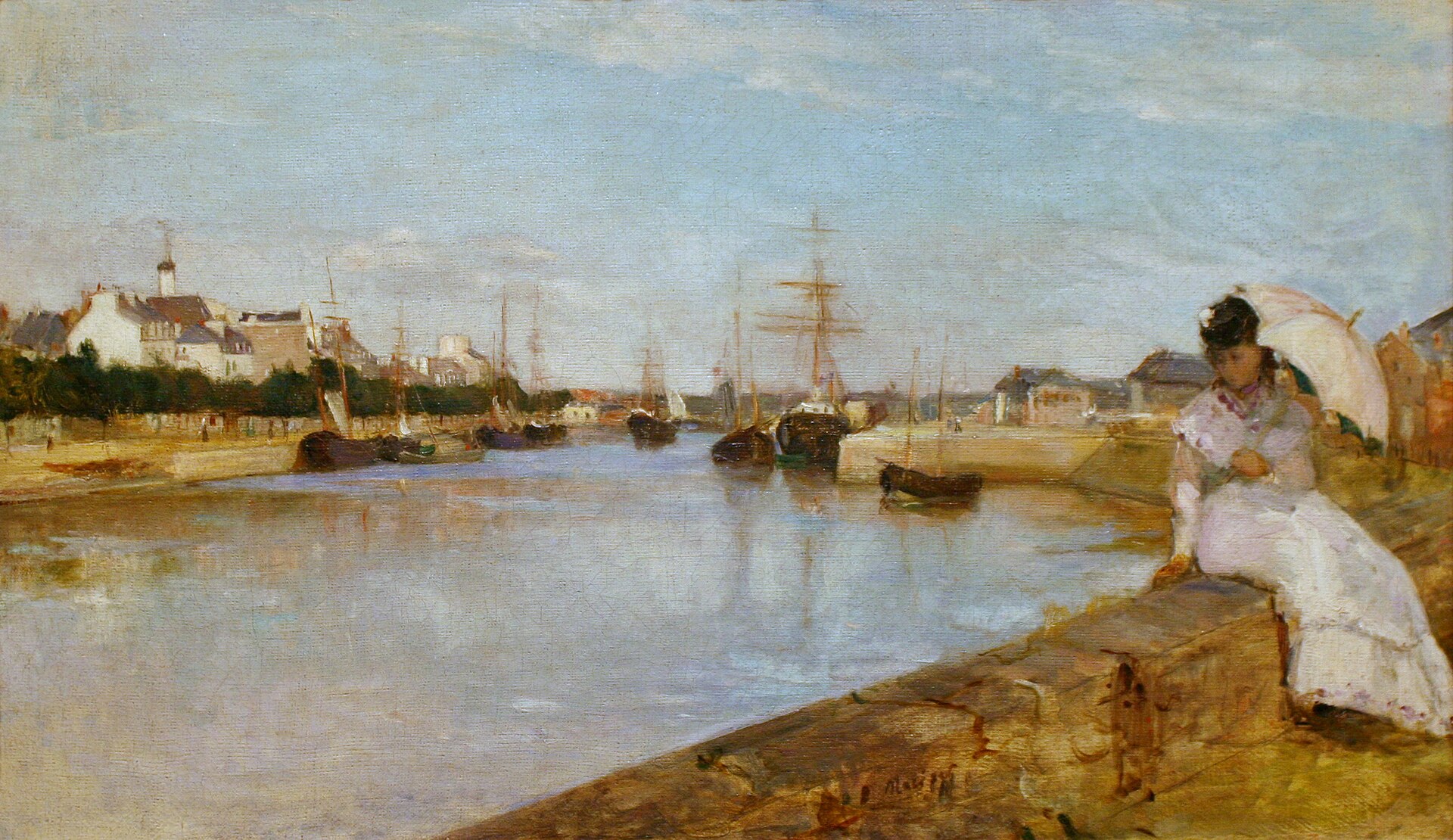
The Harbor at Lorient
By Berthe Morisot, 1869
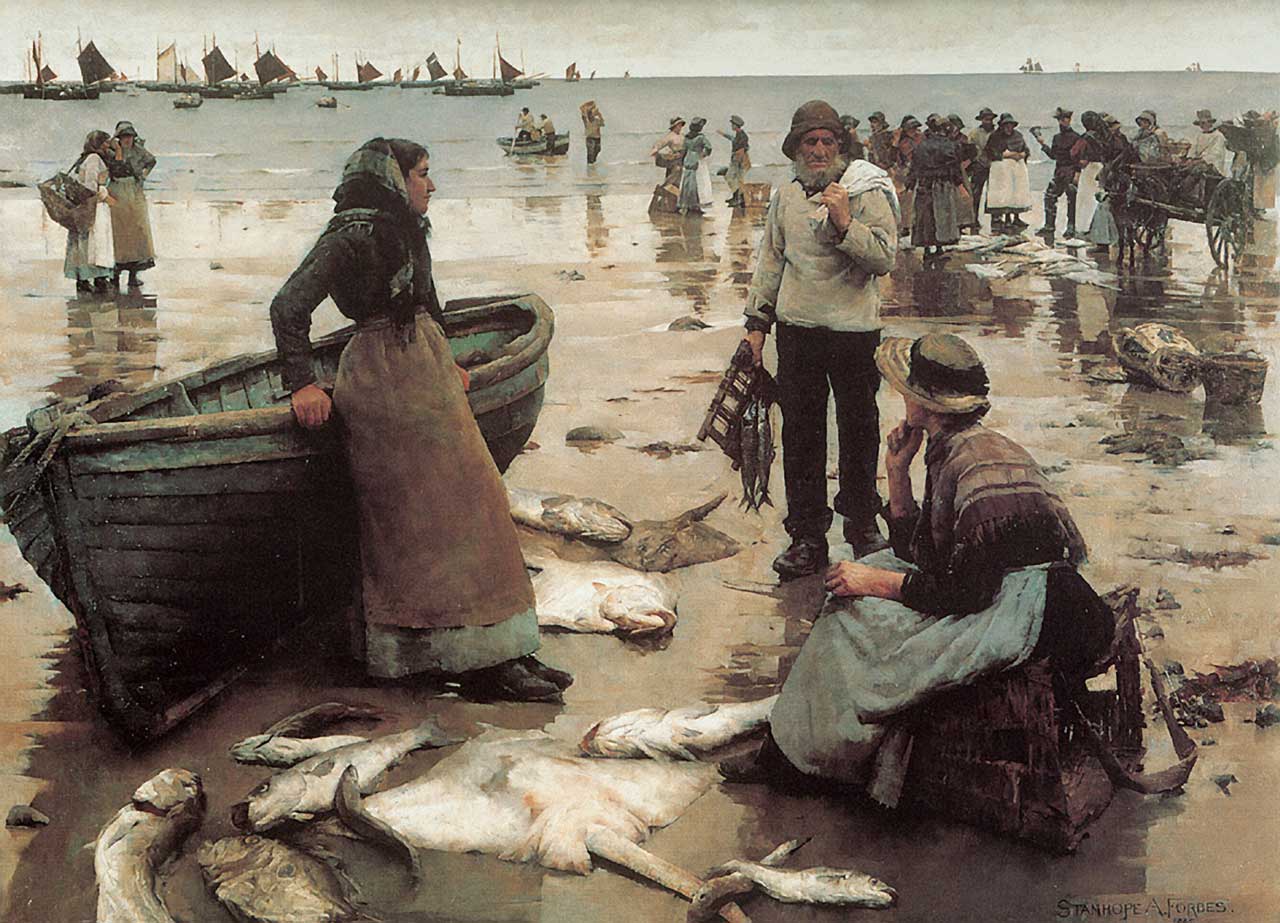
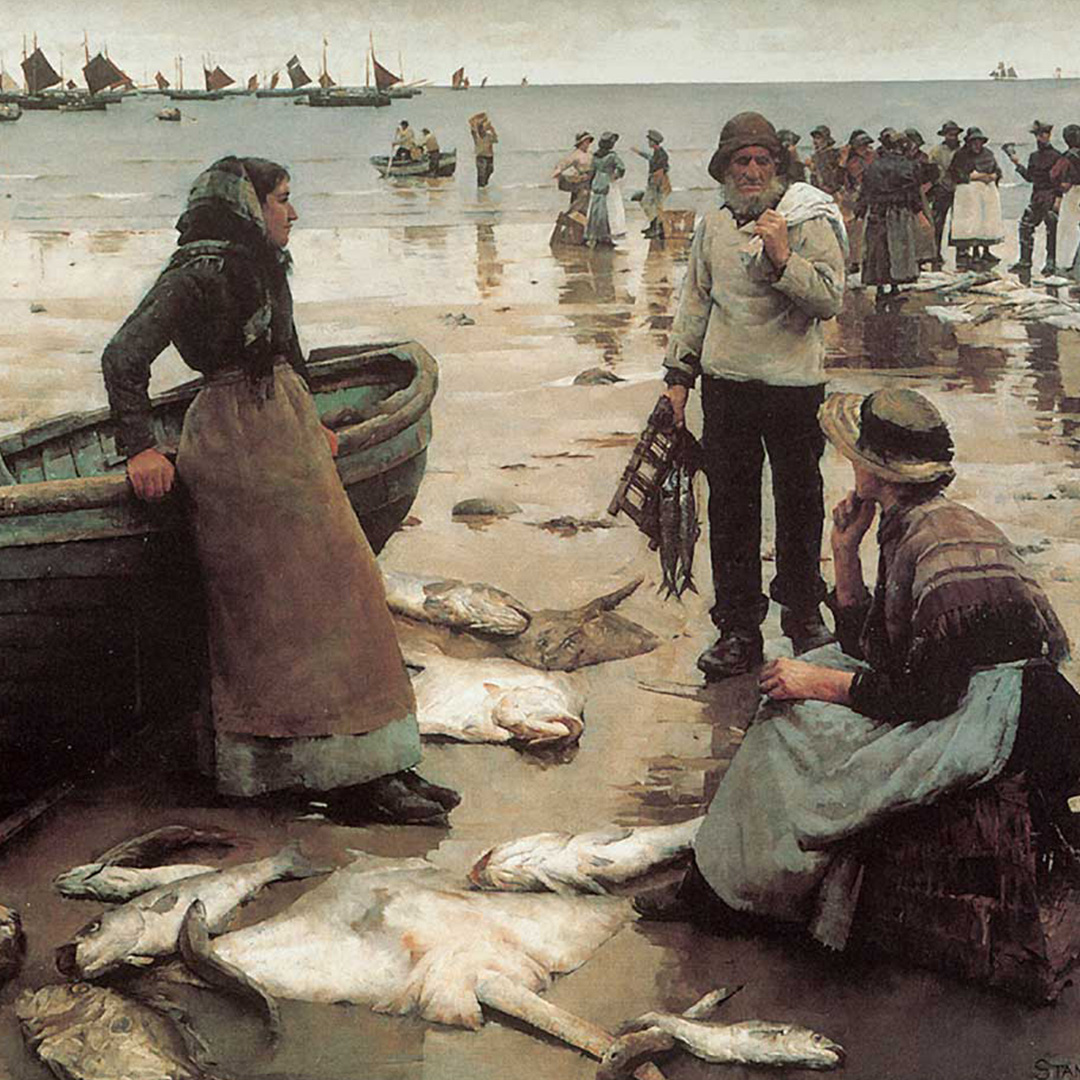
A Fish Sale on a Cornish Beach
By Stanhope Forbes, 1885
Across the Channel, something similar was happening on the southwest tip of England. In 1884, a young Irish-born painter named Stanhope Forbes (1857 to 1947) took the train as far west as it would go and walked the last stretch into a small Cornish fishing village called Newlyn. He had spent the previous summers painting in Brittany and had absorbed the new doctrine of plein air work. He was looking for somewhere in the British Isles that could offer the same gifts. He found it.
His own description of his arrival has a wonderful note of inevitability:
Newlyn became his home for the rest of his life. He painted his celebrated A Fish Sale on a Cornish Beach in 1885, exhibited it at the Royal Academy that summer, and the painting essentially launched what became known as the Newlyn School. Other artists began to arrive. A community formed. Forbes wrote that plein air painting was "a breath of fresh air in the tired atmosphere of the studios," and in another moment described his and his peers' philosophy with stripped-down clarity: they painted en plein air because it was the only way "to depict nature as she is."
Newlyn was always a shared effort. In 1885, a Canadian-born painter named Elizabeth Armstrong (1859 to 1912) moved there with her mother. She had already been painting at the artists' colony at Pont-Aven in Brittany and had studied across Europe. She had a reputation as a serious working artist before she ever met Stanhope. They married in 1889 and went on to found the Newlyn School of Painting together in 1899. And here is the part that often gets lost in the telling: during her lifetime, Elizabeth Forbes outsold most of her male contemporaries. Her obituary called her the "Queen of Newlyn." She painted in oil, watercolor, and pastel. She made etchings influenced by Whistler. She raised a son, ran a school, and never stopped working. She was an equal partner in the entire Newlyn enterprise, full stop.
Her paintings of Brittany and Cornwall, with their luminous attention to children and ordinary working life, brought a different sensibility to the Atlantic edge. Stanhope's eye often went to the gathering of a crowd. Elizabeth's lingered on the smaller, quieter moments. A girl with a basket. A figure at a doorway. The way light fell across a country lane in May.
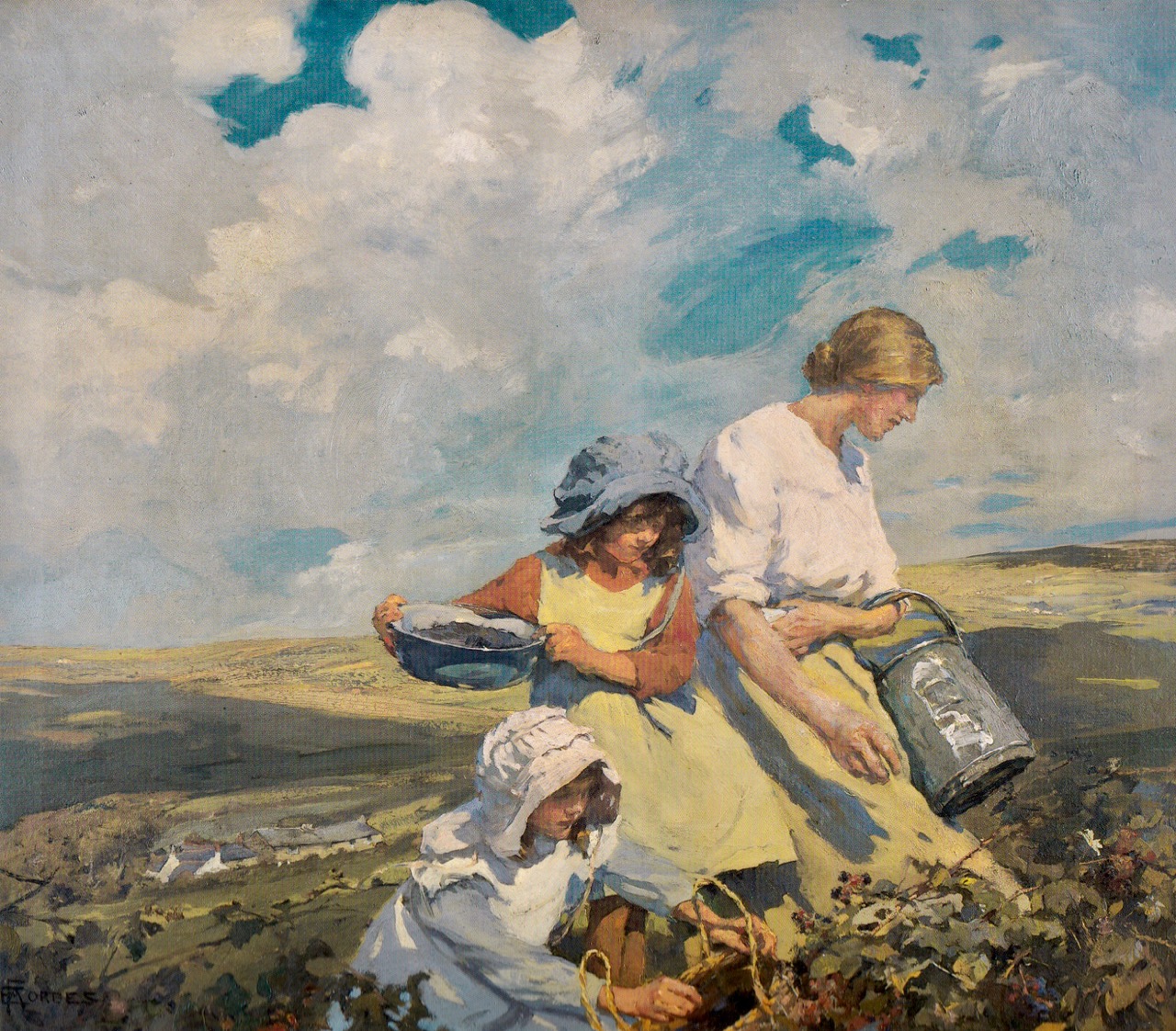
Blackberry Gatherers,
By Elizabeth Armstrong Forbes, 1912
By the time the next generation of painters began making their way to the Atlantic, the colonies in Brittany and Cornwall were already established. The next frontier lay further west still. Ireland.
We will spend more time with Paul Henry in this issue's Master Artist Study, so I will not say much about him here. But it is worth noting that he, too, was part of this larger movement. He arrived on Achill Island off the coast of County Mayo in 1910 and stayed for nearly a decade. He was looking for what every painter in this story had been looking for. Light that moved. A landscape that hadn't been arranged for the comfort of the viewer. The rough, honest, expansive truth of a place that wouldn't sit still.
The west of Ireland gave him all of it.
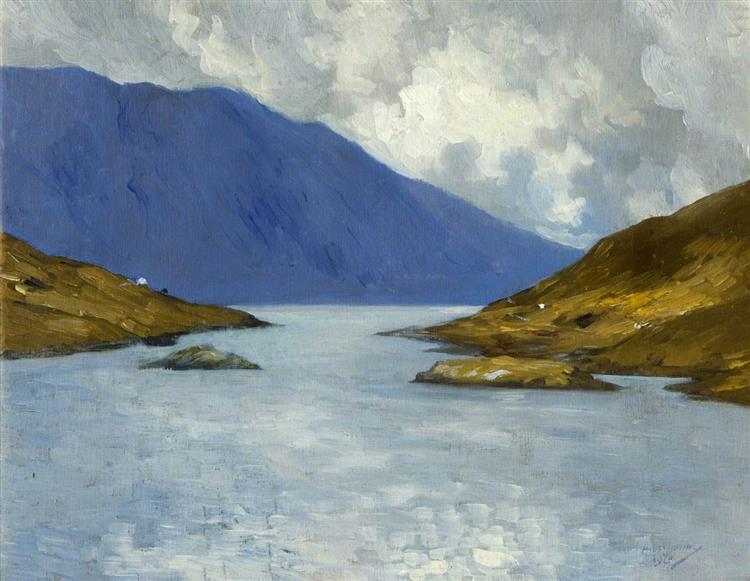
Leenane
By Paul Henry, 1913
Looking back at this whole movement now, more than a century later, what strikes me most is how clearly these artists understood that wildness was not an obstacle to their work. Wildness was the work itself. The wind that blew Stanhope Forbes's painting into the sea off Newlyn pier (a real event, by the way, in 1910). The fast-moving Atlantic light that demanded speed and decisiveness. The discomfort of working outside in unpredictable weather. All of it was the point.
There is something here for our own creative lives. These artists wanted weather that surprised them. Light that wouldn't sit still. Conditions that demanded they keep up. They left their controlled environments on purpose, walking toward landscapes that asked them to surrender their preference for comfort. To trust what was actually in front of them rather than what they had been trained to expect.
The wild call has always been answered, in art history, by people willing to leave the studio behind. To walk the dusty road past the last village. To set up an easel on a windy pier. To paint, as Stanhope Forbes put it, what is actually there.
This month, as we lean into our own midyear horizon, we are in good company. Painters have always heard this call. Many of them, more than the official histories tend to remember, were women, working with as much courage and skill as anyone, in the open air, at the edge of the known world.
The horizon is still there. The call is still there.
What does it ask of you?
After spending time with the artists of Brittany, Cornwall, and the west of Ireland, something settles in me. These were not painters who waited for ideal conditions. They walked toward conditions that asked something of them. The wind. The cold. The fast-moving light. The discomfort of being out in weather that refused to perform.
I have been thinking about what that means for those of us working today, in studios that are usually warm and well-lit, with good chairs and reliable WiFi. We have made our creative spaces comfortable, and that is a real gift. But comfort has a way of dulling things, too. After a while, the very setup that protects our practice can start to flatten it.
This month, I want to invite a small experiment. Two of them, actually. One practical, one deeper.
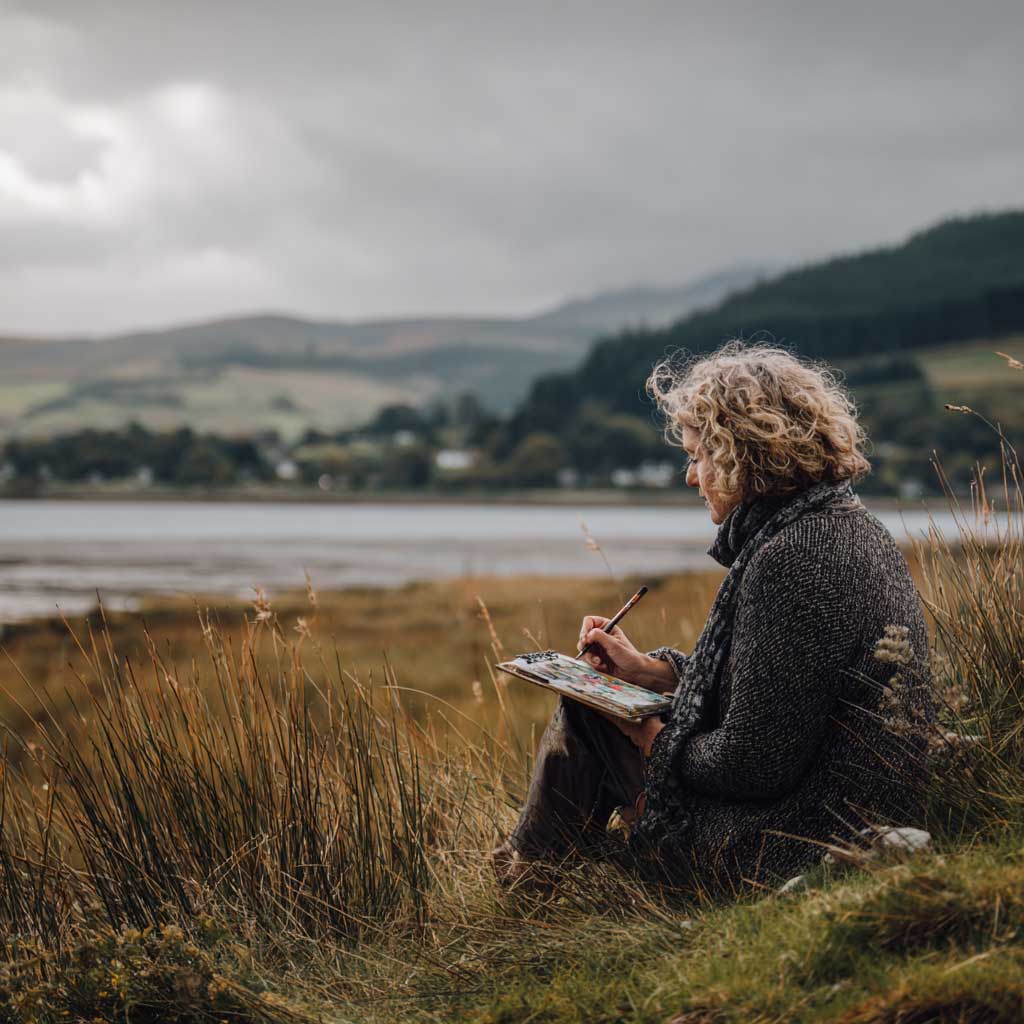
The first invitation is simple. Take your work outside.
You don't need to commit to a full plein air practice. You don't need to drive to a wild coastline. The point is the act itself. Sitting on a bench in your local park with a sketchbook. Setting up a small watercolor on your back step. Bringing a camera or a notebook to a place you've walked past a hundred times and finally stopping to really look.
Outside, things change in ways that will surprise you. The light moves while you work, and your painting has to keep up. A breeze lifts the page. A dog barks. Someone walks by and says something. You cannot control any of it, and that is exactly the gift. Your work has to respond. You have to make decisions faster, more honestly, with less time to second-guess.
Stanhope Forbes once described painting outside as the only way to depict nature as she actually is. That instinct has nothing to do with perfectionism. It has to do with truth. There is a kind of honesty available outdoors that simply isn't available anywhere else.
You will probably feel a little awkward the first time. That is part of it.
The second invitation is quieter and takes more time to answer.
The painters in this month's essay all heard a pull toward something specific. Brittany. Cornwall. Achill Island. They followed it, often without knowing exactly why. They just trusted that the pull meant something.
Most of us, if we are honest, can feel a similar pull in our own creative lives. There is usually one direction we keep almost going in and then turning away from. A medium we want to try. A subject we keep circling. A scale we are afraid of. A theme that feels too vulnerable, or too unfashionable, or too far from what we are known for.
What if that pull is the wild call? Not as a grand metaphor, but as actual information about where your creative life wants to go next?
Take a quiet half hour this week. Make a cup of something. Sit somewhere that feels good. And ask yourself, with as much honesty as you can manage:
What direction has been pulling at me? What have I been almost trying? What would I make if I trusted the pull?
You don't need to act on the answer immediately. You just need to let yourself name it. Naming the pull is most of the work. Once you have said the thing out loud, even just to yourself, it tends to keep finding ways to come back.
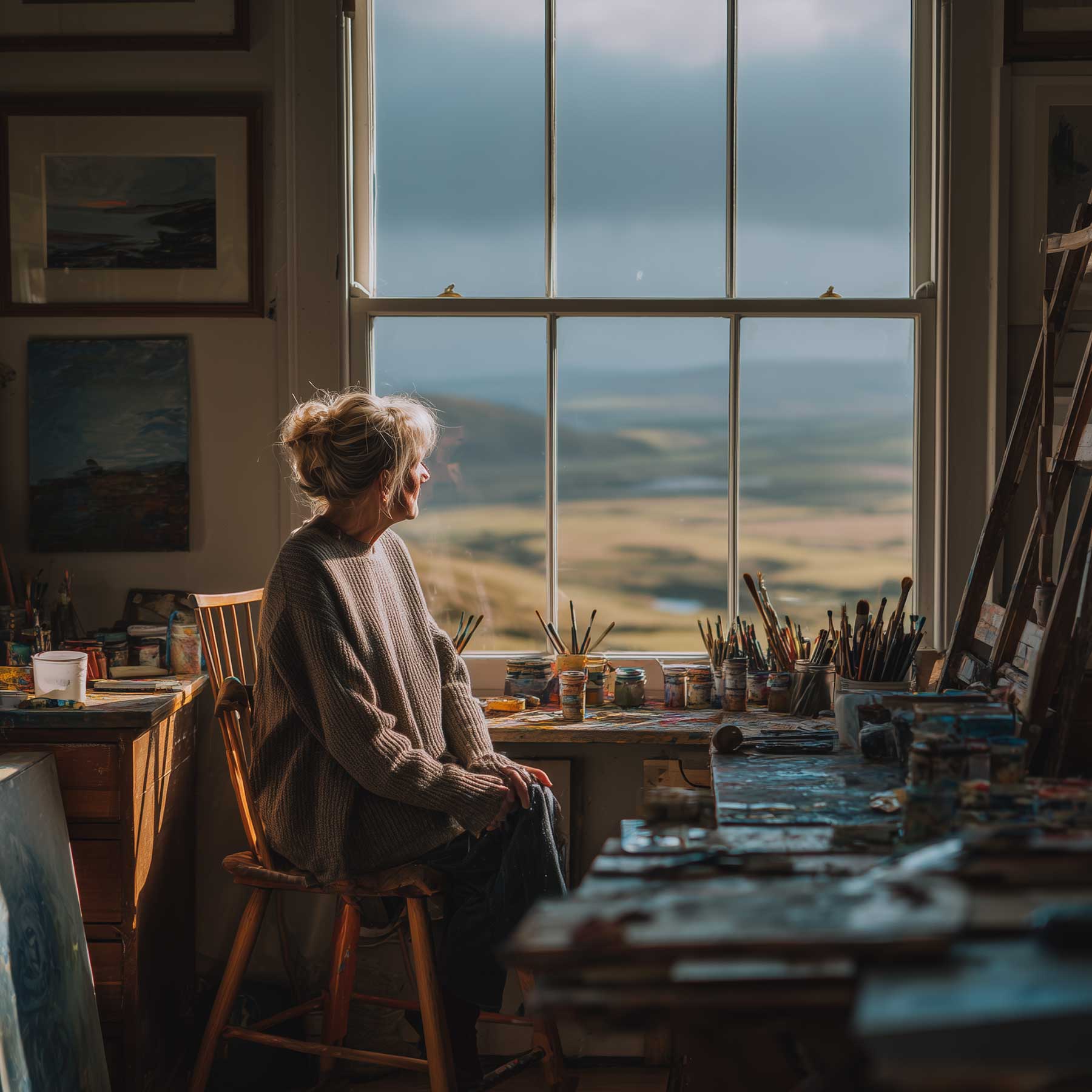
Both of these invitations involve some version of discomfort. Working outside is awkward. Following an unfamiliar pull is even more so. I am not going to pretend otherwise.
But every artist in this month's essay walked toward that discomfort on purpose. They knew, somehow, that the polished interior could not give them what the wild edge could. They were right. The work that came out of those windswept colonies still moves us more than a century later.
The horizon is asking something of you this month. It might be small. It might be huge. Either way, it is worth listening to.
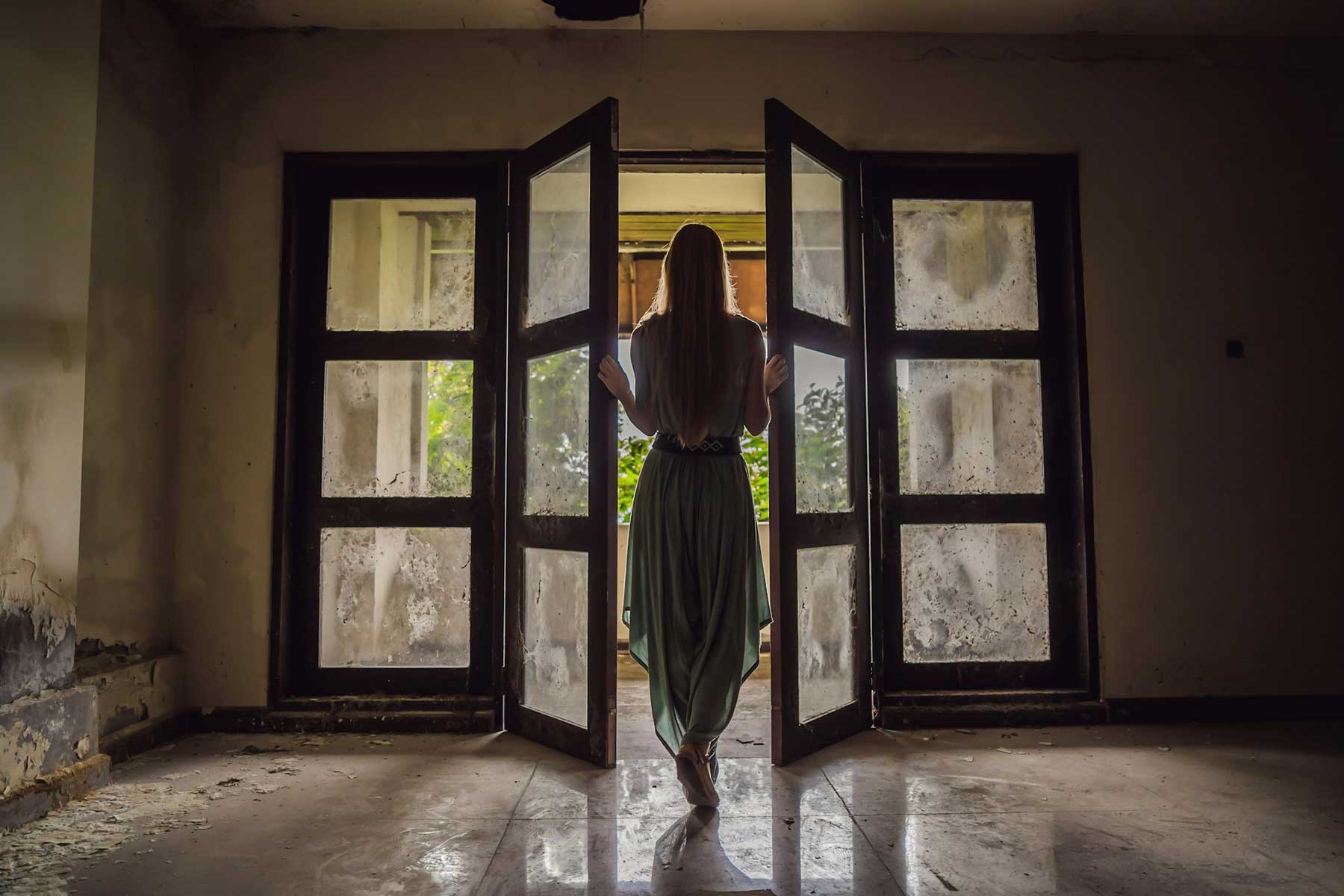
According to the Oxford English Dictionary, initiation is defined as the action of beginning something and the process of being formally introduced or admitted into a group or activity, typically with special ceremonies or rituals.
There is more in that definition than first appears. Two things, actually. A beginning. And a rite of passage. Both are present every time we answer a creative call we have never answered before.
We tend to think of initiation as something that happens to other people. In other cultures. In other centuries. Ceremonies around fires, elder figures in ceremonial dress, young people crossing into adulthood under a full moon. We have quietly decided that modern life doesn't really do initiation anymore.
But creative life does it constantly. Every time you begin working in a medium that scares you, you are crossing a threshold. Every time you follow a pull that doesn't make practical sense, something in you is being tested and changed. Every time you leave the familiar and walk toward the wide open, you are being initiated into a larger version of your own creative self.
The painters we explored this month understood this intuitively. Stanhope Forbes getting on a train to Cornwall without knowing it would become his life's home. Berthe Morisot insisting on painting outside when the rules of her world said otherwise. Paul Henry arriving on Achill Island and staying for a decade. None of these were casual decisions. They were initiations. Crossings from one creative life into another.
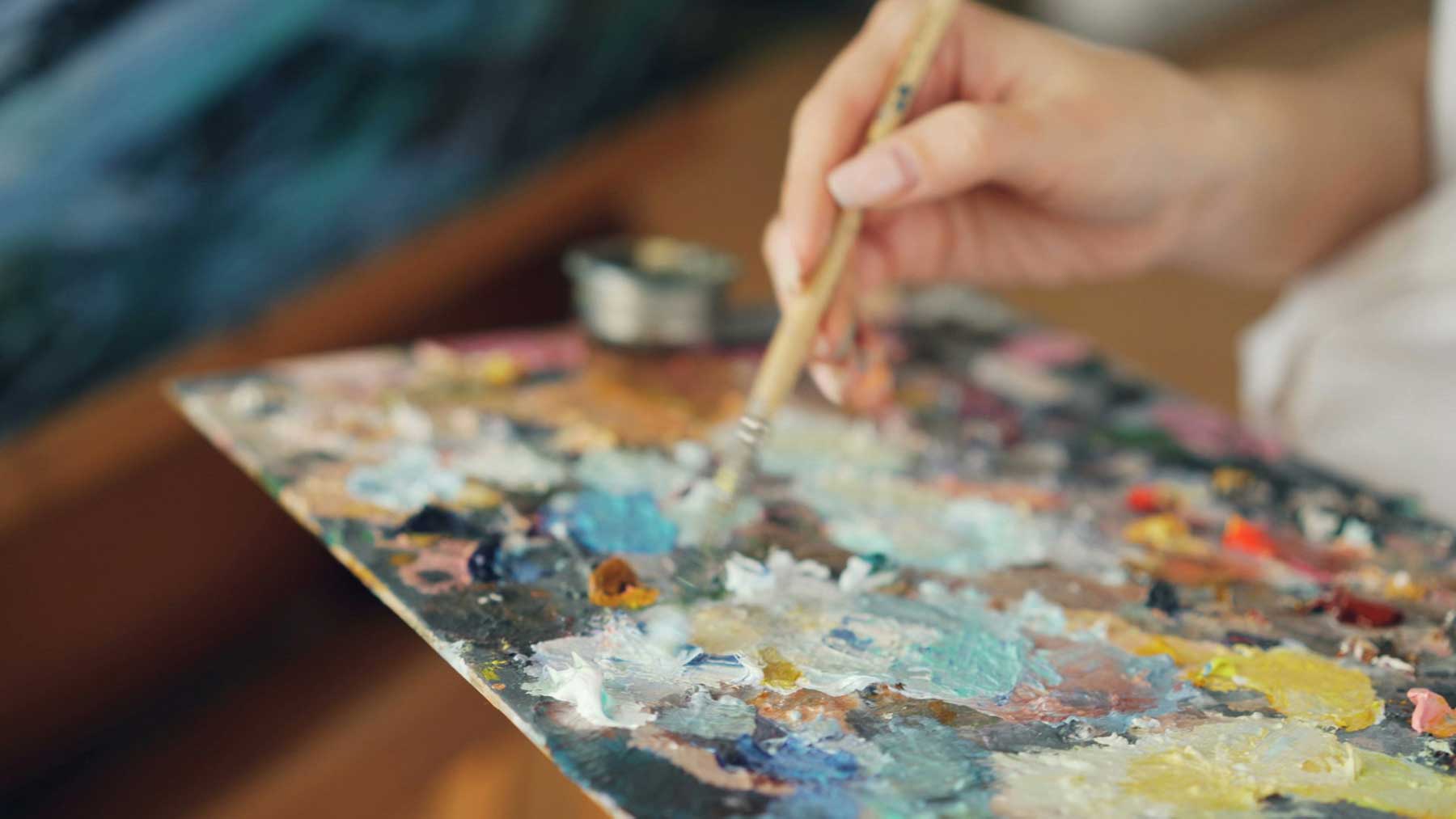
The thing about initiation is that it cannot be fully prepared for. You can read about the place you are going. You can study the artists who went before you. You can pack the right brushes and stretch the right canvases. But the actual crossing always asks something you didn't know it would ask.
This is what makes it an initiation rather than simply a plan.
In practical terms, initiation in the studio looks like the moment you commit to a new body of work knowing you might fail at it spectacularly. It looks like the first mark on a large canvas after weeks of circling. It looks like signing up for the class, booking the trip, buying the paints in colors you have never used. Small crossings and large ones. Each one changes something.
The key is recognizing these moments when they arrive. Most of us walk past them. We feel the pull, acknowledge it briefly, and then return to what we know. The initiation is offered and quietly declined.
This month, with the midyear energy running high and the Horse in full stride, is an invitation to say yes to one crossing you have been postponing. It doesn't have to be large. It just has to be real.
=
What threshold have you been standing at in your creative life?
What would it mean to actually cross it this month?
What are you afraid will be lost if you step through?
What might be waiting on the other side?
Let's tap into our creative intuition and do some self-reflective work inspired by our theme. Below you will see our month's Oracle/Tarot card spread. But fear not, if you are not one drawn to using oracle or tarot cards, no worries, just use the accompanying reflective questions as writing prompts for your journals!
Here's a four-card oracle spread that fits seamlessly with our monthly theme. Take a deep breath, grab a cup of tea and enjoy.
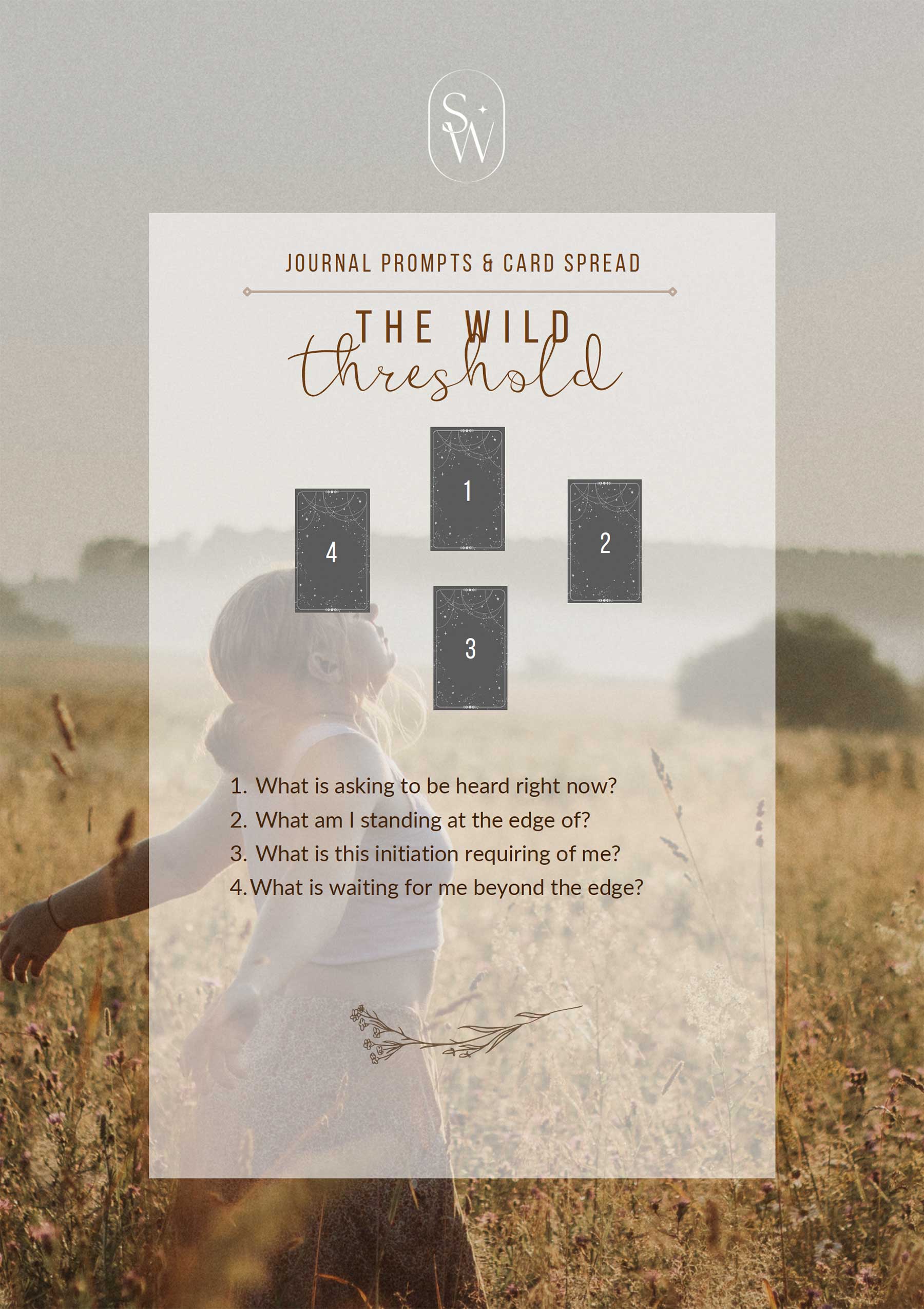
A four-card reading for the creative soul standing at the edge.
Card 1: The Call
What is asking to be heard right now?
This card represents the wild call that is arriving in your creative life at this moment. It may come as a restlessness, a recurring idea, a longing you keep pushing aside. It is not asking you to act yet. It is simply asking you to listen. This card shows you what has been trying to get your attention.
Journal Prompt: If I got very quiet and stopped being practical for a moment, what would I admit is calling me?
Card 2: The Threshold
What am I standing at the edge of?
This card reveals the crossing that is available to you right now. The threshold you have been circling. It may be a new body of work, a medium, a way of seeing, a commitment to your practice you have been postponing. This card names the doorway. You don't have to walk through it today. But it helps to know it is there.
Journal Prompt: What have I been almost ready to begin? What would it feel like to take one step across?
Card 3: The Asking
What is this initiation requiring of me?
Every crossing asks something. This card shows you what this particular threshold requires. It might be courage, patience, surrender, discipline, or simply showing up consistently when the excitement fades. This is not a card of obstacles. It is a card of honest preparation. Knowing what is asked of you is the first gift of any initiation.
Journal Prompt: What quality or practice do I need to strengthen in order to cross this threshold with integrity?
Card 4: The Other Side
What is waiting for me beyond the edge?
This card offers a glimpse of what becomes possible when you answer the call. Not a promise, and not a guarantee. More like a lantern held at a distance. Something worth moving toward. Let this card remind you why the crossing matters, especially on the days when the threshold feels too wide and the call too uncertain.
Journal Prompt: If I trusted the call completely, what might my creative life look like on the other side of this crossing?
Find a quiet moment before drawing your cards. As you turn each one, notice your first response before interpreting. Pay attention to what stirs, softens, or catches in your chest. This spread works beautifully with both oracle and tarot decks and can be revisited whenever the question of creative identity feels uncertain.
This month's meditation felt like an obvious choice the moment I read the title. Beyond the Beyond. Is there a more perfect description of what it feels like to stand at a creative threshold and actually step through it? Rachel has created something truly special here. This meditation is an invitation to move past the edges of what you know, past the familiar boundaries of your own thinking, into the wide open space where creative initiations actually happen. I recommend finding a quiet moment, somewhere comfortable, and letting yourself be taken somewhere new.
You might be surprised how far beyond the beyond you actually are.
Here's a little more information from Rachel…
Are you ready to go on a journey? This is a simple but powerful meditative experience to reconnect you to your true self, who you are beyond the stories, beyond your persona, your true essence, found in the feeling space, the expanse.
xo,
Rachel
Each month we will have a positive affirmation. I recommend you print out this affirmation and put it in your sketchbook or somewhere in your studio. Recite the affirmation out loud each time you show up to create. Saying words aloud is powerful and can begin to re-write some of our own limiting beliefs or calm our fears. Try it now…
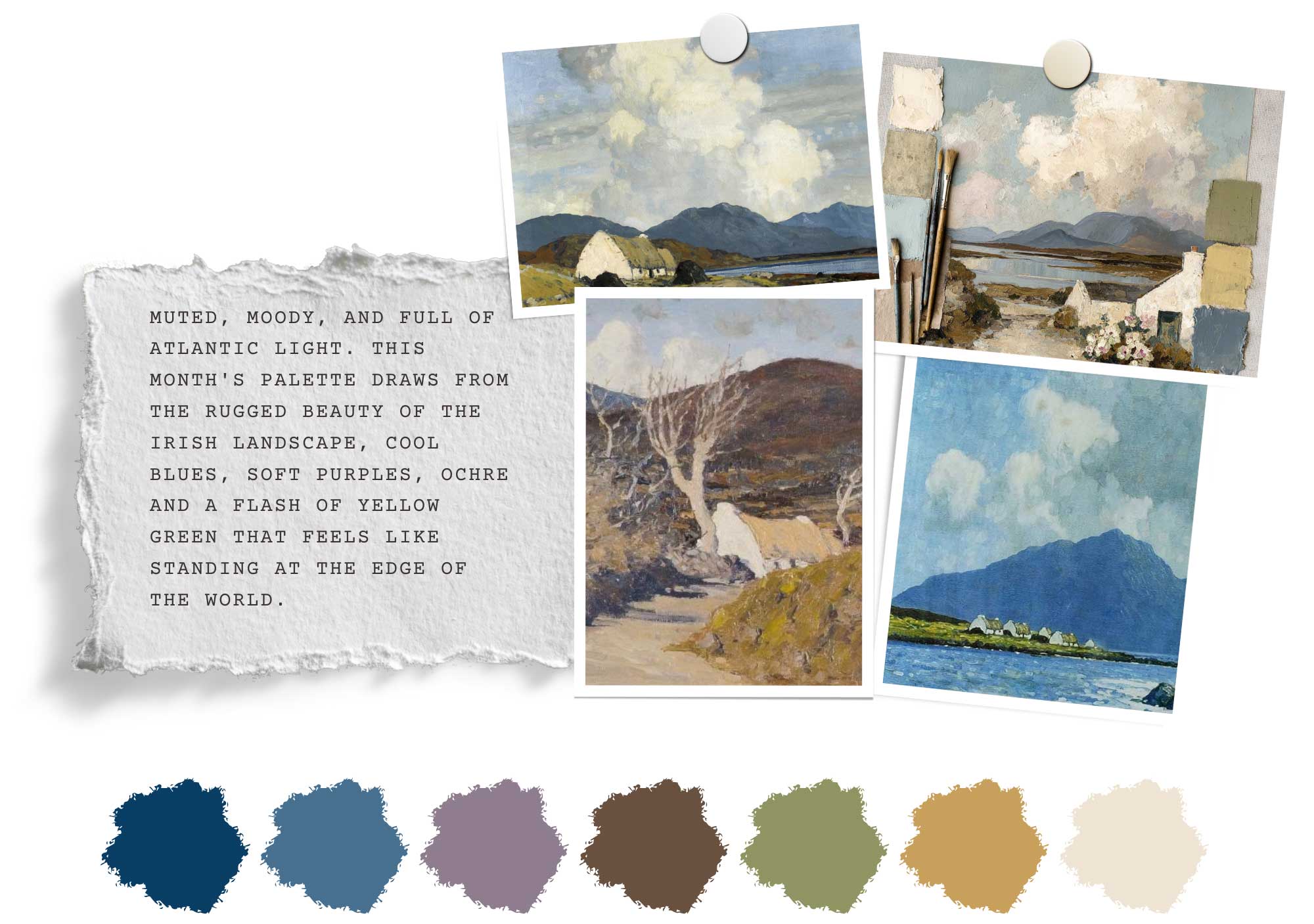
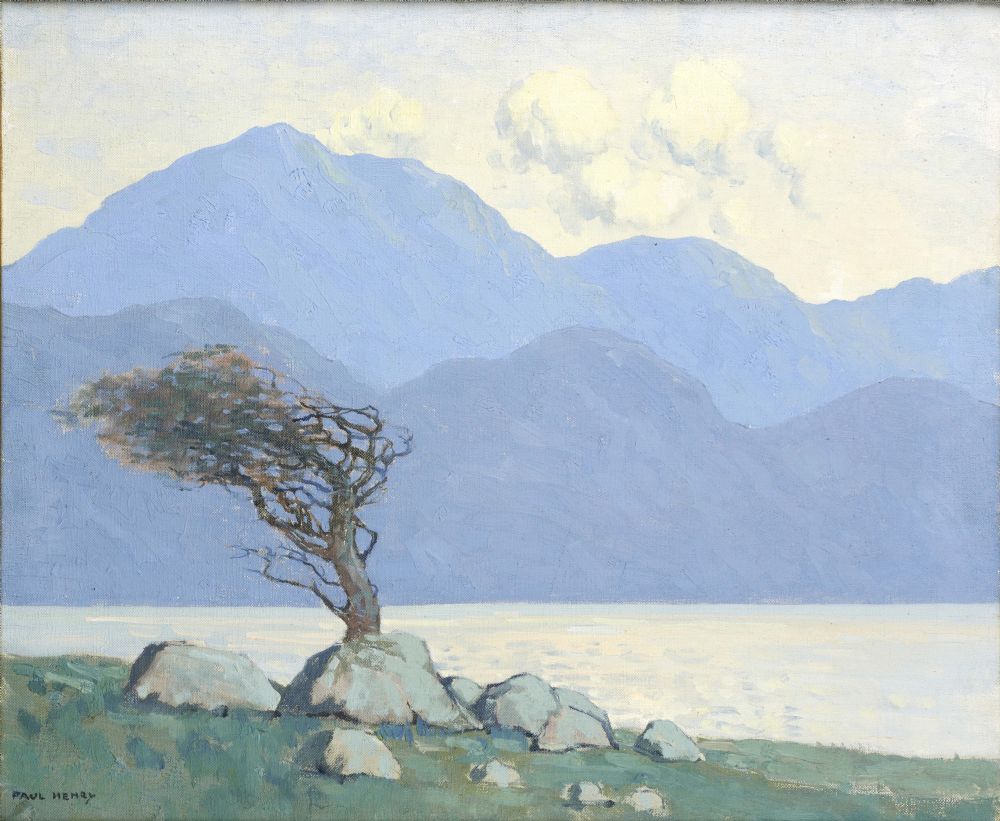
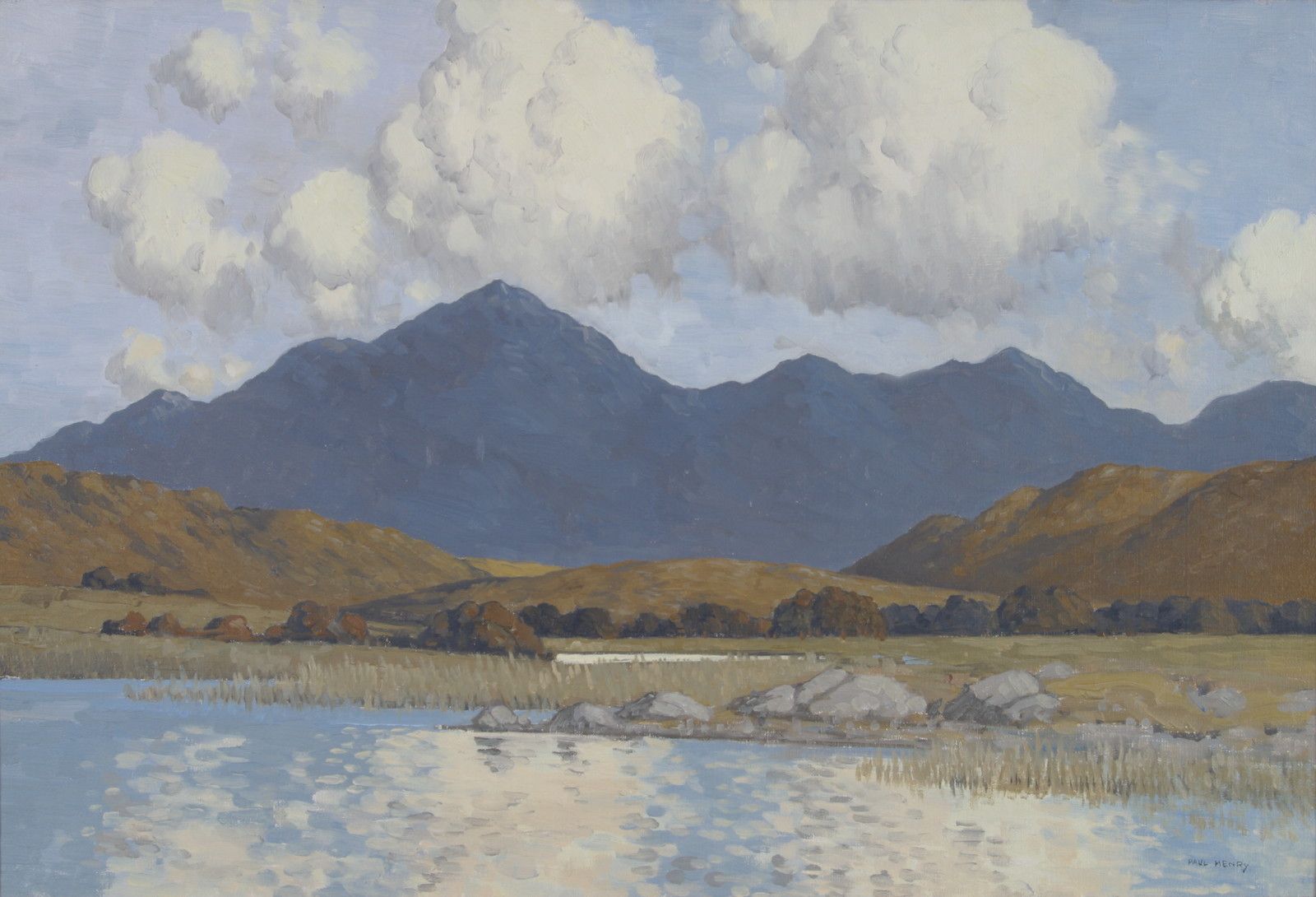
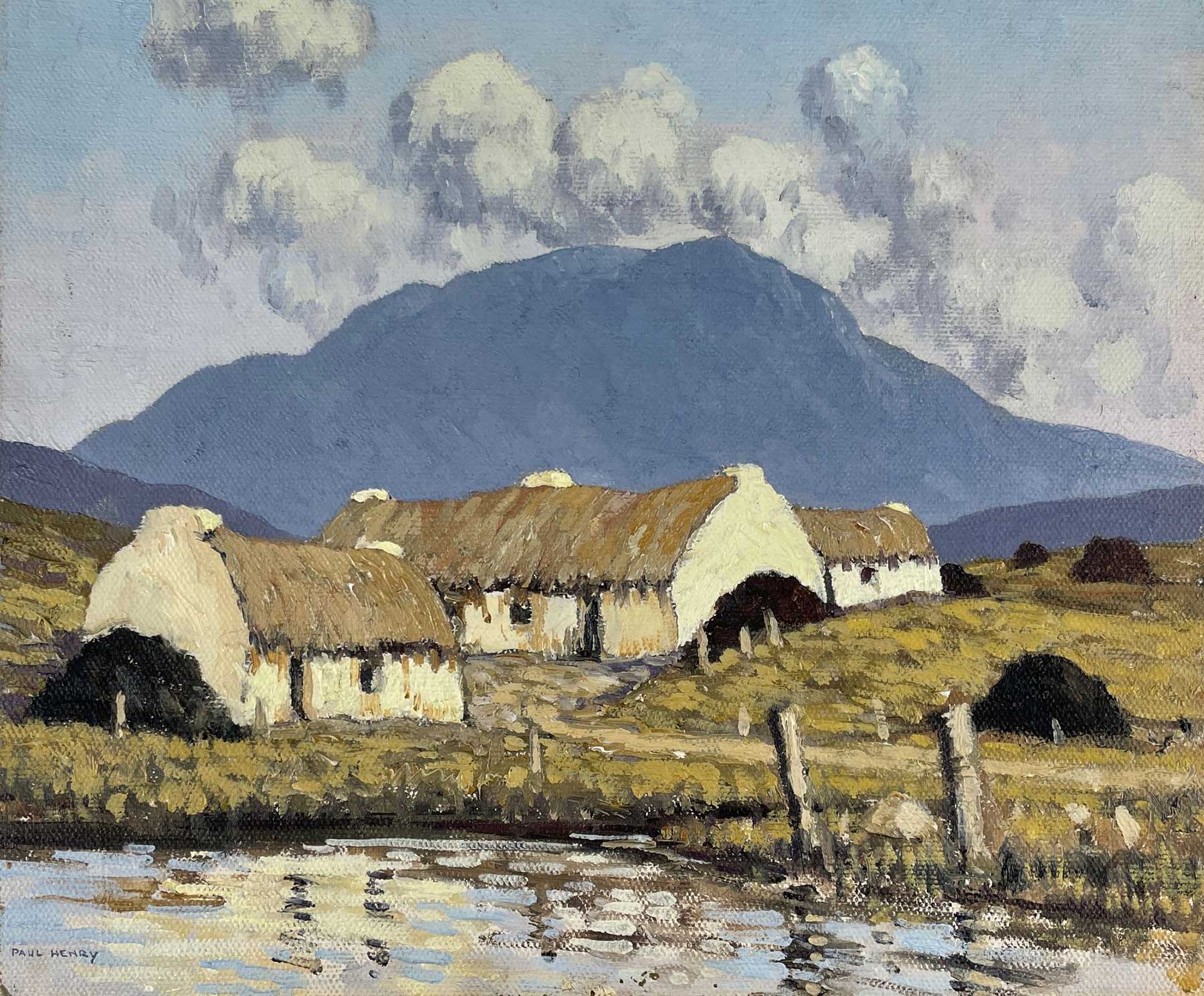
This month's palette is drawn directly from the west of Ireland landscape that Paul Henry spent a decade learning to see. He worked with a restrained, muted range, not because the landscape lacked drama, but because he understood that the drama lived in tone and light rather than in bright color. His palette captured what one critic called "the mystery of dawn," that particular quality of Atlantic light that shifts fast and refuses to be pinned down.
Atlantic sky blue anchors the palette, a cool, soft blue that reads like early morning light on still water. Soft purple drifts through the distant mountains and the shadowed bellies of clouds, that particular tone that appears when Irish light falls on forms far away. Storm cloud grey moves through the composition like weather, carrying mood and atmosphere. Turf brown grounds everything, dark and earthy, the color of cut peat stacked against the wind. Cream white lifts the clouds, those enormous cumulus forms that Henry painted with such confidence and scale. A pale golden ochre appears quietly in the distance, where the sun drops low between cloud formations and catches the horizon. And then there is that yellow green, the particular brightness of Irish grass after rain, the color that makes the west of Ireland look like nowhere else on earth. It sits in the foreground like a shock of life against all that cool grey and purple.
Work with the blues and greys as your foundation. Let purple settle into the far distance and the cloud shadows. Allow the yellow green to appear in the land closest to you, bright and insistent. Keep the ochre rare and intentional, a single streak of warmth in an otherwise cool composition. This is a palette that rewards patience. It asks you to work in close tones, to find the drama in subtle shifts rather than bold contrast.
Like Henry himself, trust the restraint. The wildness is already there.
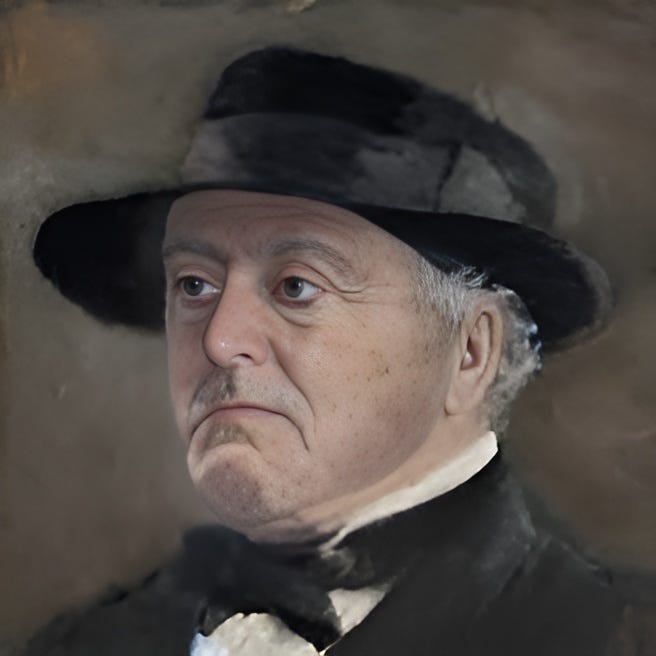
In the summer of 1910, a young painter named Paul Henry stepped off the Midland Great Western Railway train at Achill Sound, off the coast of County Mayo. He was thirty-four. He had come for a two-week holiday on the recommendation of friends. He had a return ticket to London in his pocket.
He didn't use it.
Standing on a rocky point called Gubalennaun, watching the Atlantic break against the western edge of Ireland, Henry made what he later described as one of his quick decisions. He took the ticket out of his pocket, tore it into small pieces, and scattered the fragments into the sea.
He stayed on Achill for nearly a decade.
That moment, dramatic as it sounds, was not really a beginning. It was a recognition. Henry had been preparing for the west of Ireland his whole life without knowing it. The decision to stay was simply the moment he caught up with what was already true.
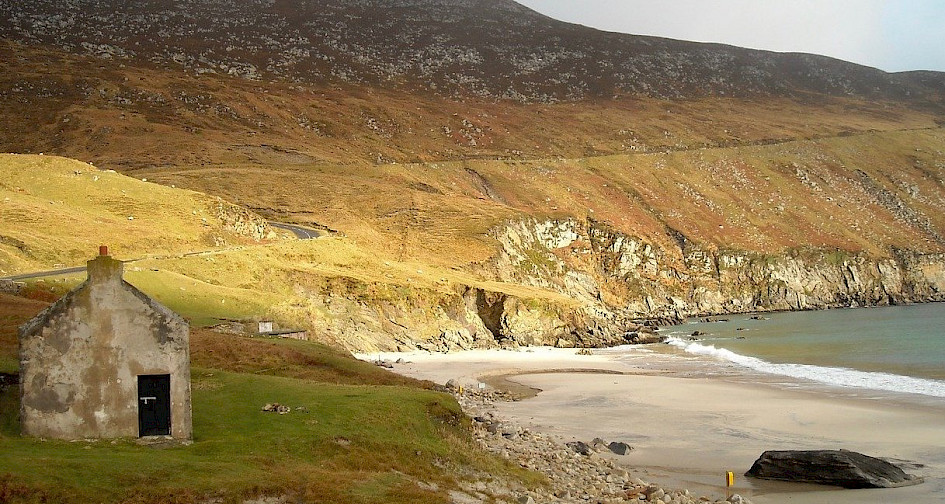
Henry was born in Belfast in 1876, the son of a strict Baptist minister. His upbringing was, by his own account, narrow and religiously austere. The art world held no interest for his father, and Henry's early ambitions to draw were nurtured almost entirely outside the home, first at Methodist College Belfast, then at the Royal Belfast Academical Institution.
When his father died in 1891, the path forward looked closed. A friend gave him free drawing lessons. He apprenticed at a damask company as a designer. He found his way to the Belfast Government School of Art. And eventually, with the help of a cousin who provided the money, Henry escaped to Paris in 1898.
Paris changed him. He studied at the Académie Julian, then switched to Whistler's Académie Carmen. Whistler's influence would stay with him for the rest of his life, particularly the master's instruction to set down observations in closely modulated tones using simple, direct terms. Henry also absorbed the Post-Impressionist work of Cézanne, Van Gogh, and Gauguin, and studied Millet's paintings of peasant life at the Louvre.
The seeds were being planted. He just didn't know yet what was going to grow.
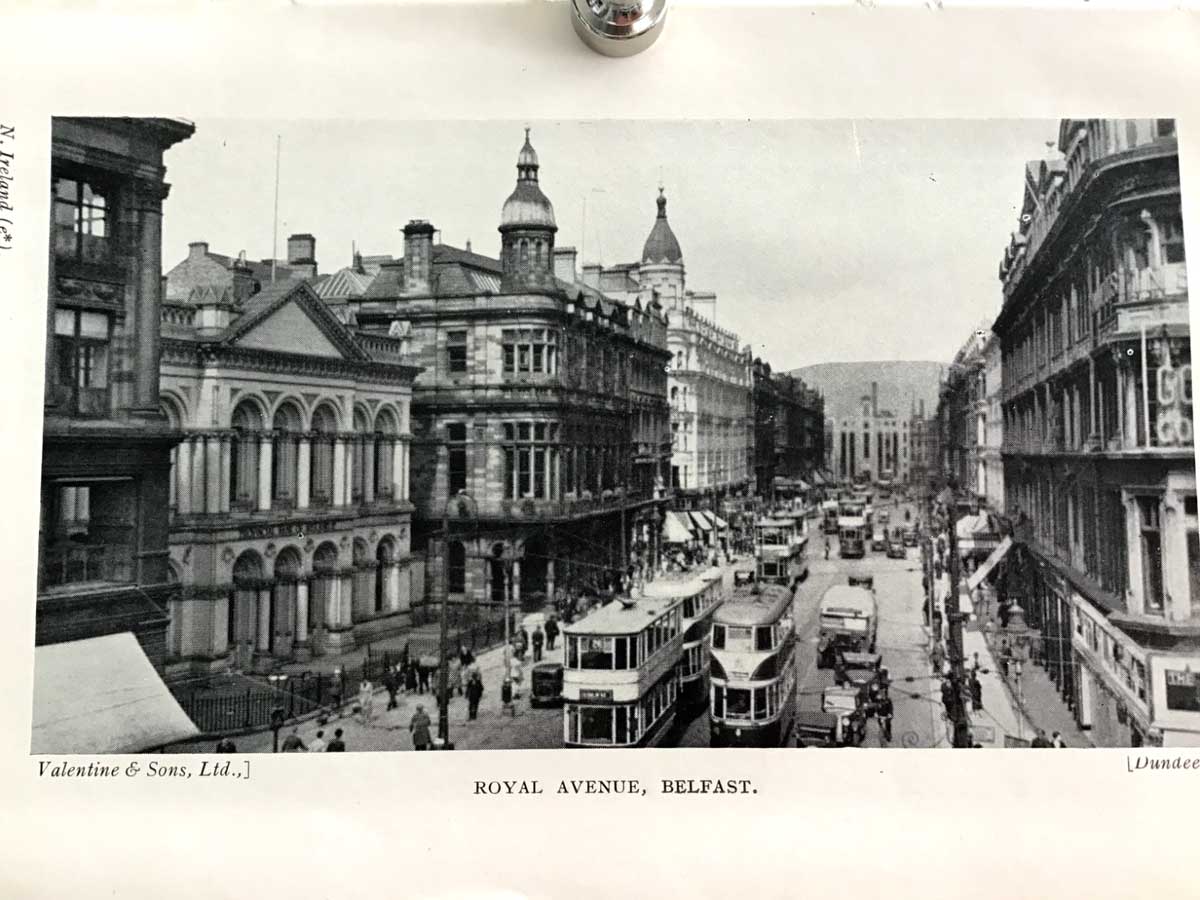
When Henry arrived on Achill in 1910 with his wife Grace, also a painter, he wrote that the island called to him as no other place had done. He described it later as a windswept island at the back of the beyond. The phrase tells you something about how he saw it. Remote. Edge of the world. Beyond.
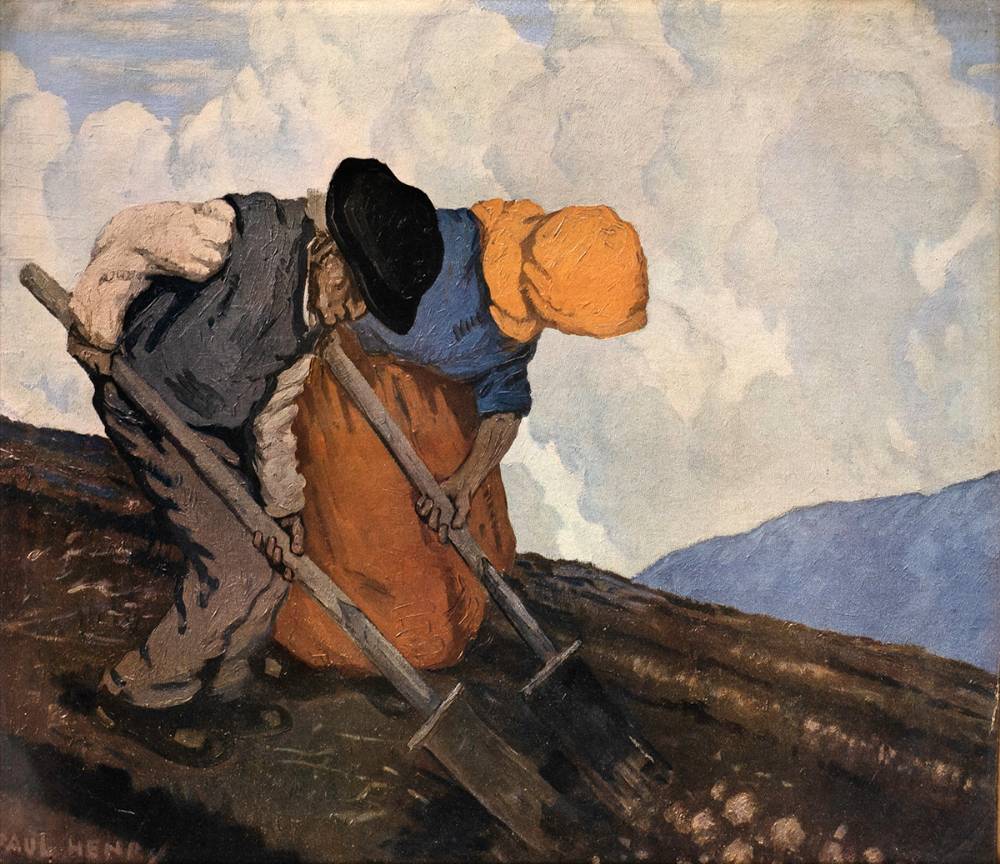
His first paintings on Achill focused on the people. Influenced deeply by Millet, he sketched the islanders at work, surreptitiously sometimes, in the fields. Digging potatoes. Cutting rye. Fetching turf. Launching the curragh to go fishing. Watching a dance. The Potato Diggers, one of his most famous early paintings, glorified this hard manual labor with a monumental weight that reminded critics of Millet's L'Angélus.
But over time, something shifted. The figures in his paintings grew smaller. Then disappeared entirely. The land itself became the subject. Not because he stopped caring about the islanders, but because he began to understand that the landscape held something he couldn't reach any other way.
Sean O'Faolain, in the foreword to Henry's autobiography, wrote that Henry was "always painting the same thing; always the one thing — light caught in a flux, a moment's dazzling miracle. His pictures are amazingly mobile with this miracle of light. He is the least static painter I know."
Light caught in a flux. That was the project.
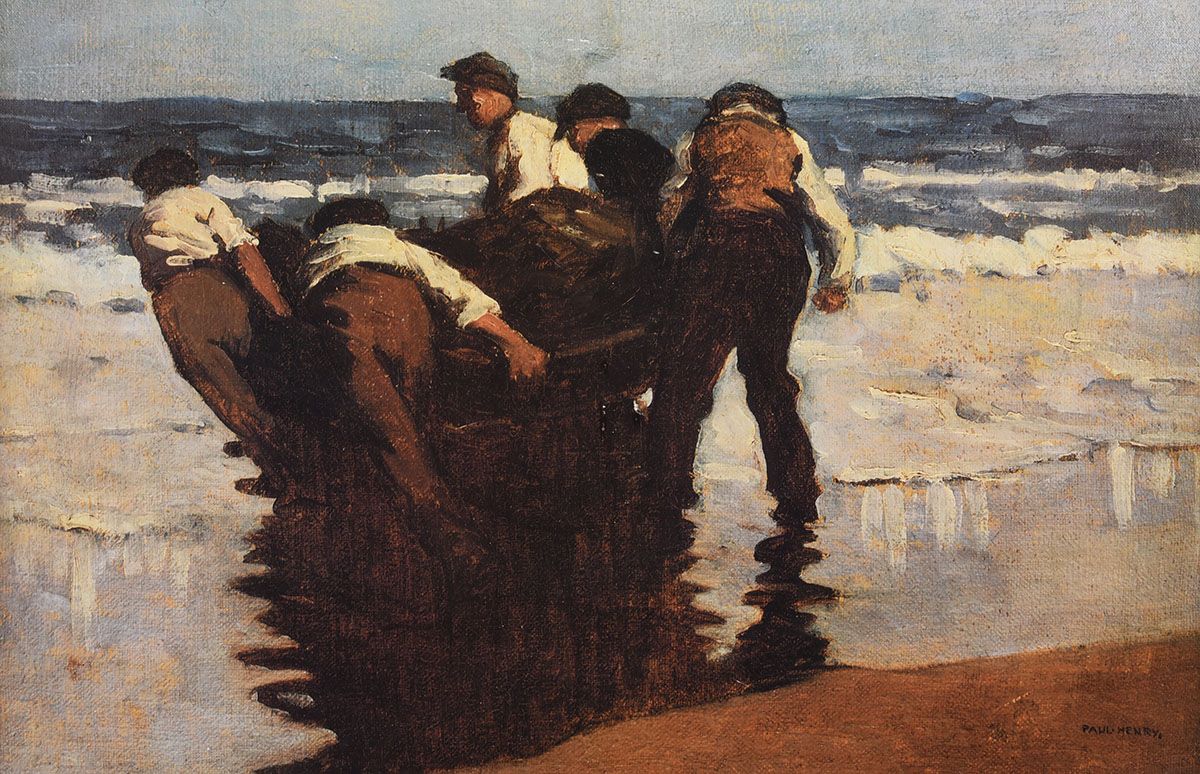
Henry's method was deceptively simple. He applied paint thinly, evenly, and precisely. He worked in close tones rather than bold color contrasts. He focused on the relationship between the few essential elements of a scene, usually mountain, lake, sky, and turf, often reducing the foreground to a narrow band so that the sky could carry most of the composition.
His palette stayed disciplined throughout his career. Muted blues and greys, earth browns, soft purples in the distant mountains, cream and white in the cumulus clouds, occasional streaks of gold where the sun broke through. He suffered from red-green color blindness from 1910 onward, which may have shaped his preference for what he called the "mystery of dawn."
What he was after was tonal harmony. The idea, inherited from Whistler, that a painting holds together not through dramatic contrast but through the careful relationship of close values. A grey can sit next to a blue and create more atmosphere than a green next to a red ever could, if the artist has the patience to find the exact tone.
This is one of the reasons his paintings still feel so calm to look at. They are not arguing with themselves. Every element belongs to the same family of light.
Henry's life was not easy. The years on Achill strained his marriage to Grace, partly because the island offered her less than it offered him. They left in 1919 and the marriage eventually ended.
His success in the 1920s and 1930s, when he became Ireland's best known artist and his Connemara landscapes were used on railway posters across Britain, brought its own complications. The demand for paintings led to repetition. Critics later accused his later work of becoming formulaic, and there is some truth in that. But the body of work from his Achill years and the early 1920s remains extraordinary.
He lost most of his sight in 1945. He never painted again. He spent his final years dictating his autobiography, An Irish Portrait, to his second wife Mabel Young. He died in 1958.
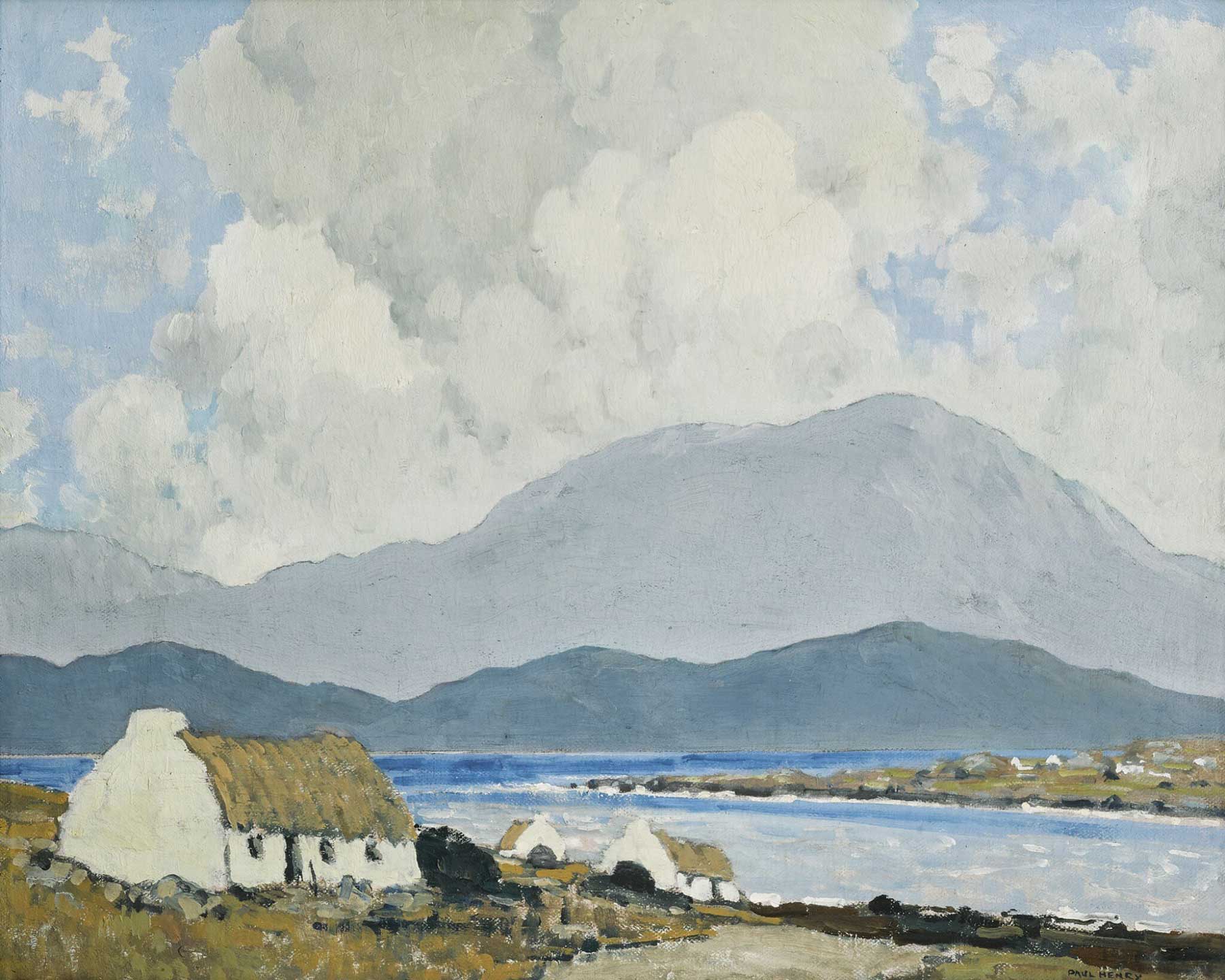
What strikes me most about Henry, looking at his work and his life now, is the willingness. The willingness to recognize a landscape that called to him, and to actually answer. The willingness to stay long enough for the place to teach him something. The willingness to abandon a more commercially promising career in London for an island at the back of the beyond.
There is courage in that. He didn't tear up that return ticket because he was being theatrical. He tore it up because he had recognized something true and didn't want to risk talking himself out of it later.
Most of us have stood at our own version of Gubalennaun. A moment when something in our creative life calls to us with a clarity we cannot easily explain. A pull toward a place, a subject, a way of working that doesn't fit our existing plan. The temptation in those moments is always to stay practical. To use the return ticket.
Henry teaches us what becomes possible when we don't.
He also teaches us about restraint. About the discipline of working in close tones, of saying less, of trusting that the wildness is already in the landscape and doesn't need to be amplified by the painter. "He recognised the singular beauty of the landscape and the light in the West of Ireland," one critic wrote, "and he learned to articulate this using his own palette of muted colours."
He learned. That is the operative word. None of this was instant. Henry needed years to find his way of seeing Achill. The recognition was instant. The mastery took the rest of his life.
Henry described the west of Ireland as the back of the beyond. That phrase has been used as if it meant remote or backward, but I don't think that is what he meant. He meant beyond. Past the limits of what most people are willing to see. Past the comfortable interior. Past the well-lit studio.
He went there. He stayed. He painted what he found.
The wild call, when it comes for us, asks something similar. Not necessarily a literal island off the coast of Mayo. But a place beyond. A creative landscape that exists past whatever has been holding our attention. We may not know what it will give us until we get there.
We just have to be willing to tear up the return ticket.
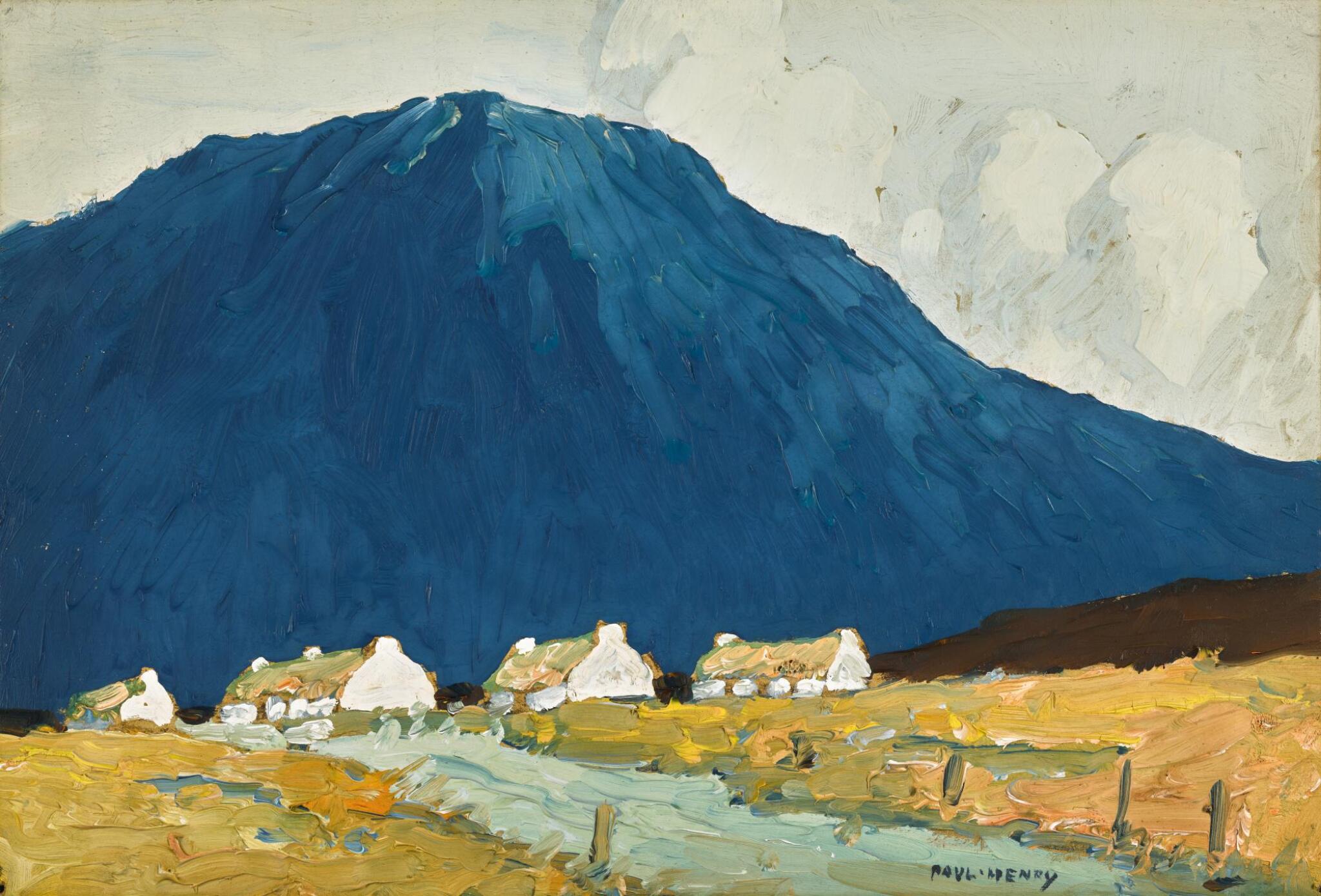
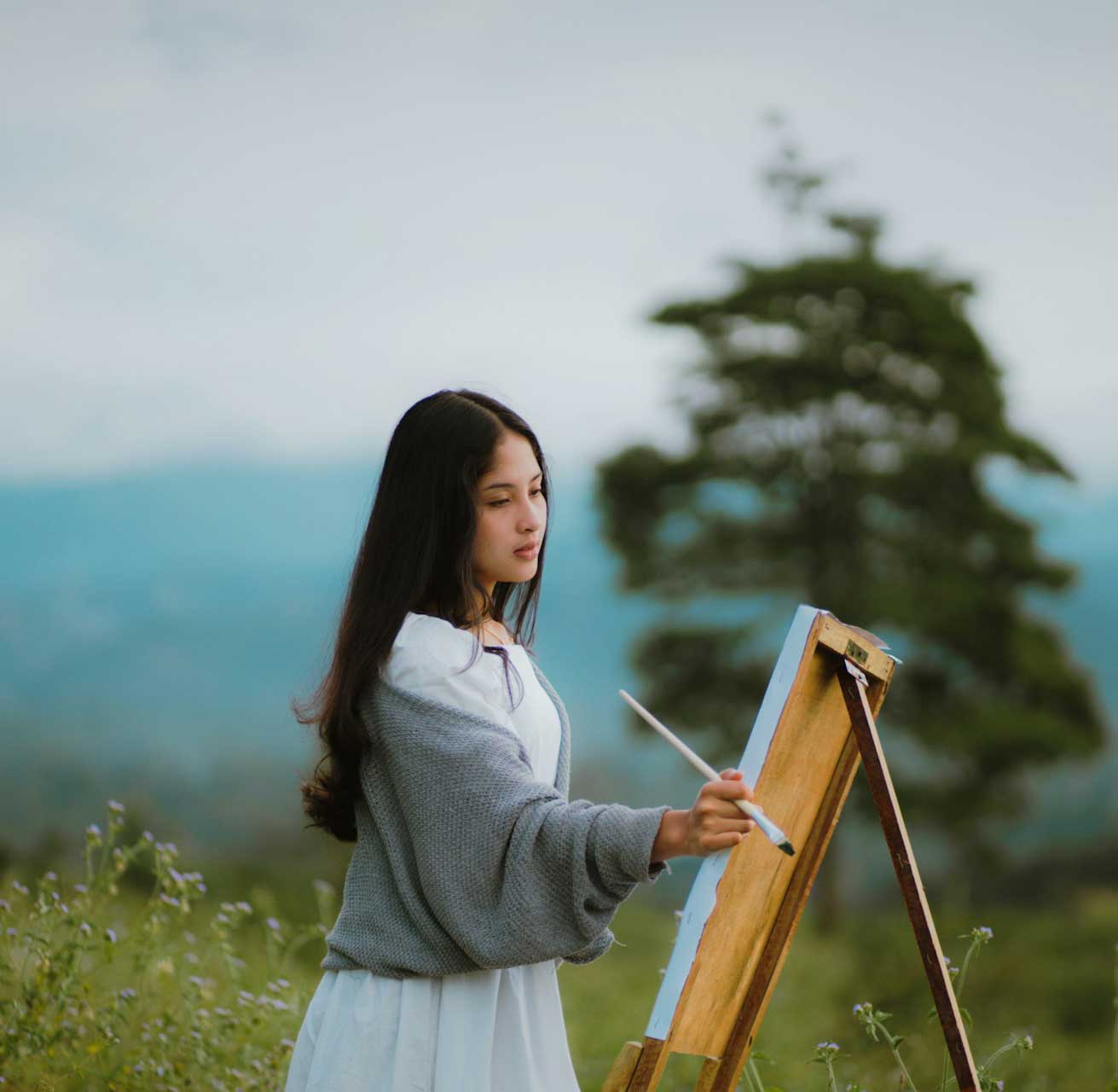
This month's first invitation is simple and a little bit brave. Take your sketchbook, or a small canvas, or whatever materials feel easiest to carry, and go outside. Find a spot where you can see some sky. It doesn't need to be dramatic. A garden, a park, a bench at the end of your street. Just somewhere beyond the four walls of your studio.
Set a timer for thirty minutes and work from what is directly in front of you. Don't plan the composition too carefully. Let your eye settle on what catches it first and begin there. If the light changes while you work, let it change. If a cloud moves through your composition, follow it or leave it. The point is not a finished piece. The point is the experience of working with what won't hold still.
This is exactly what the painters of the Atlantic edge were practicing. Not control. Responsiveness.
Reflect: What surprised you about working outside? What did you notice that you wouldn't have noticed indoors? Did the lack of control feel uncomfortable, freeing, or both?
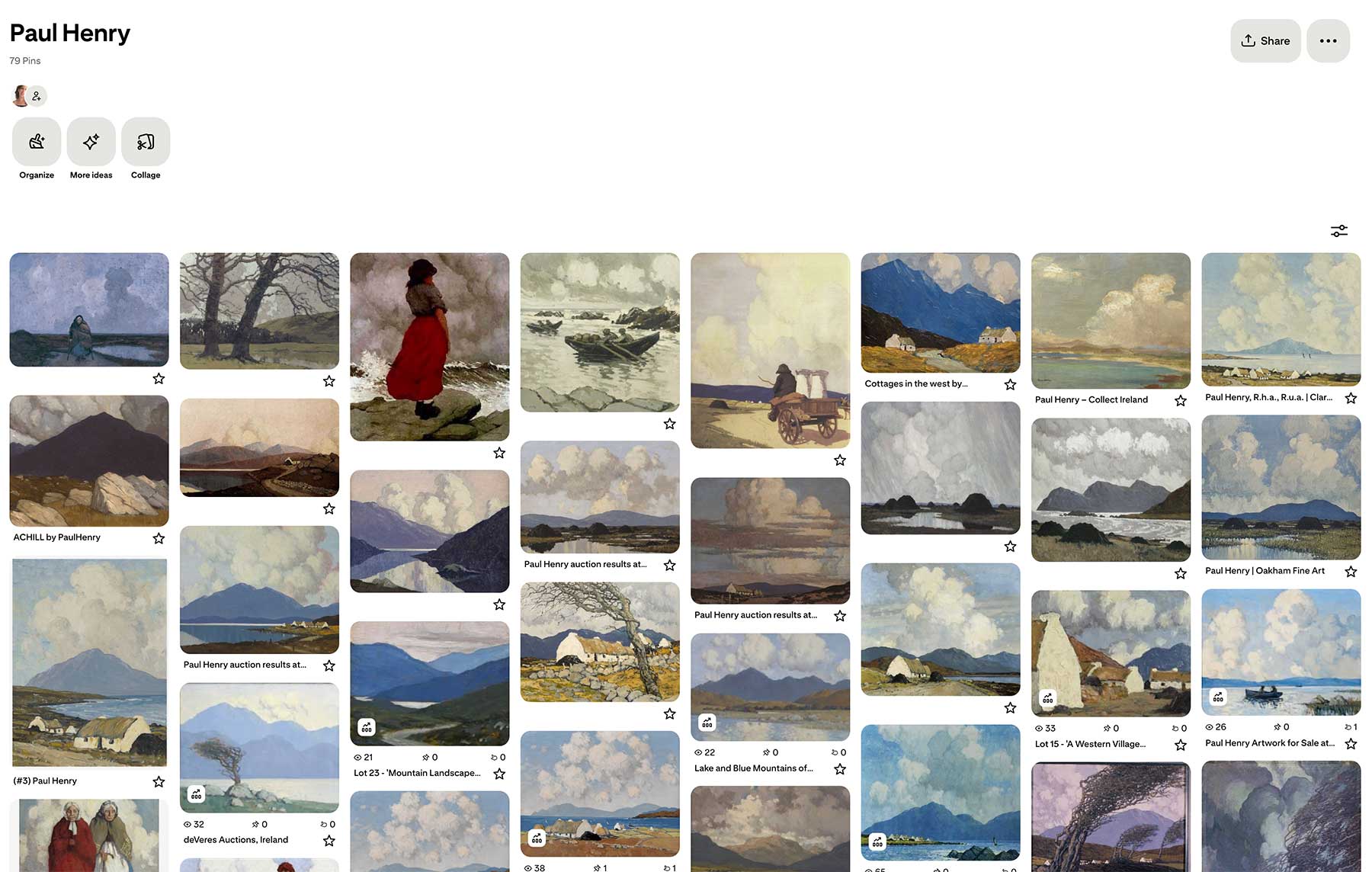
Paul Henry's clouds are one of the most recognizable things about his work. Enormous, billowing cumulus forms that take up two thirds of the canvas, painted in cream and white with soft grey shadows underneath. They are not decorative. They are the emotional center of the painting.
Choose a reference image of a Paul Henry landscape, either from this issue's slideshow or from my gallery of skies on Unsplash.
Spend a few minutes looking at how he handles the sky before you begin. Notice how much of the composition it occupies. Notice the way the clouds have weight and shadow beneath them. Notice how simply he describes them, with broad flat strokes rather than fussy detail.
On a fresh page, work just the sky. Use whatever medium feels natural to you. Focus on keeping your marks broad and confident. Work from light to dark, laying in the cream and white first, then adding the grey shadows underneath the cloud forms. Resist the urge to overwork. Henry's clouds feel monumental precisely because he knew when to stop.
You can add a simple horizon line and a suggestion of land at the bottom if you wish, but the sky is the study.
Reflect: How did it feel to give most of your page over to sky? What did you learn about Henry's restraint by trying to work the way he worked?
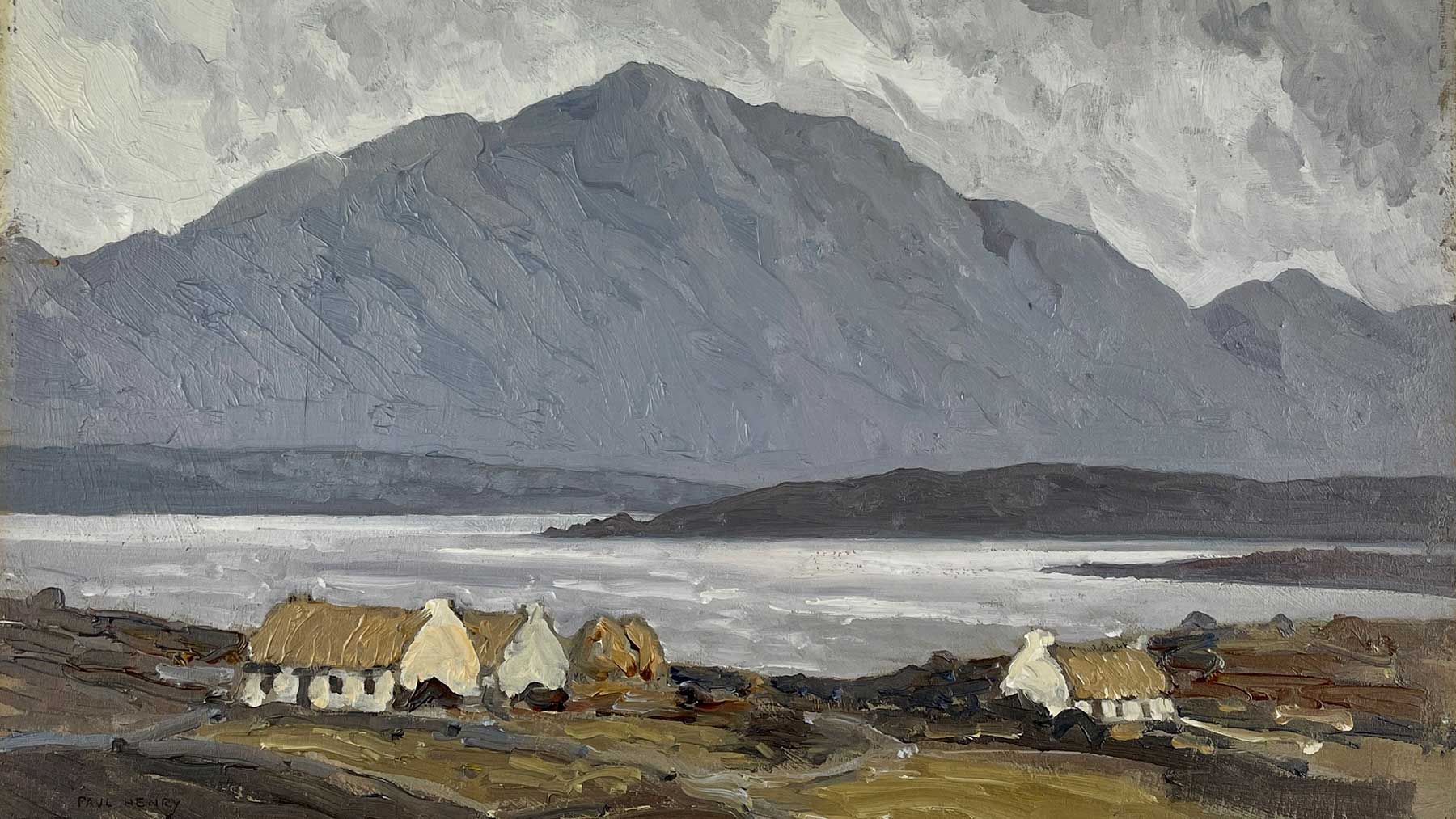
This exercise asks you to spend time with one Paul Henry painting and work a careful copy of a small section of it, focusing entirely on his use of close tones.
Choose a section of a Henry landscape that contains at least three different areas of color, perhaps where the mountains meet the sky, or where the turf foreground meets the middle distance. Look carefully before you begin. Notice how similar in value his colors actually are. The blue of the sky and the blue-grey of the mountain are close relatives. The turf brown and the shadow grey are not far apart. This is the Whistler influence at work, the discipline of finding harmony through tonal restraint rather than contrast.
Work slowly. Mix your colors carefully and test them before committing. The goal is not a perfect likeness but a genuine understanding of how Henry made close tones sing together. If your colors feel too bright or too contrasting, ask yourself which one needs to move closer to its neighbor.
This exercise will teach you more about atmospheric painting than almost anything else you could practice this month.
Reflect: Where did you struggle to find the right tonal relationship? What shifted in your understanding of Henry's palette by working this closely with it? How might close tones change the mood of your own work going forward?
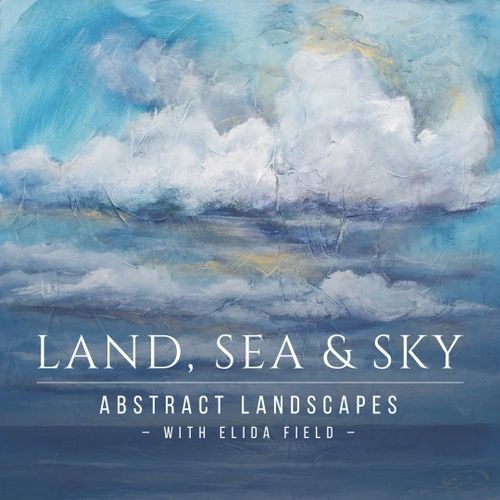
This month, we're excited to bring you *Land, Sea and Sky* by Elida Fields.
Some of the best advice Elida ever received on painting skies was to look at the clouds through a blurred lens. If you have a manual camera, try taking some pictures of skies out of focus and see how that affects your painting. Sometimes we get so fixated on painting every little detail that we lose the big picture, and the piece ends up feeling constrained and overworked. With this class, Elida's hope is to help you create an "essence" versus an "exact replication" of landscapes and seascapes.
With these new tools and techniques under your belt, you'll find that painting landscapes and seascapes will be so much more fun and free.
You can also listen to this month’s issue of the Studioworks journal. I find I love listening to books, podcasts and music while I draw, paint or go on a long walk. Enjoy.
One of my favorite things to do is to curate inspiration. From Pinterest boards to books, resources, playlists and more - I love to share anything that might facilitate learning, expansion, and sparks of curiosity! Being an artist, we naturally crave these things so here are some of this month’s picks from me to you.
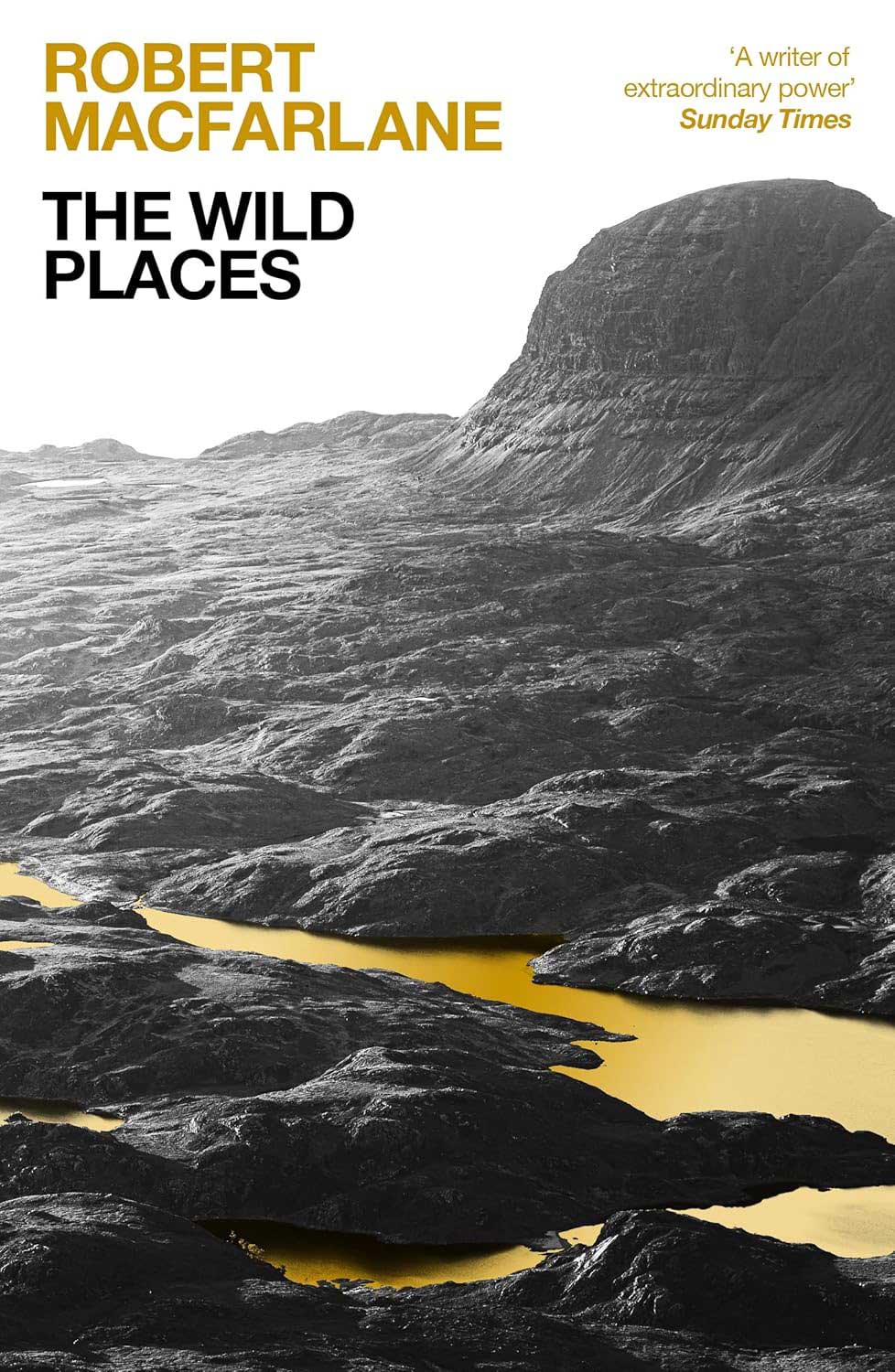
Macfarlane journeys to Britain and Ireland's last truly wild places: clifftops, moorlands, storm beaches, ancient islands. But he finds more than landscape. He uncovers what wildness does to us, how it slows us down and returns us to something essential. Intelligent, deeply felt, beautifully written. The perfect companion for summer wanderers.
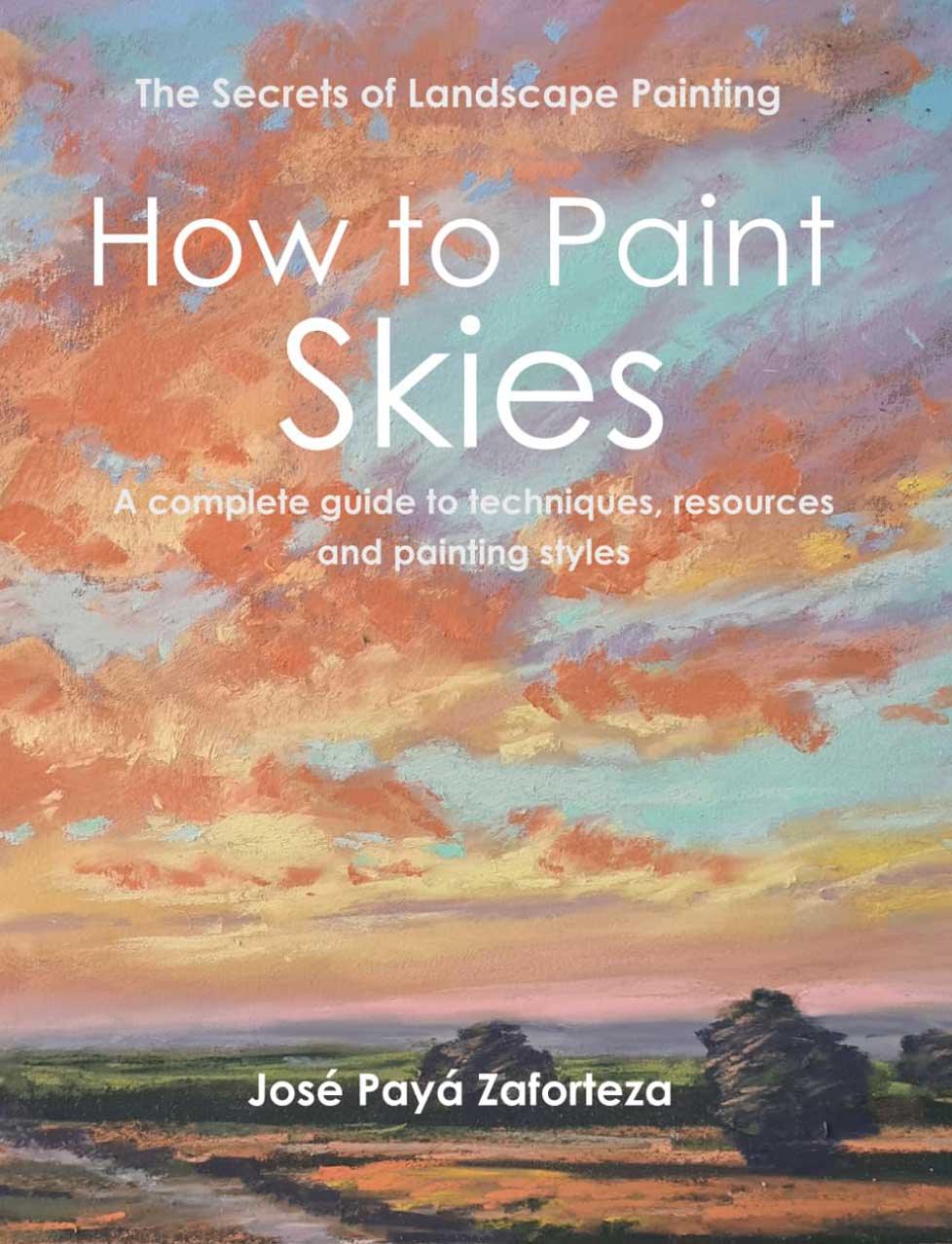
After spending time with Paul Henry's cloud-filled canvases, you may want to understand how a sky like that comes together. This comprehensive, beautiful book covers every kind of sky, cloudy, stormy, dawn, dusk, nocturnal, across oils, acrylics, pastels, and watercolor. It also traces sky painting from the Middle Ages on. A wonderful studio companion for June.
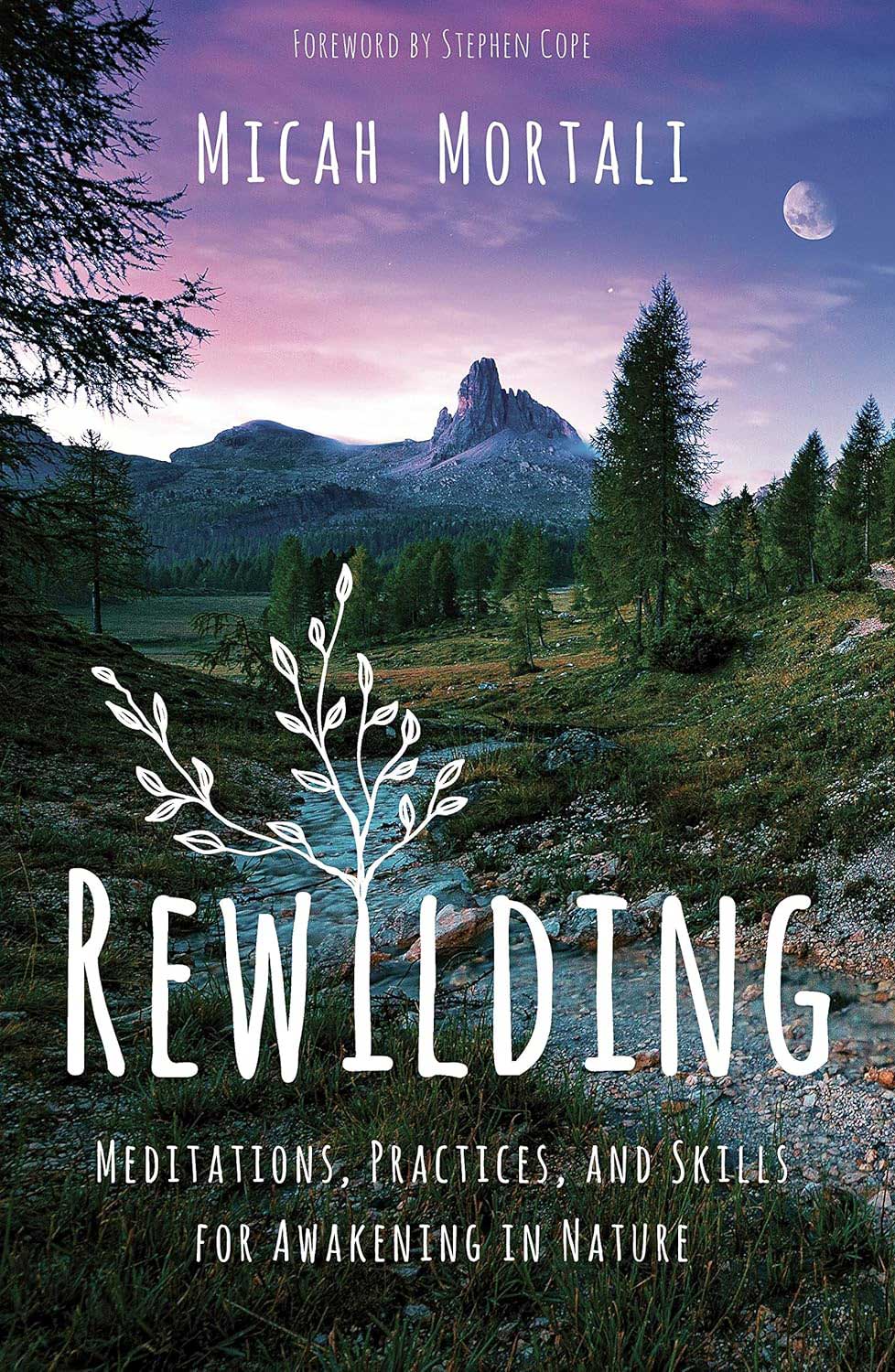
Mortali's premise is simple and profound: for most of history we lived intimately with the wild earth, and something in us still knows it. This is a practical, soulful guide back, through mindfulness, forest bathing, and ancestral skills. For artists it asks: what becomes available when nature is teacher, not scenery?
I had so much fun curating this list. I hope you enjoy!!
Classes that pair well with this month’s theme in your Studioworks Creative Library