Dear creative friends,
By the time you read this, my front door will have already opened to receive my family.
My parents fly in from Oregon on the first of May. My brother and sister-in-law too. One aunt from New Zealand, another from New Mexico. All of us converging in Portugal within days of each other, the kind of gathering that takes a year of planning and feels, even so, slightly impossible until it actually happens.
I haven't seen them in over a year. That's the strange arithmetic of a life lived far from where you began. You build something beautiful in a place that isn't home by birth, and the people you love most have to travel across oceans to find you in it.
I've been thinking about what this kind of homecoming actually means. Not the word itself, but the feeling underneath it. The way a room changes when the right people are in it. The way you can suddenly hear yourself differently when you're surrounded by people who knew you before you became who you are now.
Portugal has become home in the deepest sense. I know its light, its rhythms, which markets to take visitors to first, which hill to climb for the view that stops people mid-sentence. But home is also something that travels. It lives in the people who hold your history.
My parents are staying for a full month. I want them to slow down into the rhythm of this place. The long lunches, the unhurried evenings, the afternoon light moving across old stone walls. I want my mother to sit in my studio. I want my father to drink coffee in the square and feel no particular need to be anywhere else.
There's something I've noticed about creative work and the people we love: we make our best art when we feel held. The people who have known us longest carry a particular steadiness. They remind us of what was always there, before ambition, before reinvention, before all the useful becoming.
This month's issue is for you if you've ever felt the pull between the life you've built and the people who formed you. If you've wondered whether those two worlds can ever fully meet. They can. Sometimes they meet in a kitchen in Portugal, over too much food and a very good bottle of wine.
With love,

There is a particular kind of courage in staying put.
Not the courage of the explorer or the adventurer, though those are real enough. The quieter courage of the artist who looks at the life immediately around her and decides it is enough. More than enough. That the garden, the dining table, the children running through afternoon light, the friend reading in a chair, that all of it contains everything she needs.
This is the courage that animated some of the most quietly revolutionary art of the late nineteenth century. And it is the thread that runs through the Impressionist movement and its inheritors: artists who understood that being deeply embedded in a place and a people was not a limitation on creative vision. It was the very source of it.
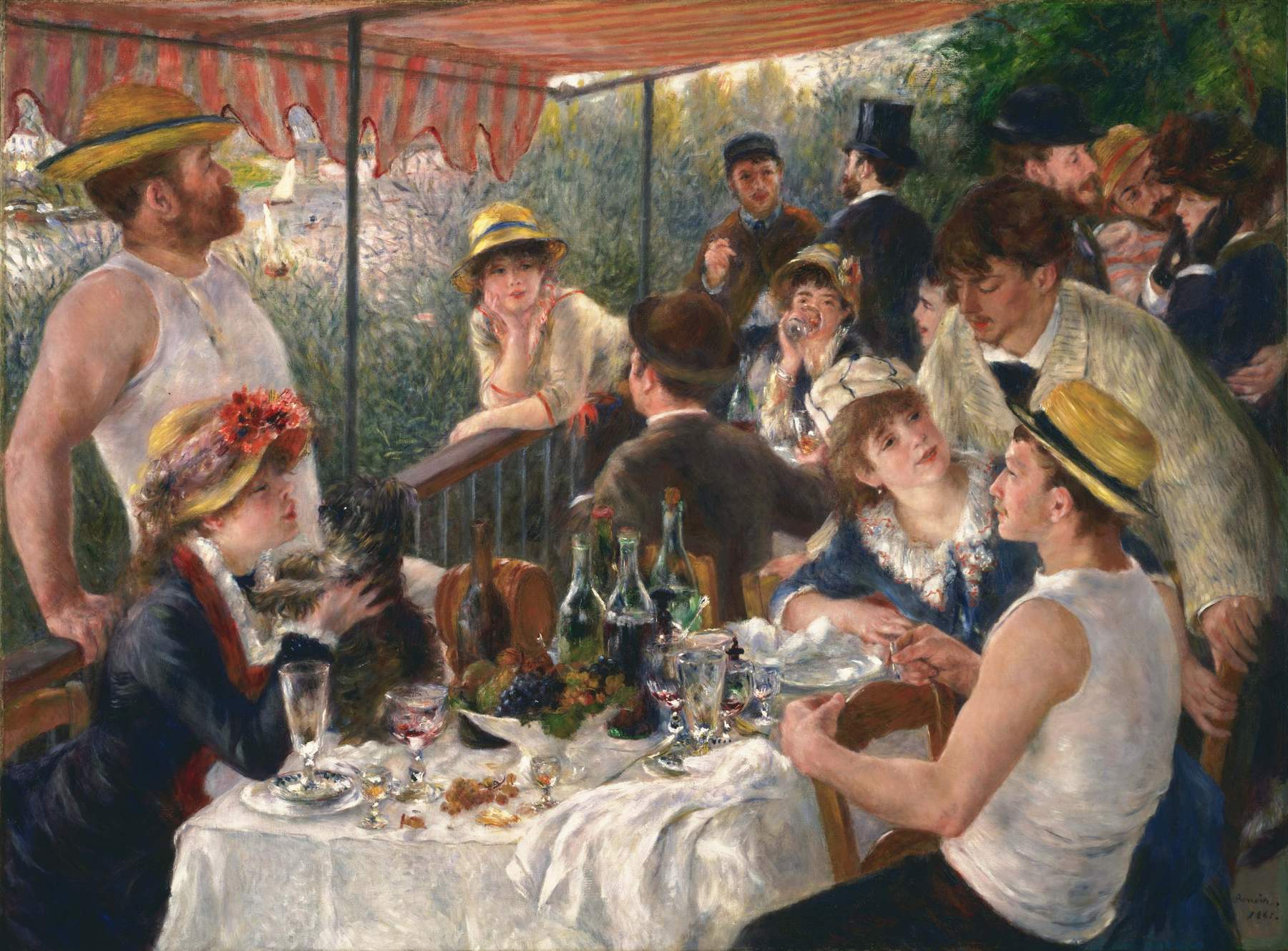
Pierre-Auguste Renoir, Luncheon of the Boating Party, 1880–81
When the Impressionists began exhibiting in Paris in 1874, they were doing something genuinely disruptive. They turned away from the grand historical and mythological subjects favored by the Academy and toward the world as it actually appeared: light on water, figures in a garden, the shimmer of a Sunday afternoon. The revolutionary act was not just stylistic. It was philosophical. They were saying that ordinary life was worthy of serious artistic attention.
Monet painted his gardens at Giverny with the same devotion he might have brought to a cathedral. Renoir painted the people he loved, at lunch, at the theatre, dancing on a Sunday. What united them was not just technique, the broken brushwork, the interest in natural light, the rejection of academic finish but a shared conviction that paying close attention to what you already had was a form of creative devotion.
Of all the Impressionists, it was Berthe Morisot who pushed most deeply into domestic life as serious subject matter. Not because she was confined to it, though as a woman in nineteenth-century Paris her freedom of movement was genuinely limited but because she found in it an inexhaustible source of visual and emotional complexity.
Her paintings of women and children in domestic interiors, gardens, and at the edges of rooms are not charming scenes of bourgeois comfort. They are precise psychological studies. The figures in her work are often caught mid-thought, turned slightly away, absorbed in their own interior lives. The rooms around them feel lived-in and specific, lit by the same broken, contingent light she applied to everything else.
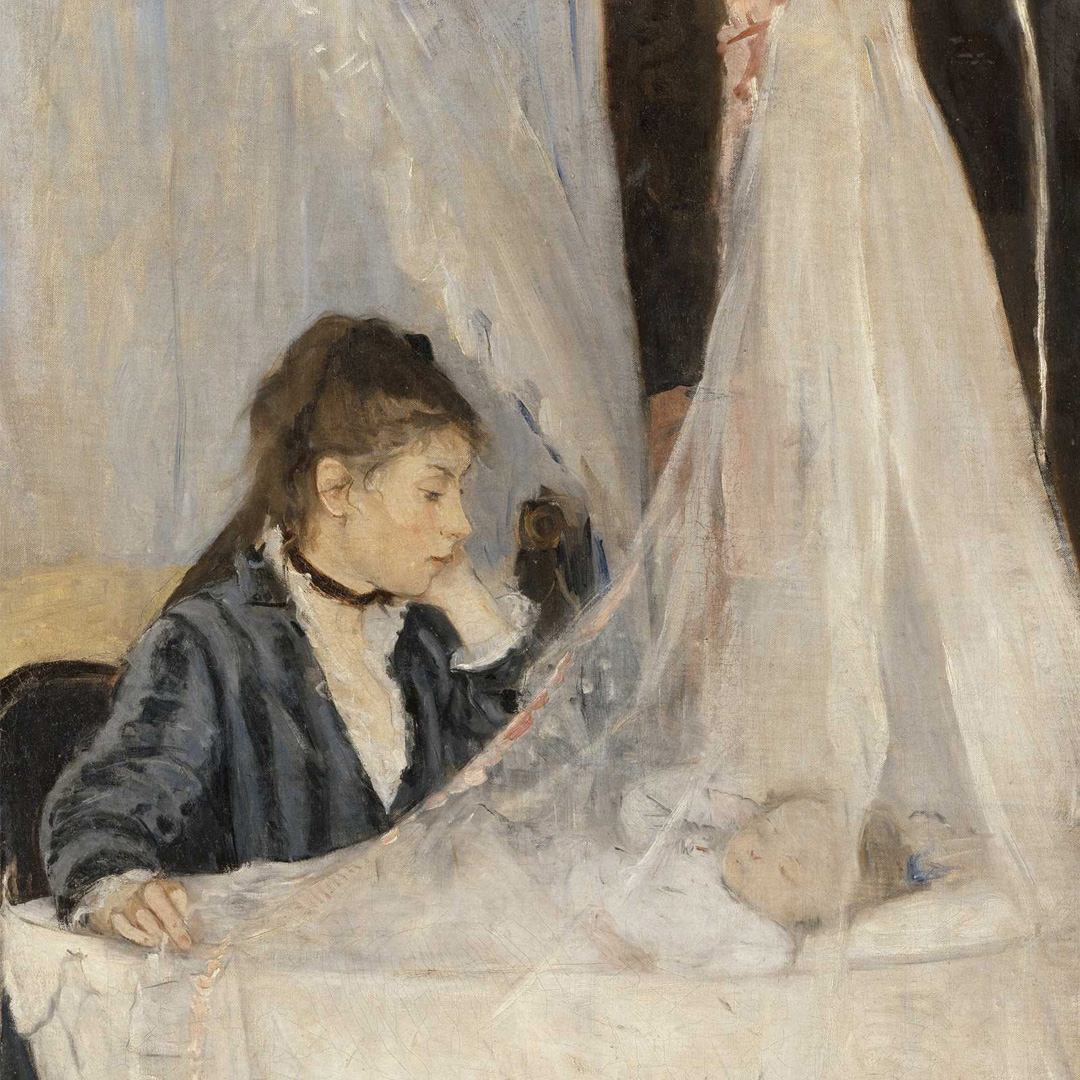
In The Cradle, painted in 1872, Morisot's sister Edma watches over her sleeping infant daughter through gauze curtains. What she captures is not just a mother and child but the particular quality of watchful stillness, the way love makes you slow down, the way you look at someone you are responsible for and feel the weight of it as something tender rather than heavy.
She painted her daughter Julie repeatedly across years and seasons with the same seriousness she brought to landscape and figure studies. These are not merely affectionate records. They are a sustained inquiry into what it means to witness another person's growing.
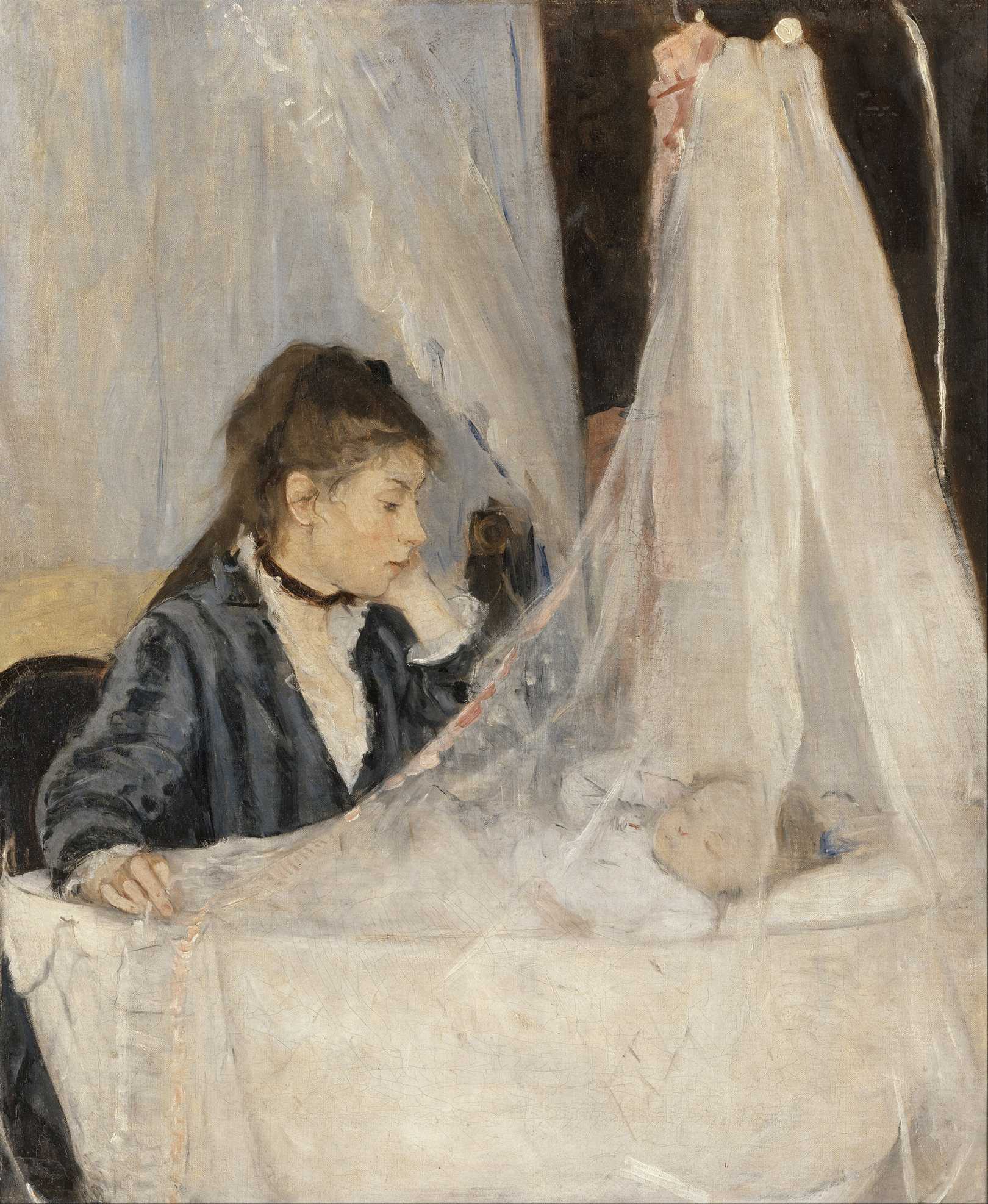
Berthe Morisot, The Cradle, 1872
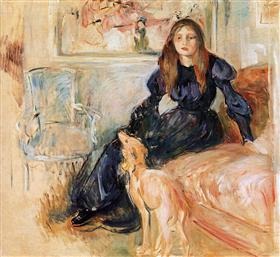
Berthe Morisot, Julie Manet with her Greyhound Laerte, 1893
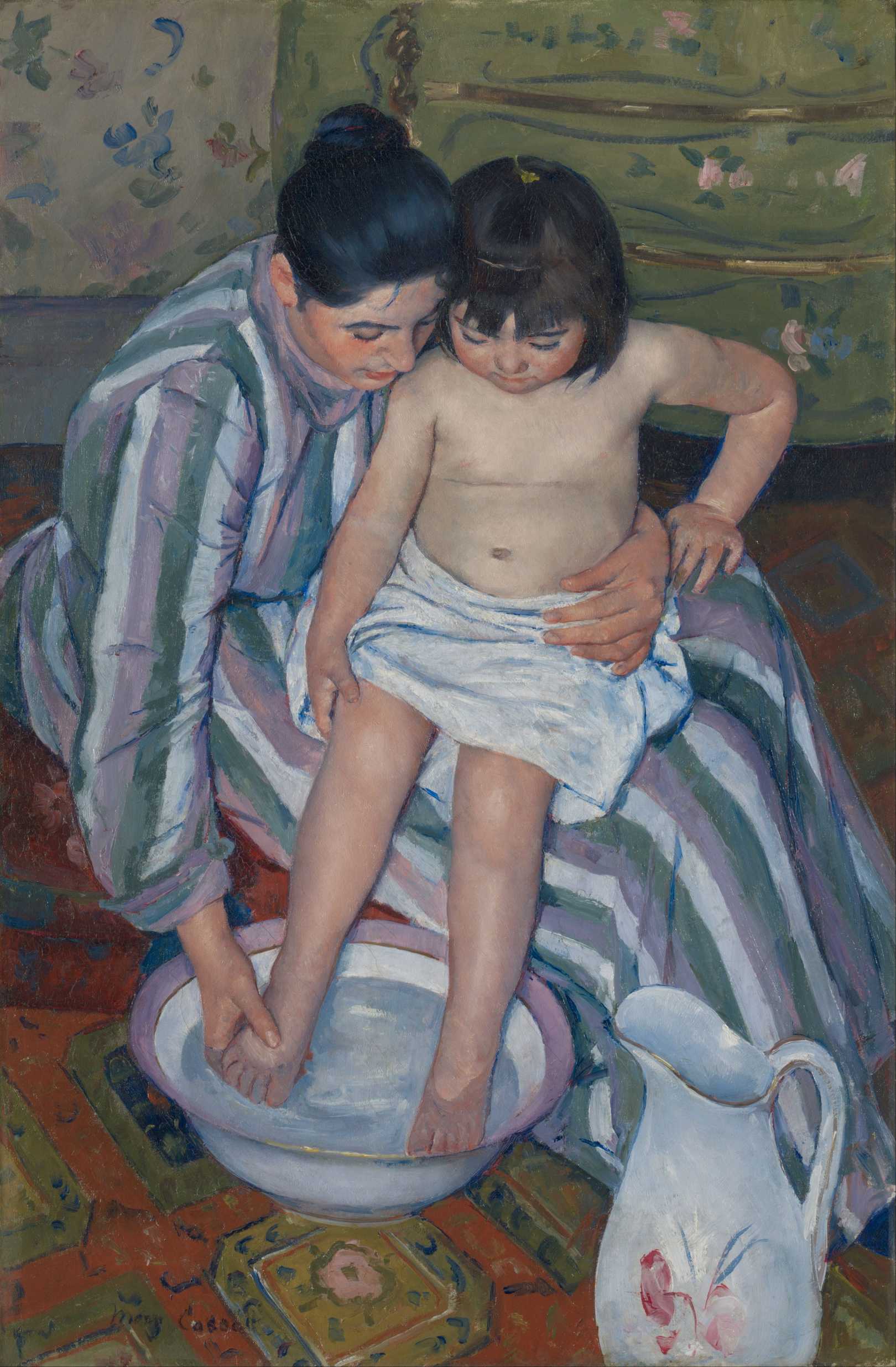
Mary Cassatt, The Child's Bath, 1893
Mary Cassatt approached similar territory from a different angle. An American who spent most of her adult life in France, she was the only American artist to exhibit with the Impressionists, and her work focused with remarkable consistency on the world of women and children — not as sentimental subjects but as a complete emotional universe.
Her paintings of mothers and children bathing, dressing, reading, and resting are among the most formally rigorous works of the movement. Deeply influenced by Japanese woodblock prints, she used flat planes of color, strong contour lines, and bold cropping to frame scenes of intense intimacy with considerable structural confidence.
What Cassatt understood was that closeness has its own grammar. The way a mother holds a child's foot. The angle at which two people lean toward each other over a letter. The geometry of two bodies sharing a small domestic space. These configurations are as visually compelling, she argued through her work, as any battle scene or mythological tableau. More so, in fact, because they are true.
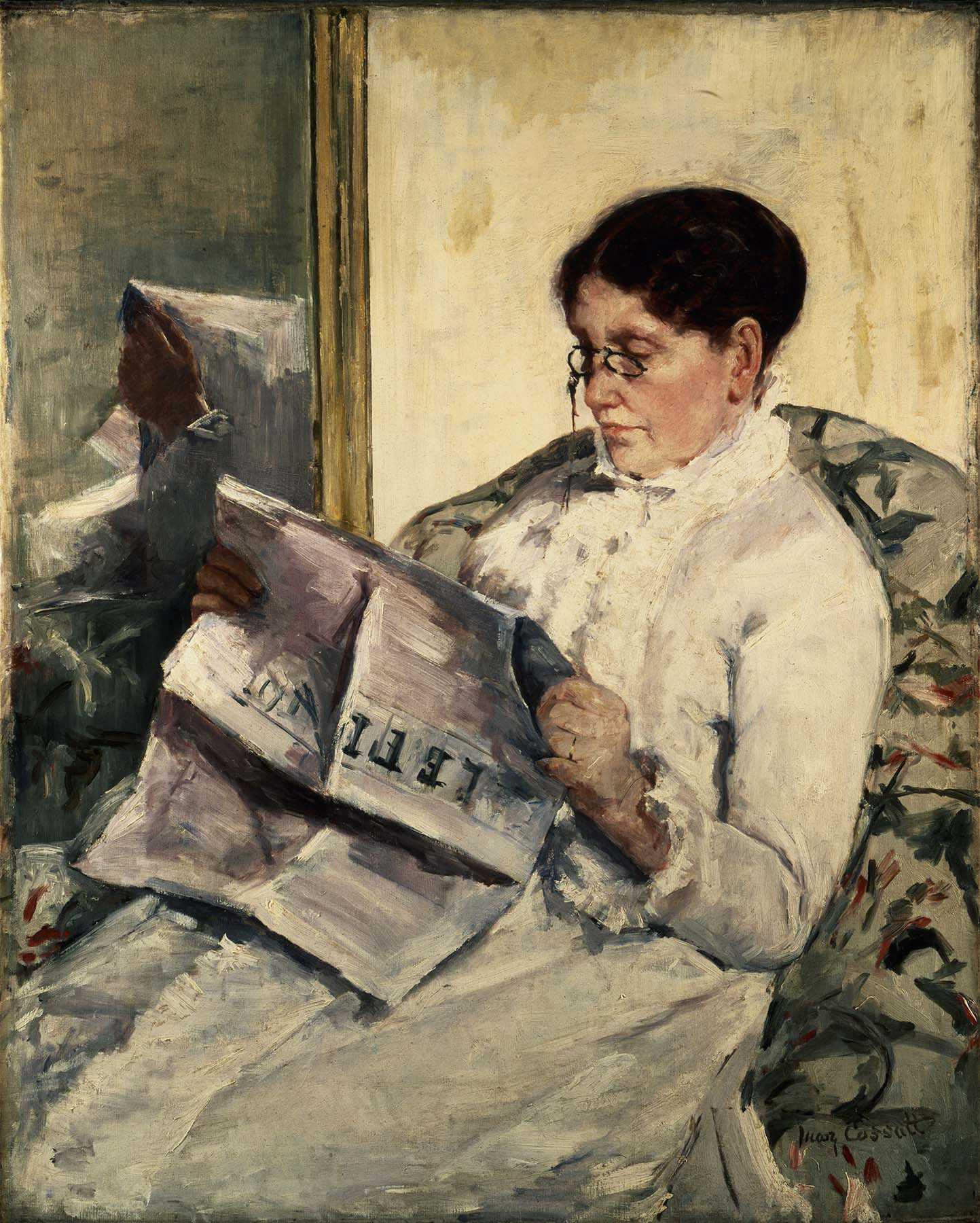
Mary Cassatt, Reading Le Figaro, 1878
For Monet, rootedness expressed itself differently. His great subject was not family but place — specifically, the places he could return to again and again, watching them change across light and season until he knew them at a level no single visit could yield.
His series of paintings, haystacks, the Rouen Cathedral facade, the Thames at Westminster, the water lilies at Giverny, are an extended meditation on what sustained looking produces. Not just information but something deeper. An intimacy with the visual world that only comes through repeated return.
He wrote once that he wanted to paint the air around things. Not the things themselves but the atmosphere that held them. That ambition required him to be in one place long enough to feel the air change. To notice how the same cathedral looked at dawn and at dusk, in winter frost and summer heat. You cannot paint the air around things from a moving train. You have to stay.
The garden at Giverny, which he designed and tended with obsessive care for more than thirty years, became his final and greatest subject. Not a backdrop for other themes but the subject itself: color and water and light in constant dialogue, endlessly shifting, endlessly worthy of another canvas.
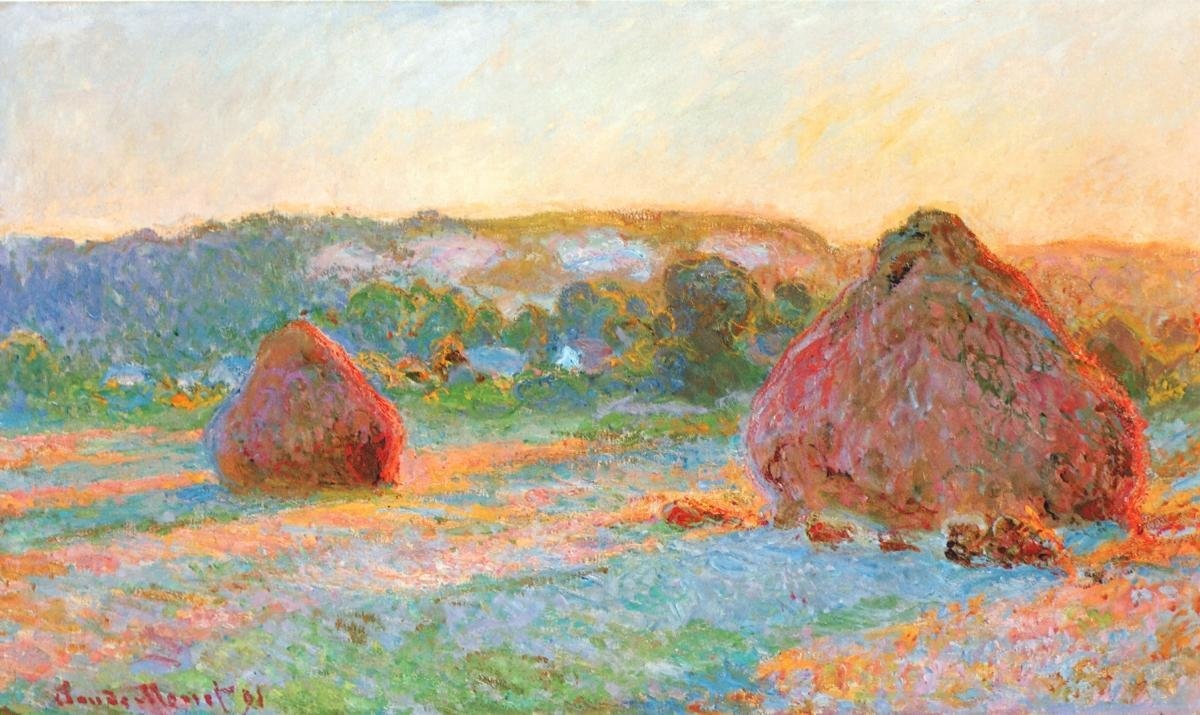
Claude Monet, Haystacks (End of Summer), 1891
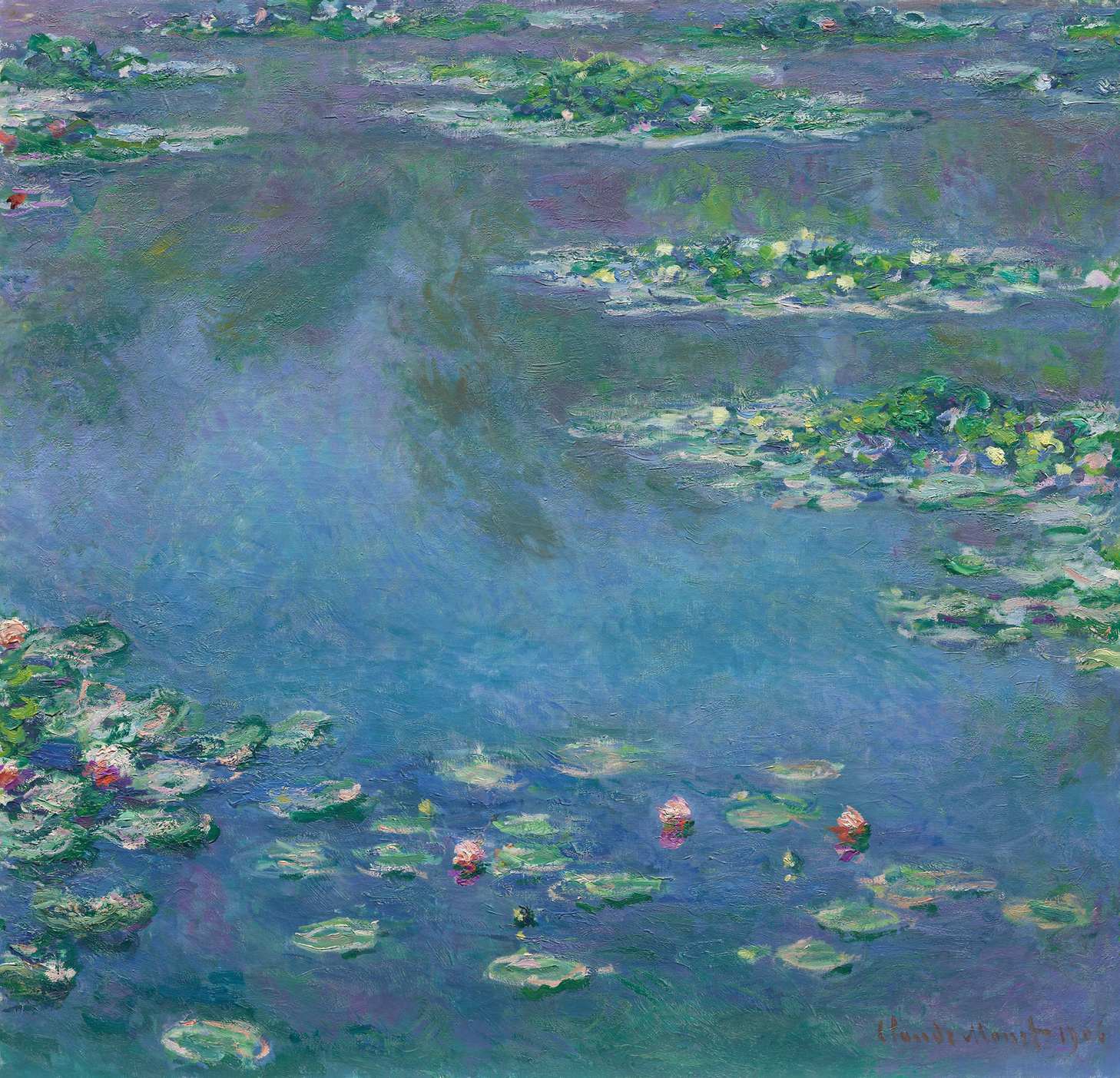
Claude Monet, Water Lilies, 1906
What the Impressionists offer us, beyond the beauty of the work itself, is a kind of permission. An argument made in paint over several decades that the life you are already living is a legitimate creative subject. That the people at your table, the garden you pass through every morning, the particular quality of light in your kitchen at seven in the evening, these are not lesser subjects awaiting a more important vision. They are the vision.
In a month shaped by the question of home, this feels worth holding. The Impressionists did not make their most enduring work by leaving everything familiar behind. They made it by looking at what they had with the deepest possible care.
You don't stop missing people. You just get better at carrying it.
In the first weeks after a move, the missing is sharp. It catches you mid-sentence, mid-meal, mid-thought. Then time does what time does, and the sharpness softens into something quieter. A low hum. A steady awareness that part of you is rooted somewhere else, that the people who hold your earliest self are living their lives in another time zone while you are living yours in this one.
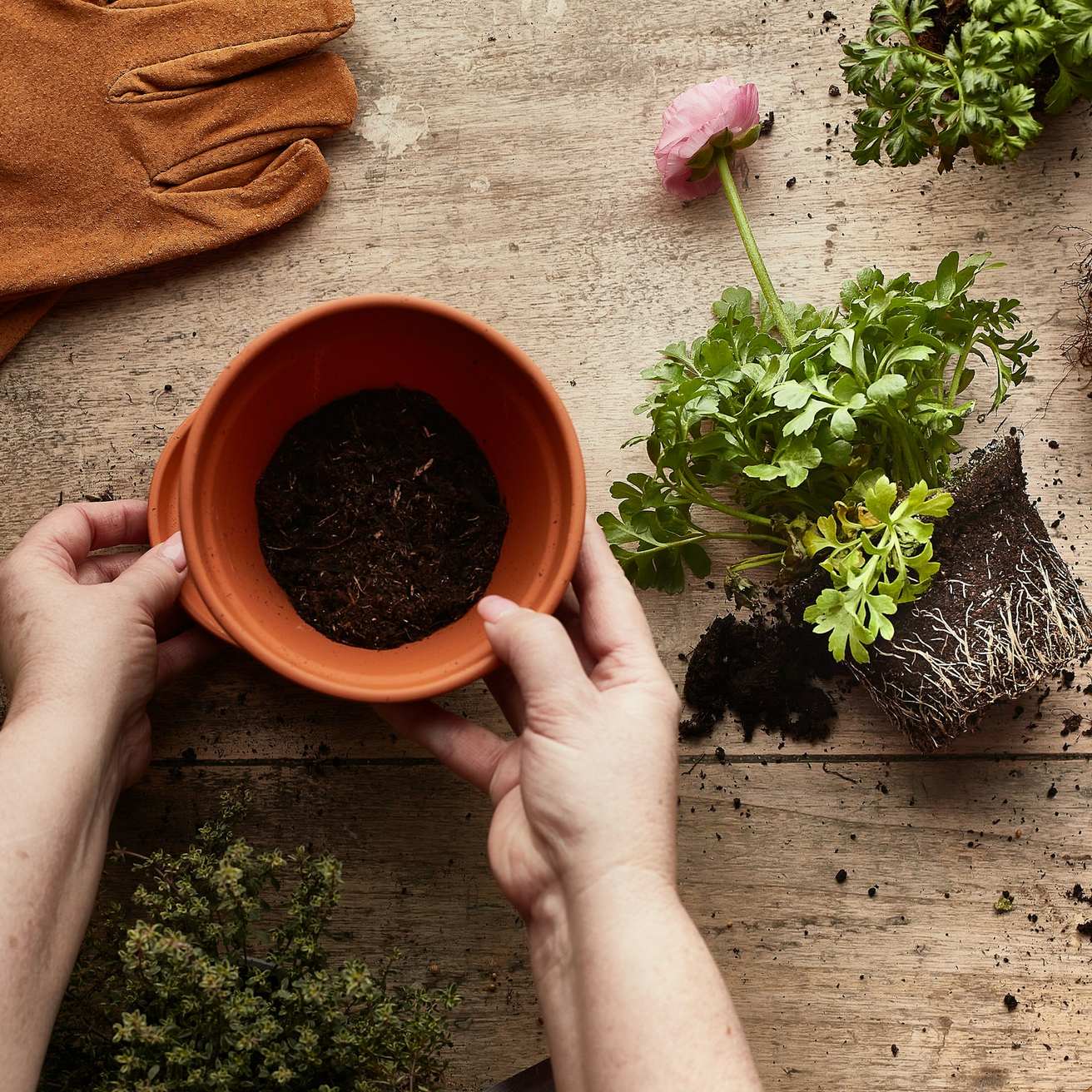
I've been in Portugal long enough now that this no longer startles me. But it hasn't disappeared either. It has simply become part of the texture of a life built far from where it began.
What I've learned, slowly and with some resistance, is that this kind of longing isn't a problem waiting to be solved. It is information. It tells you something true about what matters to you at the level below ambition and achievement and reinvention. Before all of that, you were someone's child. Someone's sibling. Someone's niece. Those connections don't dissolve because you've grown toward different light.
Painting has taught me this more clearly than anything else. The earliest influences are always present in the work. Not visible on the surface, but structural. The way I was first taught to see colour. The light in the house I grew up in. The particular grey of a Pacific Northwest sky heavy with rain. These things live in everything I make, whether I consciously invite them or not.
This is what carrying more than one home inside you does to a person, to an artist. It doesn't split you. It layers you. Each place, each set of people, each season of your life adds depth rather than division. You become someone capable of holding more than one version of home at once.
My family arrives this month. For thirty days I will watch Portugal through their eyes. I will see the market I no longer notice because I pass it every week. I will hear the language differently because they are hearing it for the first time. I will feel, for a whole month, simultaneously the person I am here and the person I was before here. Both of them real. Both of them mine.
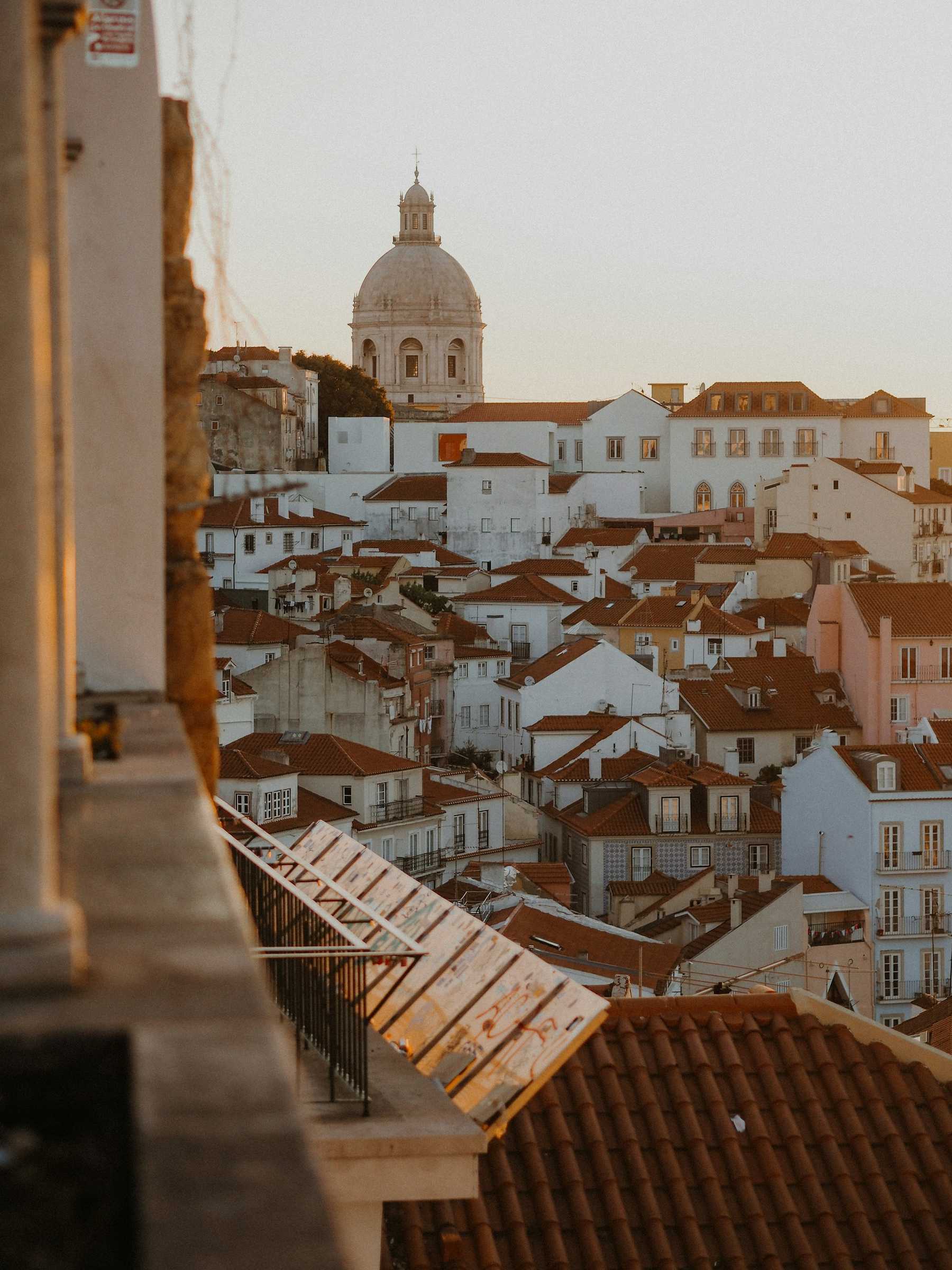
That doubling used to feel disorienting. Now it feels like richness.
If you have ever carried two homes inside you, this issue is for you. If you have ever wondered whether the life you have built and the people who formed you can ever fully coexist, I want to offer this gently: they already do. You are the place where they meet.

According to the Oxford English Dictionary, belonging is defined as:
The feeling of being comfortable and happy in a particular situation or with a particular group of people.
The state of being a member or part of something.
Belonging is not passive. It isn't simply being present in a place or near people you love. It is something more active, a quiet ongoing act of choosing. You belong somewhere because you return to it. You belong to someone because you continue to show up. It is made, and remade, through repeated acts of attention.
For artists, this has particular resonance. We belong to our practice the same way. Not through grand declarations but through the daily, ordinary act of returning to the work. Picking up the brush again. Opening the sketchbook. Staying in the room even when the room feels empty.
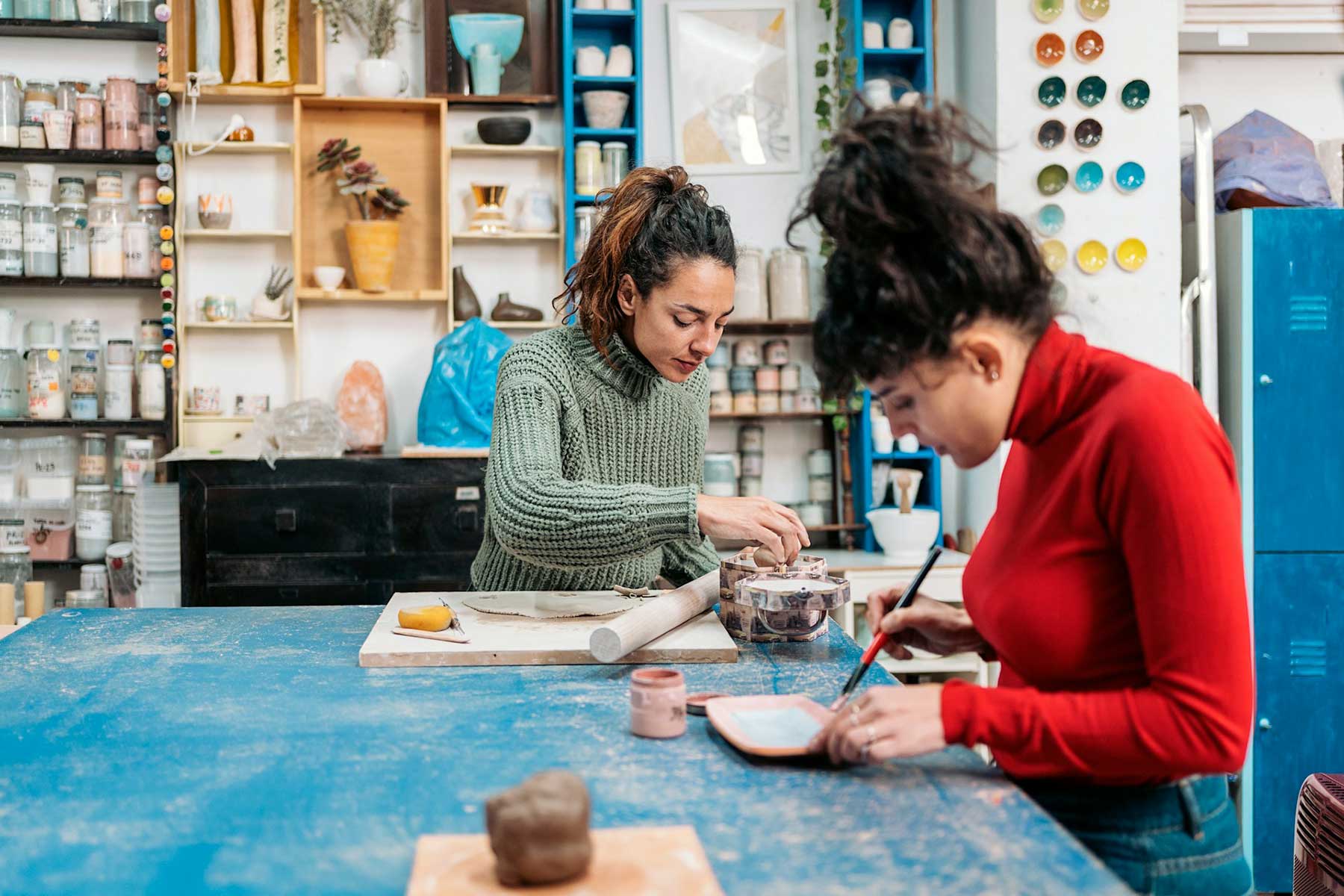
The question of where we belong creatively is one that many of us circle for years. We try on different styles, subjects, mediums, communities. Some of it sticks. Some falls away. Over time, if we pay close attention, a shape emerges, a set of recurring subjects, a palette that keeps reasserting itself, a particular mood that feels unmistakably ours.
This is creative identity forming. And like all real belonging, it isn't something you declare. It is something you discover by showing up long enough to notice what was already there.
There is also the question of artistic community, the people who witness us making. The Impressionists understood this intuitively. They showed together, argued together, supported and challenged each other across decades. Some found their people in a Parisian café. Others in a village in Normandy. A few across continents and oceans.
We need people who see us in the act of making. Not to validate every choice, but to hold the space in which the making happens.
Where does my creative practice feel most like home?
Who are the people that hold space for my work?
What subjects do I return to not because I planned to, but because I simply cannot help it?
Creative belonging is accumulated slowly, through repeated return. Through the willingness to stay with what feels true even when it seems too small, too personal, too close to home.
It is in the close and the personal that most of the best work is made. Go back to it. It's been waiting.
Let's tap into our creative intuition and do some self-reflective work inspired by our theme. Below you will see our month's Oracle/Tarot card spread. But fear not, if you are not one drawn to using oracle or tarot cards, no worries, just use the accompanying reflective questions as writing prompts for your journals!
Here's a three-card oracle spread that fits seamlessly with our monthly theme. Take a deep breath, grab a cup of tea and enjoy.
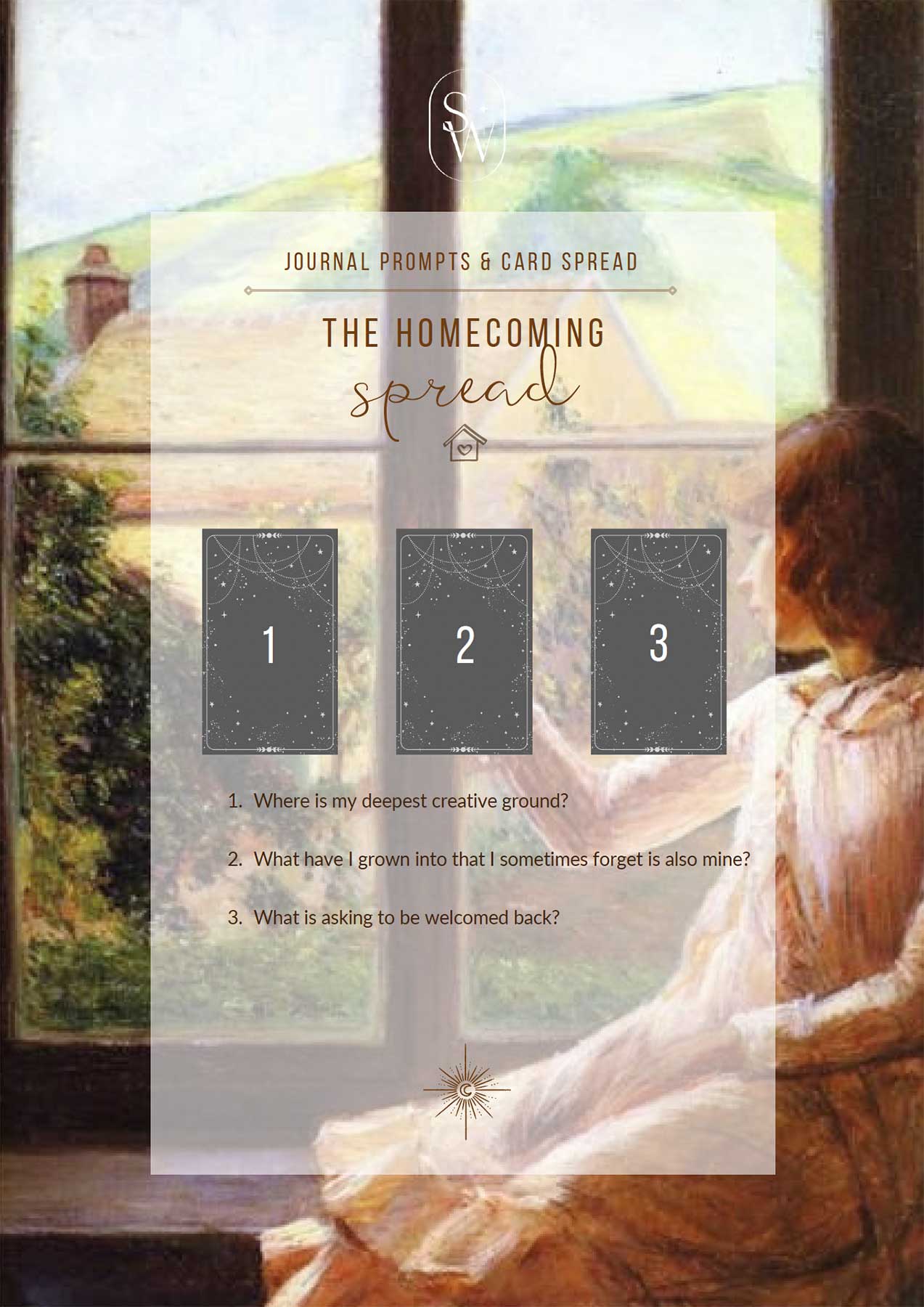
A three-card check-in for the creative soul.
Card 1: The Root
Where is my deepest creative ground?
This card points to the foundation beneath your practice. The subject, the feeling, the approach that has always been present, even when you didn't notice it. The place you return to without entirely meaning to.
Journal Prompt: What did I love to make before I had any expectations of myself?
Card 2: The Branch
What have I grown into that I sometimes forget is also mine?
This card reflects the creative life you have built, the skills developed, the identity shaped through years of showing up. The parts of yourself that have grown beyond the root but are still fed by it.
Journal Prompt: What part of my current practice would surprise the younger version of me? Does that surprise feel like loss or like growth?
Card 3: The Homecoming
What is asking to be welcomed back?
This card offers a gentle invitation. Something that belongs to you creatively that you may have set aside or quietly forgotten. Not everything needs to be retrieved but some things do.
Journal Prompt: Is there a subject, a medium, or a quality of attention I once had that I miss? What would it feel like to let it back in?
Find a quiet moment before drawing your cards. As you turn each one, notice your first response before interpreting. Pay attention to what stirs, softens, or catches in your chest. This spread works beautifully with both oracle and tarot decks and can be revisited whenever the question of creative identity feels uncertain.
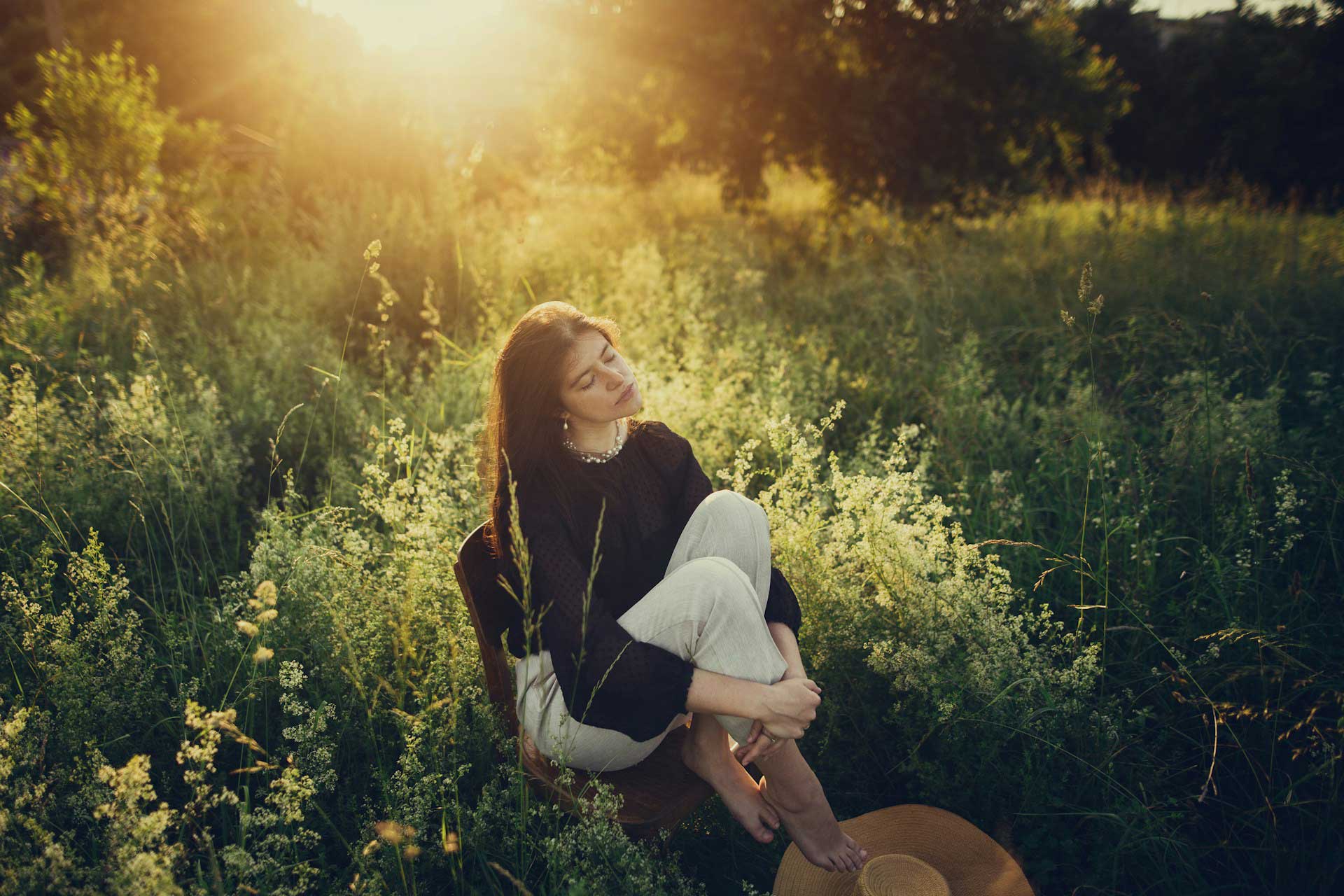
This month's meditation chose itself. When I saw the title I didn't need to think twice.
My Heart My Home feels like the quietest possible expression of everything this issue has been moving toward. Not home as geography. Not home as the people who fly across oceans to find you. But home as something you carry inside you always, available in any room, in any country, in any season of your life.
I find Rachel's meditations particularly valuable at the beginning of a creative session. Before the brush, before the sketchbook, before any decision about what to make. Just a few minutes of returning to yourself. This one feels especially right for May, a month when so much is arriving at once, when the studio might feel quieter than usual because life has filled the rest of the house beautifully.
Here's a little more information from Rachel…
This is a short and sweet but very potent heart energy experience. Leading you back to the peaceful serenity and home within, and to the patient wisdom of your heart. Sometimes, we feel lost and don't know where to turn, so here we nurture our connection within.
xo,
Rachel
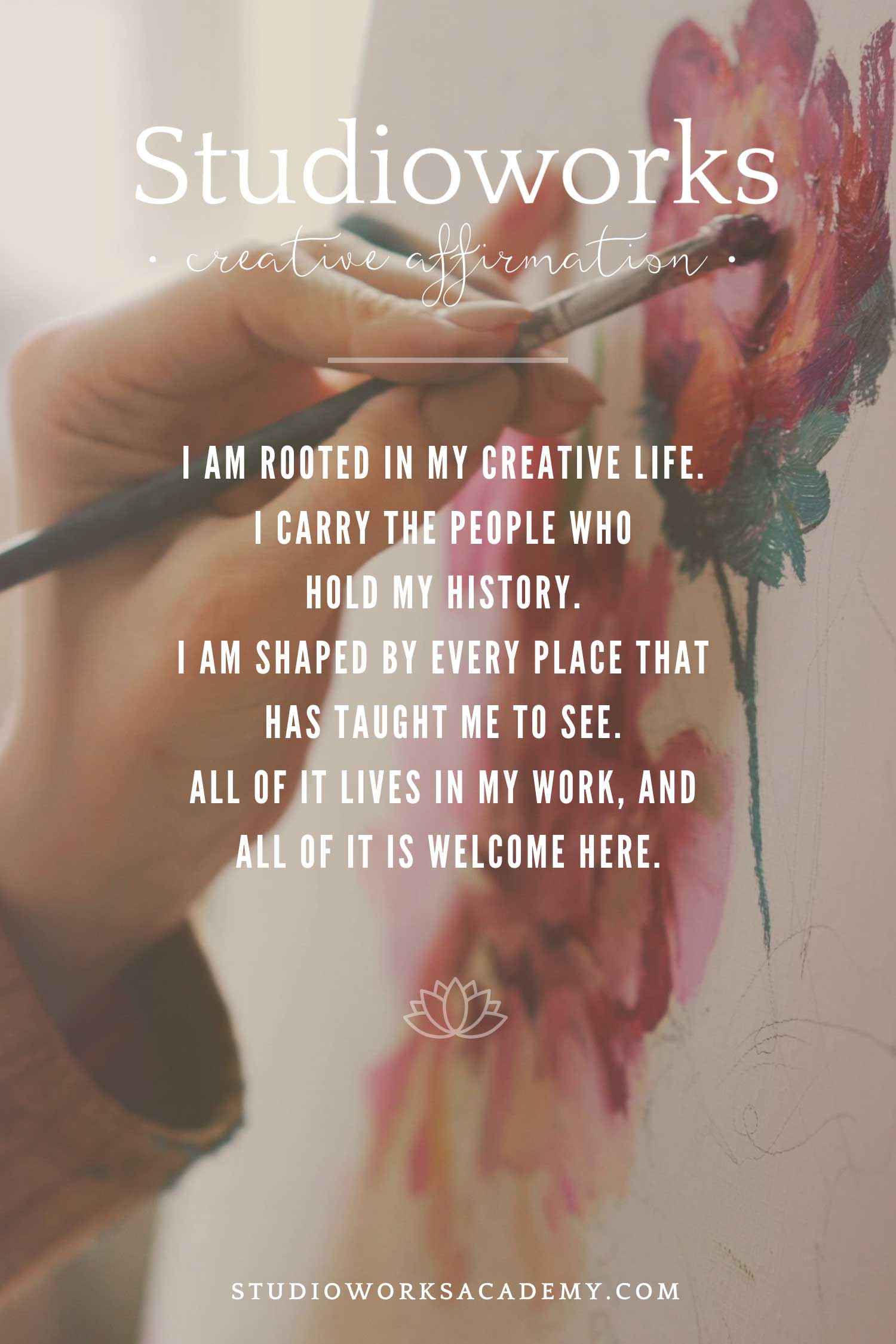
Each month we will have a positive affirmation. I recommend you print out this affirmation and put it in your sketchbook or somewhere in your studio. Recite the affirmation out loud each time you show up to create. Saying words aloud is powerful and can begin to re-write some of our own limiting beliefs or calm our fears. Try it now…
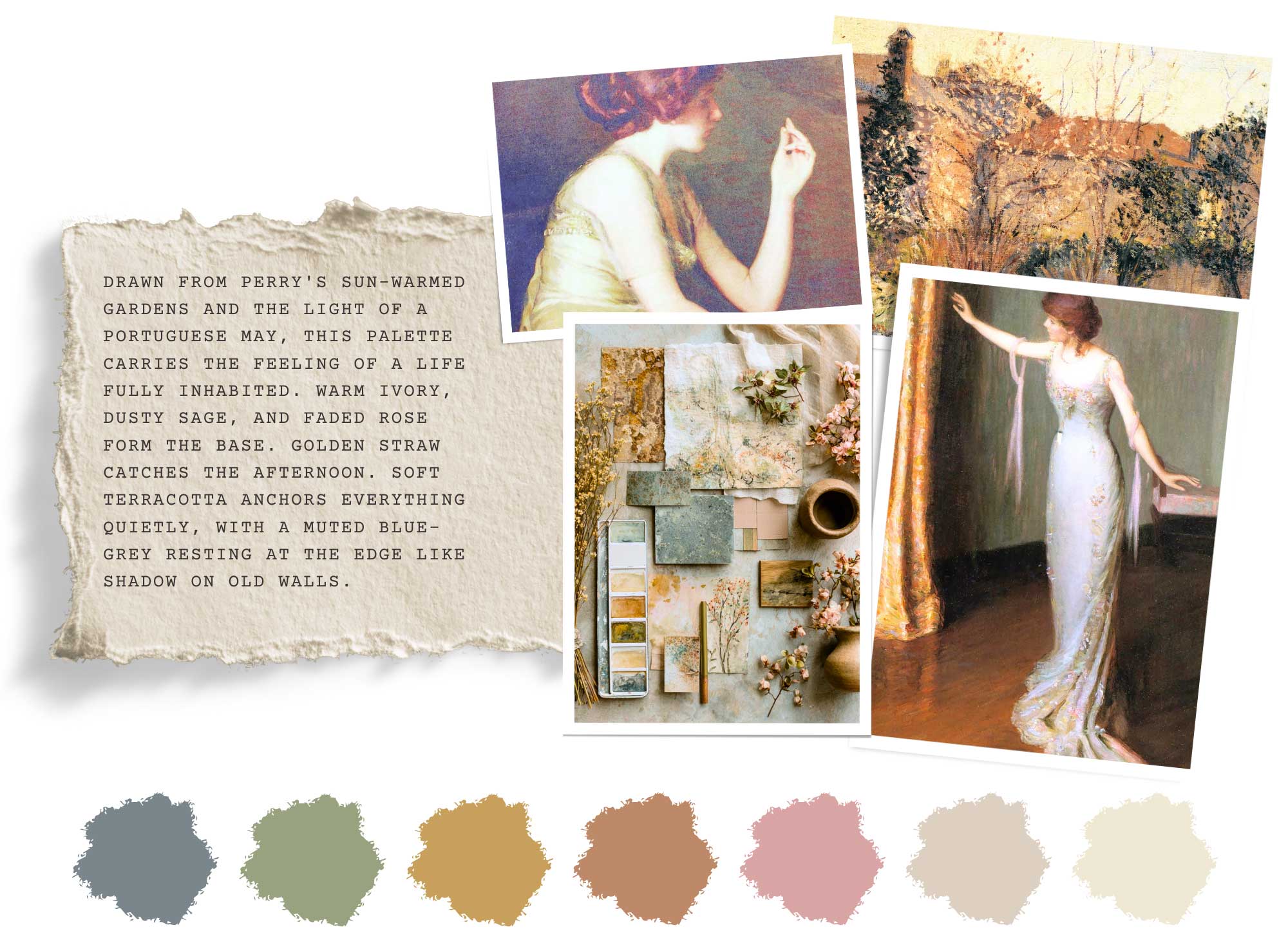
This month's palette draws from the light Lilla Cabot Perry (our master artist) found in Giverny and the warmth of a Portuguese May. It is a palette that feels inhabited, soft, layered, full of quiet life.
Warm ivory and linen white form the base, the color of old walls and sun-bleached linen. Dusty sage green brings the garden in, not sharp or vivid but the soft green of things that have been growing slowly for a long time. Faded rose adds the warmth of bougainvillea and old chintz without tipping into sweetness. Golden straw introduces a honeyed afternoon quality, the color of late light on stone. Soft terracotta grounds the whole palette and keeps it from drifting. A muted blue-grey offers shadow and depth, a place for the eye to rest.
These colors ask to be layered rather than used in isolation. Let the ivory breathe between other tones. Let the sage and rose sit close together the way they do in a garden that hasn't been too carefully tended. Use terracotta sparingly, as an anchor. Reserve the blue-grey for depth and quiet.
This is a palette for interiors and gardens, for mornings with people you love, for work that feels unhurried and honest.
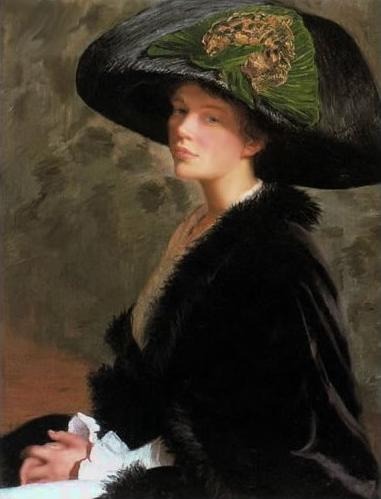
Lilla Cabot Perry, self-portrait, c.1891
There is a particular kind of artist who doesn't seek out the extraordinary. Who looks instead at the life immediately at hand and finds it, quietly and repeatedly, to be enough.
Lilla Cabot Perry was that kind of artist. The work she made from that orientation, from gardens and daughters and the shimmer of afternoon light on familiar things, is some of the most emotionally resonant painting of the American Impressionist tradition.
Lilla Cabot was born in 1848 into one of Boston's most distinguished intellectual families. Her grandfather was Oliver Wendell Holmes Sr., the poet and physician whose wit and warmth shaped Boston's literary culture for decades, which is why his words opened our essayist's reflection earlier in this issue. Her upbringing was steeped in books, ideas, and the assumption that the life of the mind was a serious undertaking regardless of one's gender.
She married Thomas Sergeant Perry, a scholar and critic of considerable distinction, at twenty-six. Together they built a partnership that was genuinely collaborative: he supported her artistic ambitions without reservation, and she brought the same seriousness to her painting that he brought to his scholarship.
She came to painting in her mid-thirties, studying first in Boston and then in Paris at the Académie Colarossi, one of the few ateliers that accepted women students. She was not a prodigy. She was a woman who arrived at her vocation through sustained effort and the willingness to begin.
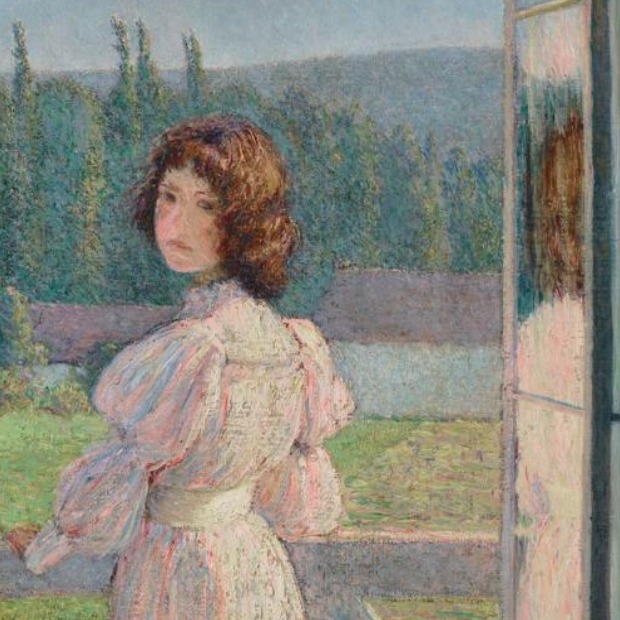
Lilla Cabot Perry, Girl on a Balcony, 1894
In 1889, Perry arrived in Giverny for the first time. She was forty-one years old, accompanied by her husband and their three daughters. The village had already become a gathering point for American painters drawn by proximity to Monet and by the particular quality of light in the Seine Valley. But Perry's relationship with the place would deepen into something more than most.
She returned for ten summers over the next two decades, renting the same house, falling into the same rhythms, watching her daughters grow through the seasons of a French village while she painted in the fields and the garden.
Her friendship with Monet was genuine and complex. He was famously private, famously reluctant to explain his methods. But something about Perry's seriousness opened him. He spoke with her about his thinking in ways he rarely did with others, and she listened carefully, translating what she heard not just into paint but eventually into words. Her 1927 essay "Reminiscences of Claude Monet from 1889 to 1909" remains one of the most clear-eyed firsthand accounts of his working methods. She wrote it as a peer, which is exactly what she was.
She once recorded his advice simply: "He never wanted you to paint like him... he only wanted you to look at nature and give your own sensations." It was guidance she spent the rest of her career embodying.
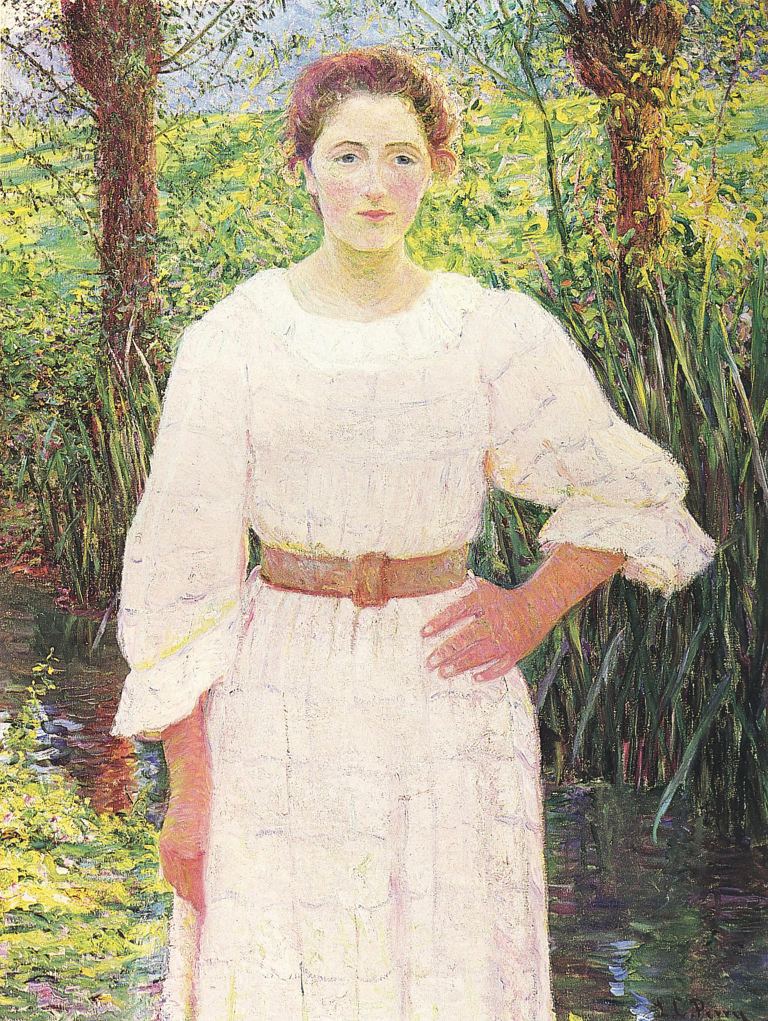
Lilla Cabot Perry, Painting By the Brook, Giverny, France 1909
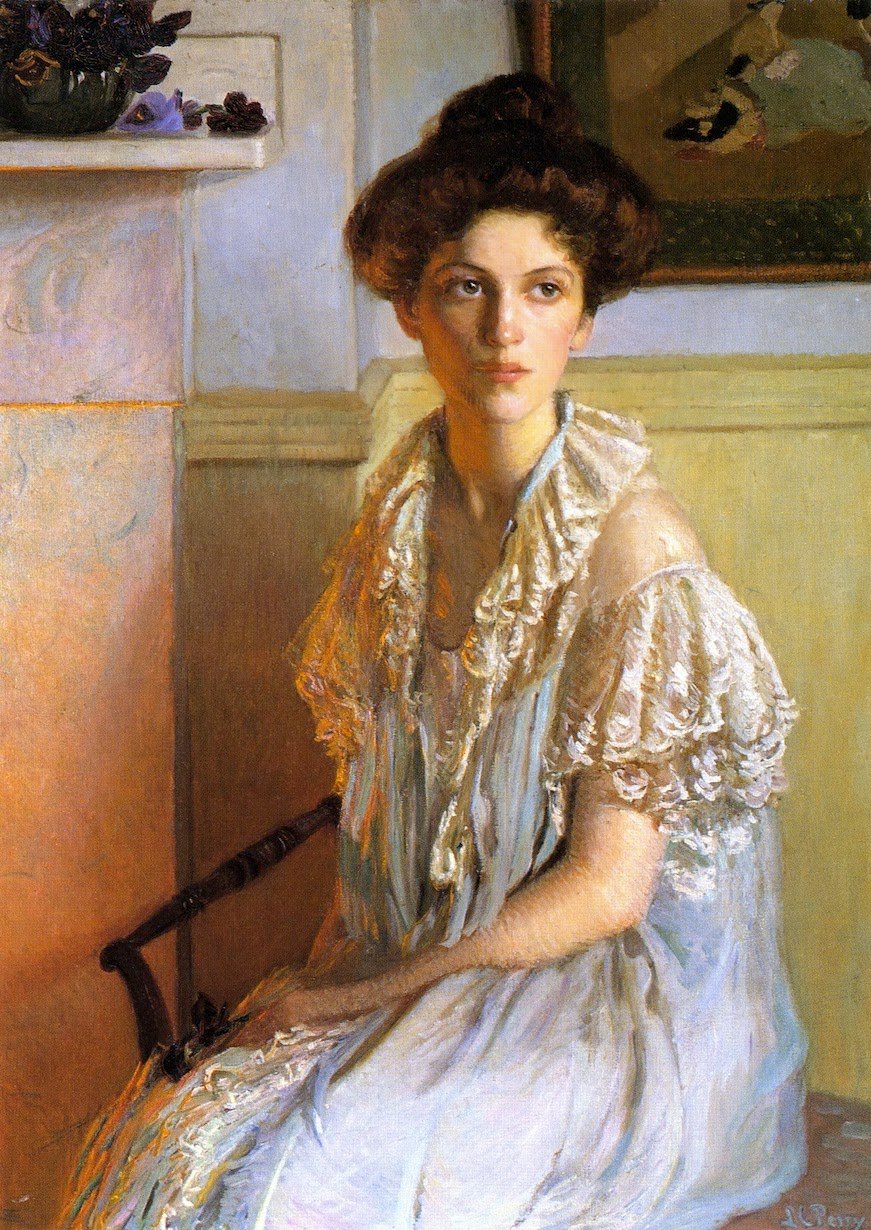
Lilla Cabot Perry, Lady with a Bowl of Violets, 1910
Perry's most beloved paintings are the ones in which her daughters appear.
They drift through gardens and stand at windows and sit absorbed in books. Painted with the same close looking she brought to water and sky, but with something additional, a quality of deep familiarity. The way you see someone you have watched, for years, from across the breakfast table.
These are not idealized portraits. They are records of someone simply being there, unaware of being observed or entirely comfortable with it. The light falls on them the way it falls on everything else in Perry's work: with democratic generosity, as if to say that a daughter reading in a garden is as worthy of serious looking as any grand historical subject.
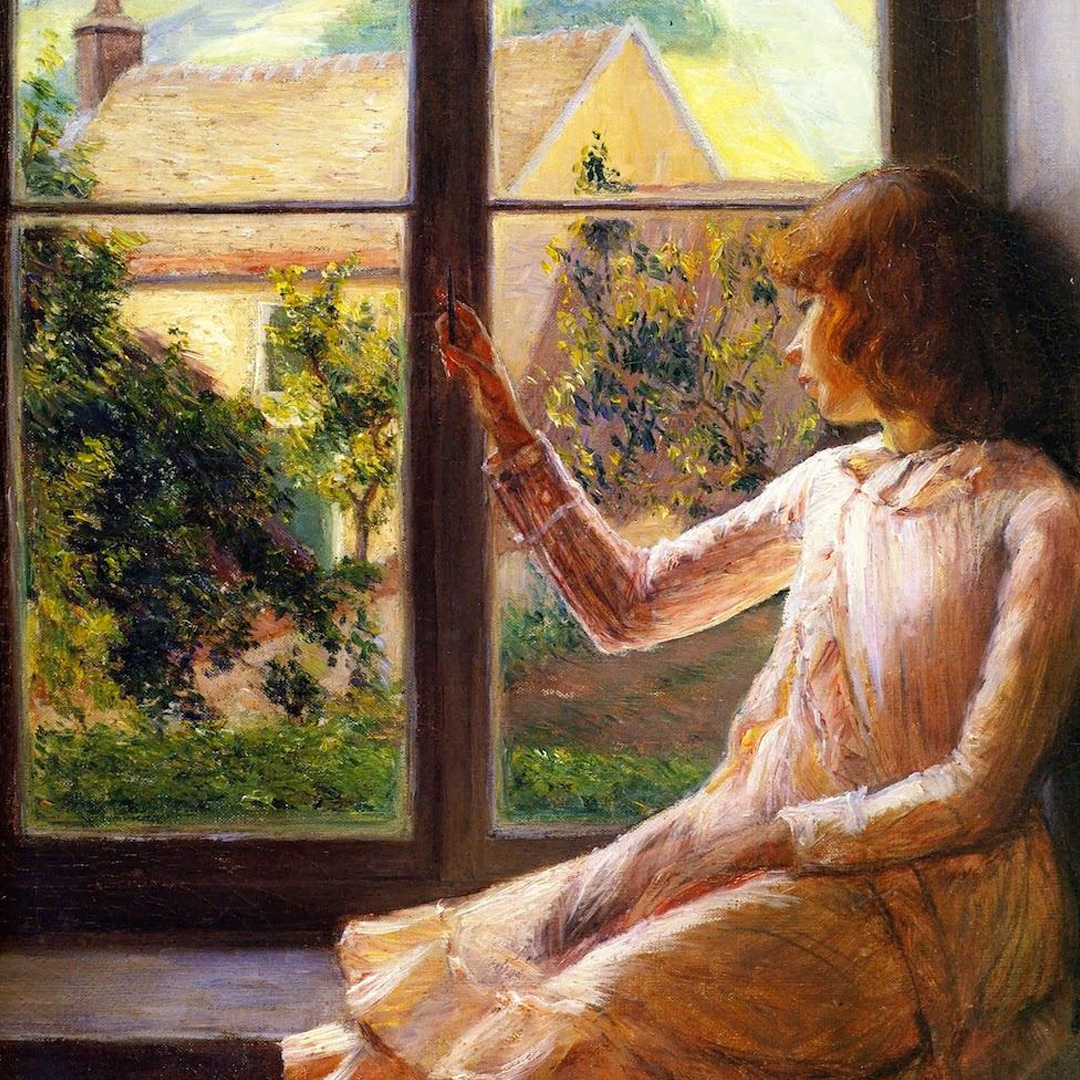
Her interior paintings carry the same quality. Figures near windows, the play of natural light on domestic objects, the geometry of rooms where people actually live. Nothing performing. Everything simply present.
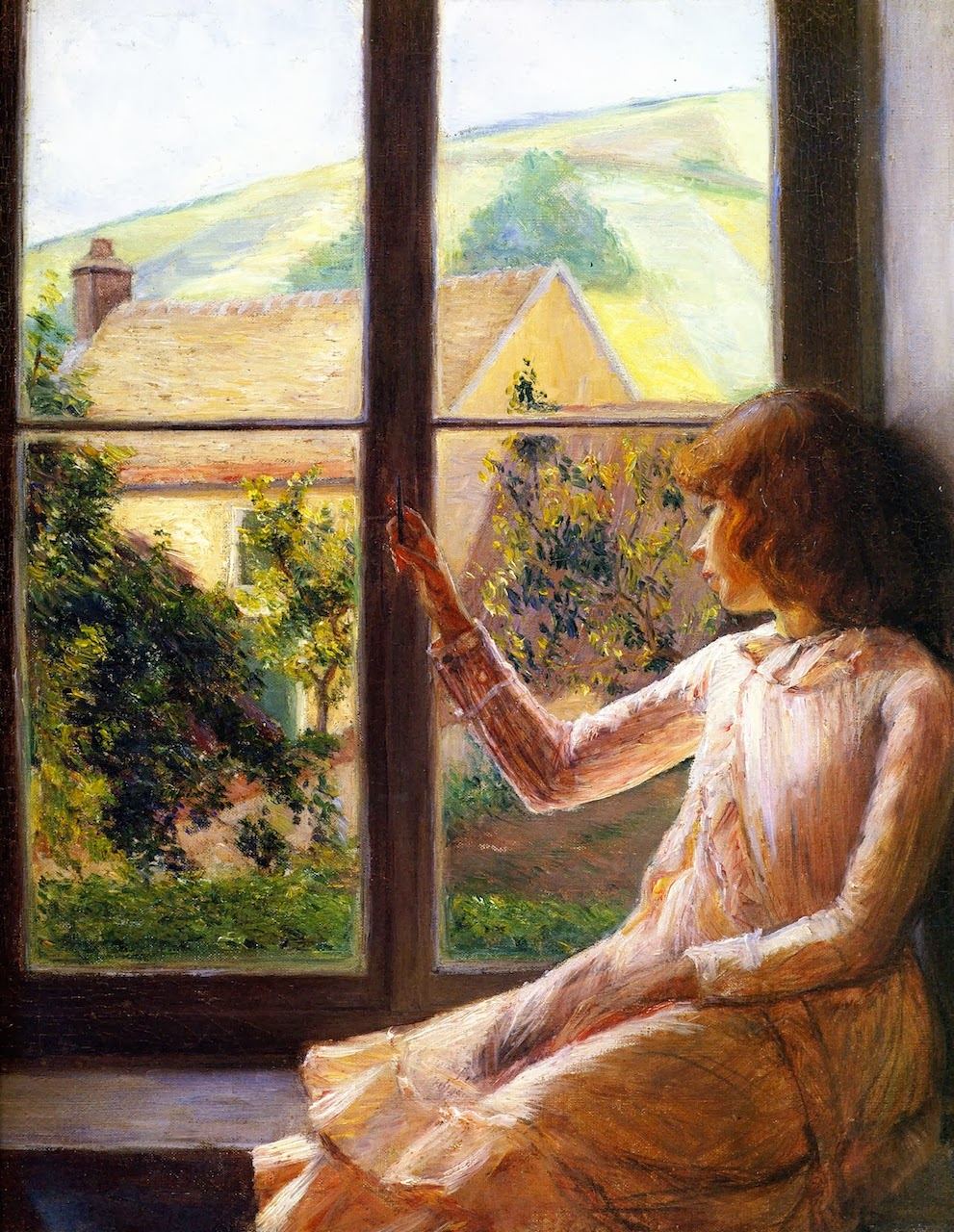
Lilla Cabot Perry, Edith Perry at the Window (Child in Window), 1891
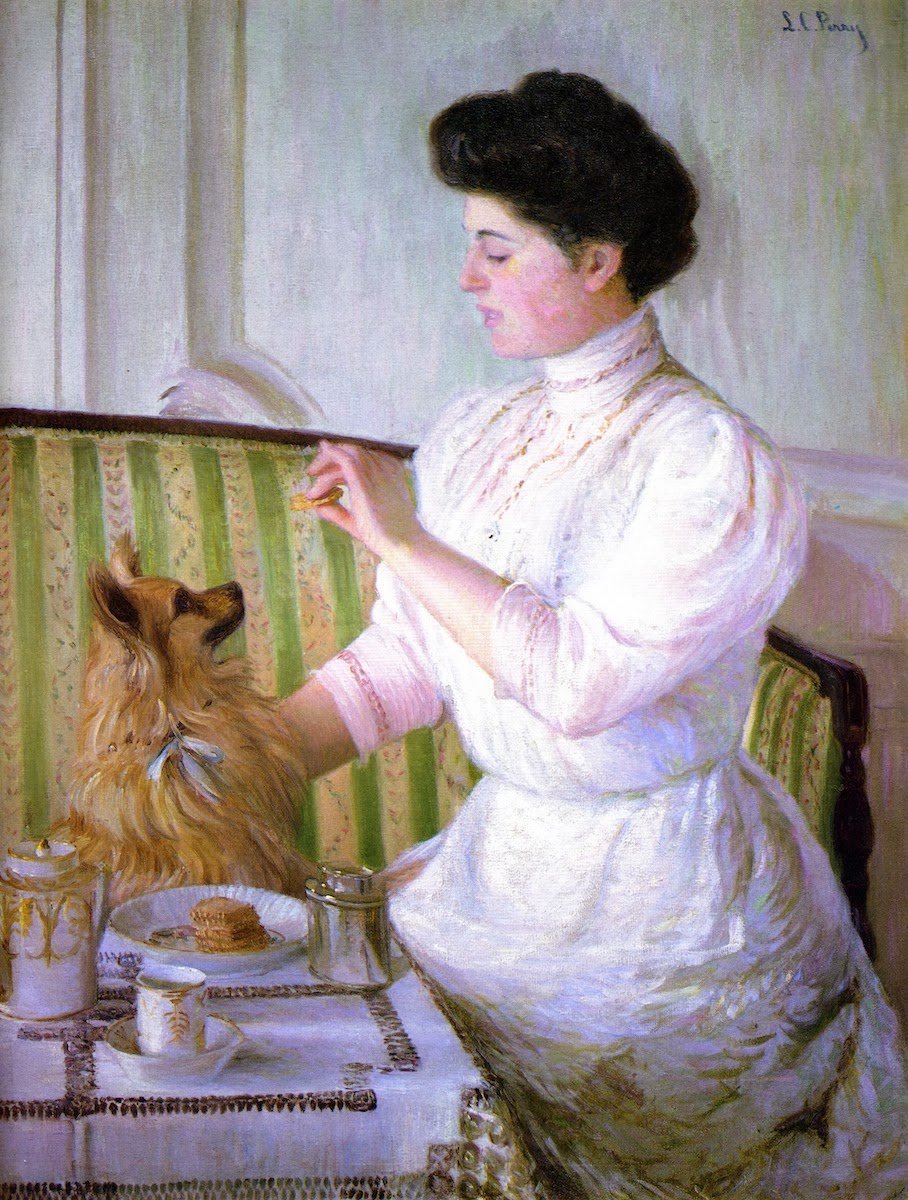
Lilla Cabot Perry, Lady at the Tea Table 1905
Between 1898 and 1901, Perry and her husband lived in Tokyo, where Thomas had accepted a teaching position. The experience expanded her visual vocabulary significantly. Japanese art's emphasis on flat planes of color, strong outline, and the expressive use of empty space found its way into her work, subtly but perceptibly.
She painted portraits of Japanese women and children with the same careful looking she had brought to her daughters in Giverny. She studied Japanese prints and thought seriously about what their compositional principles might offer a painter trained in the Western tradition.
The result is a body of work that sits at an interesting intersection: Impressionist in its sensitivity to atmosphere, but with an underlying structural clarity that owes something to Japan. She held both influences without being dominated by either.
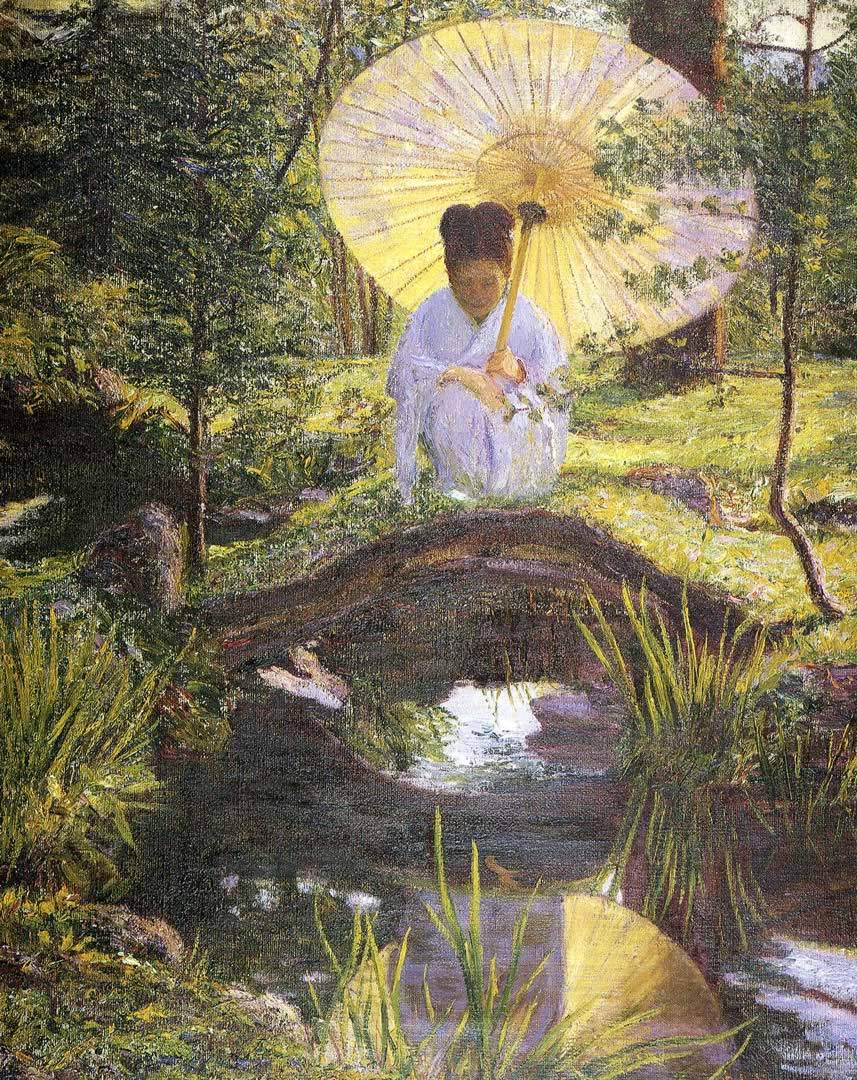
Lilla Cabot Perry, In a Japanese Garden, 1898-1901
Perry's life makes a quiet argument against the idea that serious art requires separation from the people and places you love.
She painted her daughters because she loved them and because they were there, part of the life she was living. She returned to Giverny because that community fed her work rather than distracting from it. She carried Boston and Japan and France inside her simultaneously, and none of those presences cancelled the others.
What we can take from her, beyond the luminous palette and the broken brushwork, is that willingness to let your life be your subject. To trust that paying deep attention to the people and places that hold you is not a lesser form of creative practice. It is one of the oldest and most enduring forms there is.
The daughters in the garden are still there, lit by that particular afternoon light. Still waiting to be seen.
Choose a person who is part of the fabric of your daily life. A partner, a child, a friend, a parent visiting for the month. You are not making a portrait in the formal sense. You are making a record of someone simply being there.
Set up simply, natural light if you can. Ask them to do something ordinary, read, drink their coffee, look out a window. Give them no other direction.
Work quickly and without overworking. Focus not on likeness but on light and mood: where does the light fall on their hands, their hair, the side of their face? What is the quality of the space around them?
Reflect: What did this kind of close looking at someone familiar feel like? Did anything surprise you in the seeing?
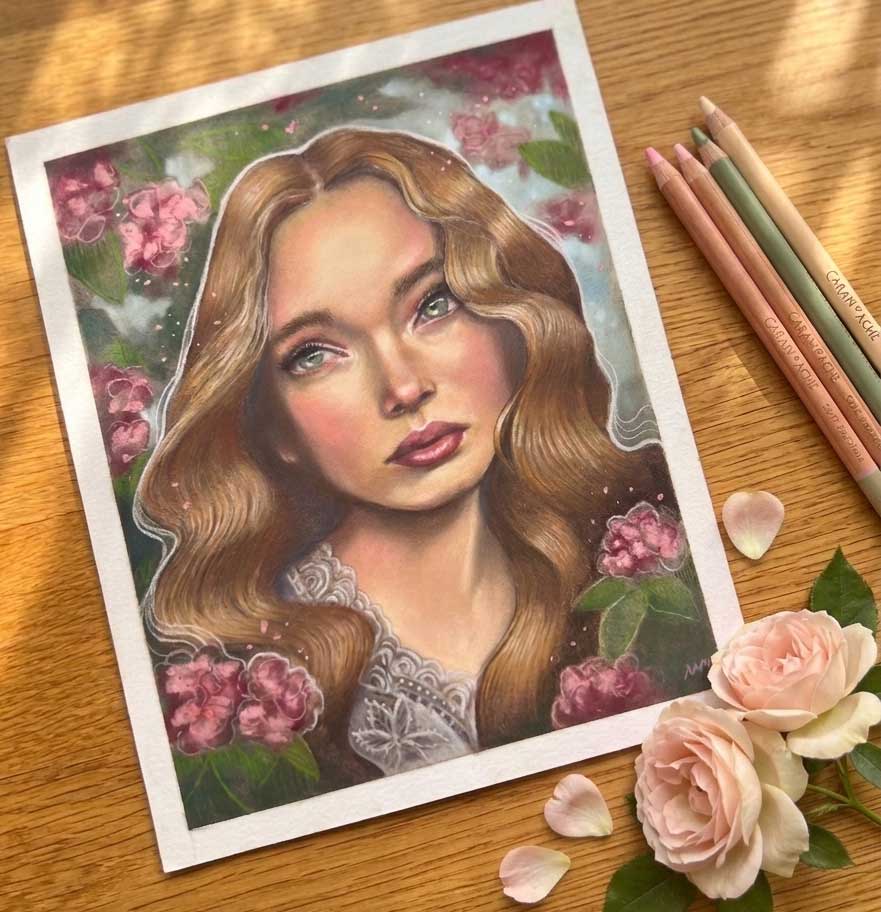
(This is a portrait i did of my youngest daughter, Claire)
One of Perry's great gifts was finding the luminous in the immediate and everyday. This exercise asks you to do the same.
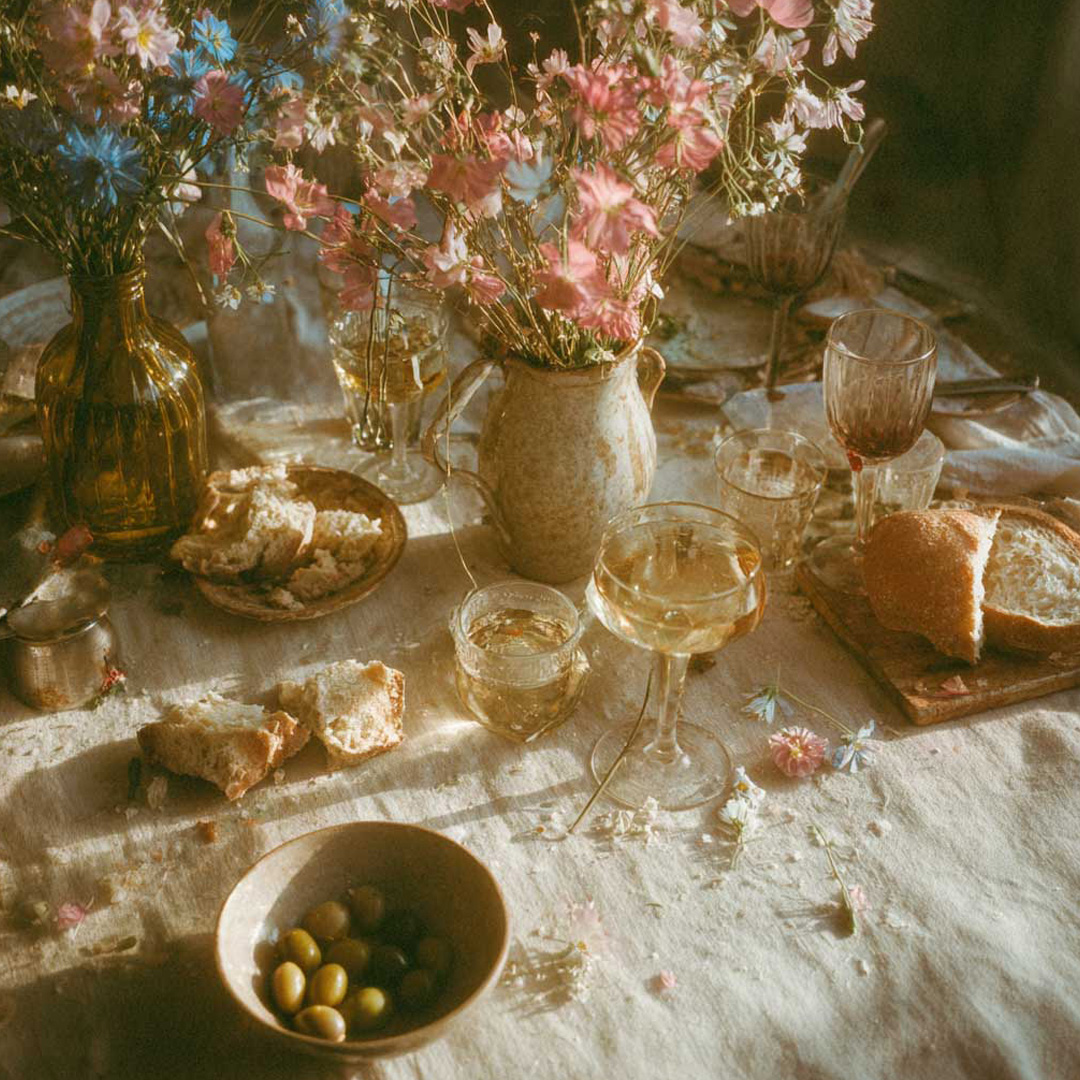
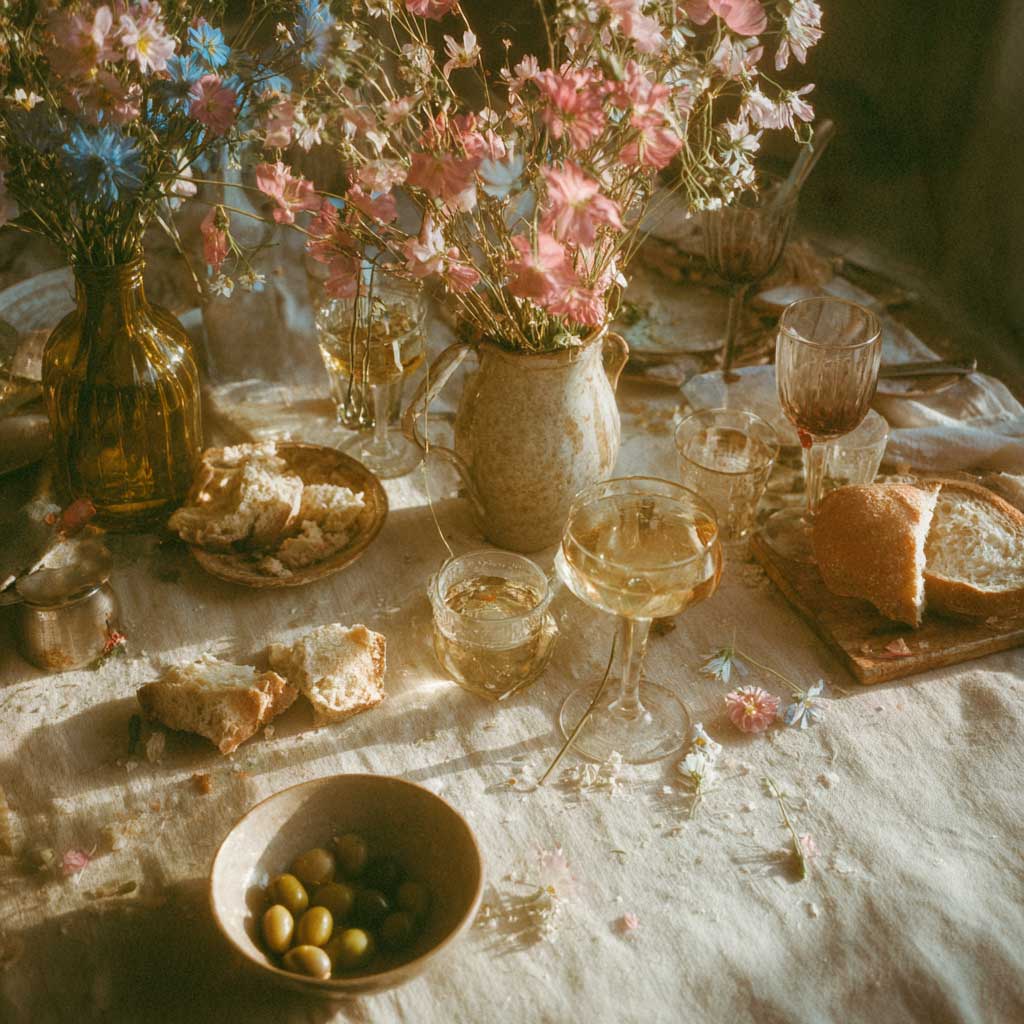
After a meal, before you clear the table, stop. Look at what is there: the glasses, the plates, the bread, the wine, the flowers if there are any, the folded napkins. The particular disorder of a table after people have eaten and talked and lingered.
Make a quick sketch or small painting of exactly what you see. Work fast. Don't rearrange anything. Let it be as it is.
Reflect: What does this particular arrangement say about the meal, the people, the occasion? What does it mean to treat the ordinary table as a worthy subject?
Choose one of Perry's figure paintings. Spend several minutes looking before you begin.
Notice: How does she handle the edges of the figure against the background? Where does she let forms dissolve into light? Where does she sharpen a line?
Make a careful study in your own medium. You are not trying to replicate her brushwork. You are trying to understand her decisions. Why this composition? Why this light source? What holds the painting together?
Reflect: What did you learn about Perry's approach by attempting to follow it? What surprised you about her choices?
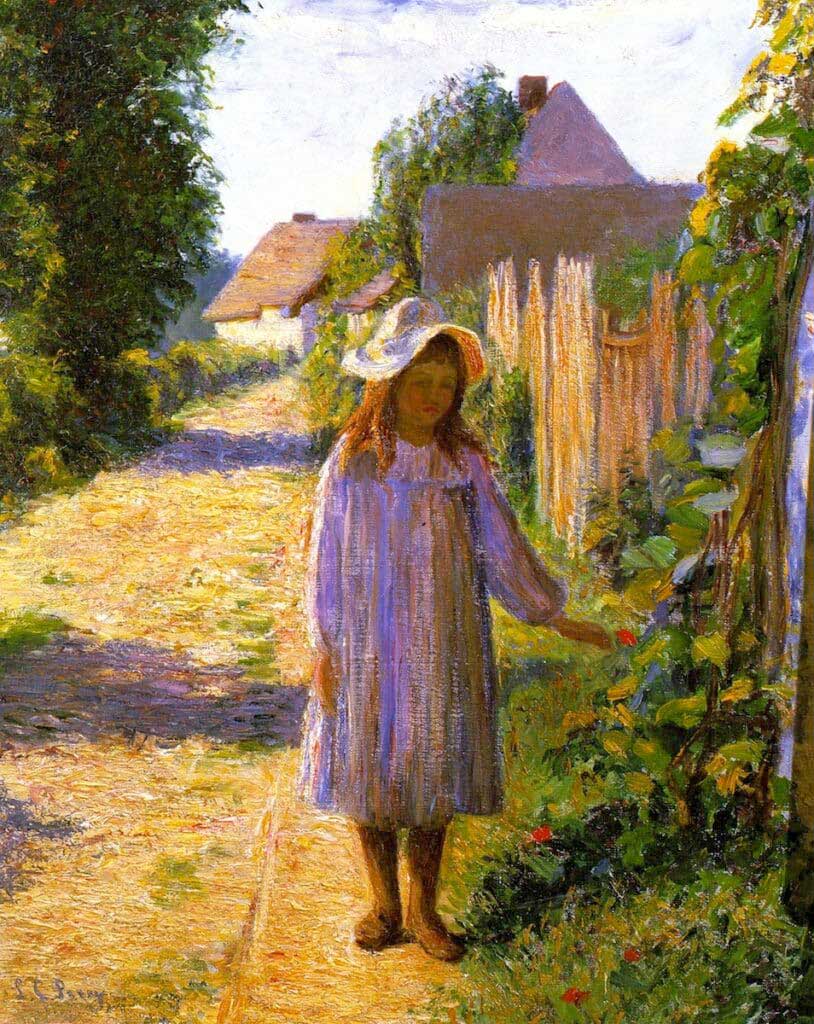
Lilla Cabot Perry, Alice in the Lane, c. 1891
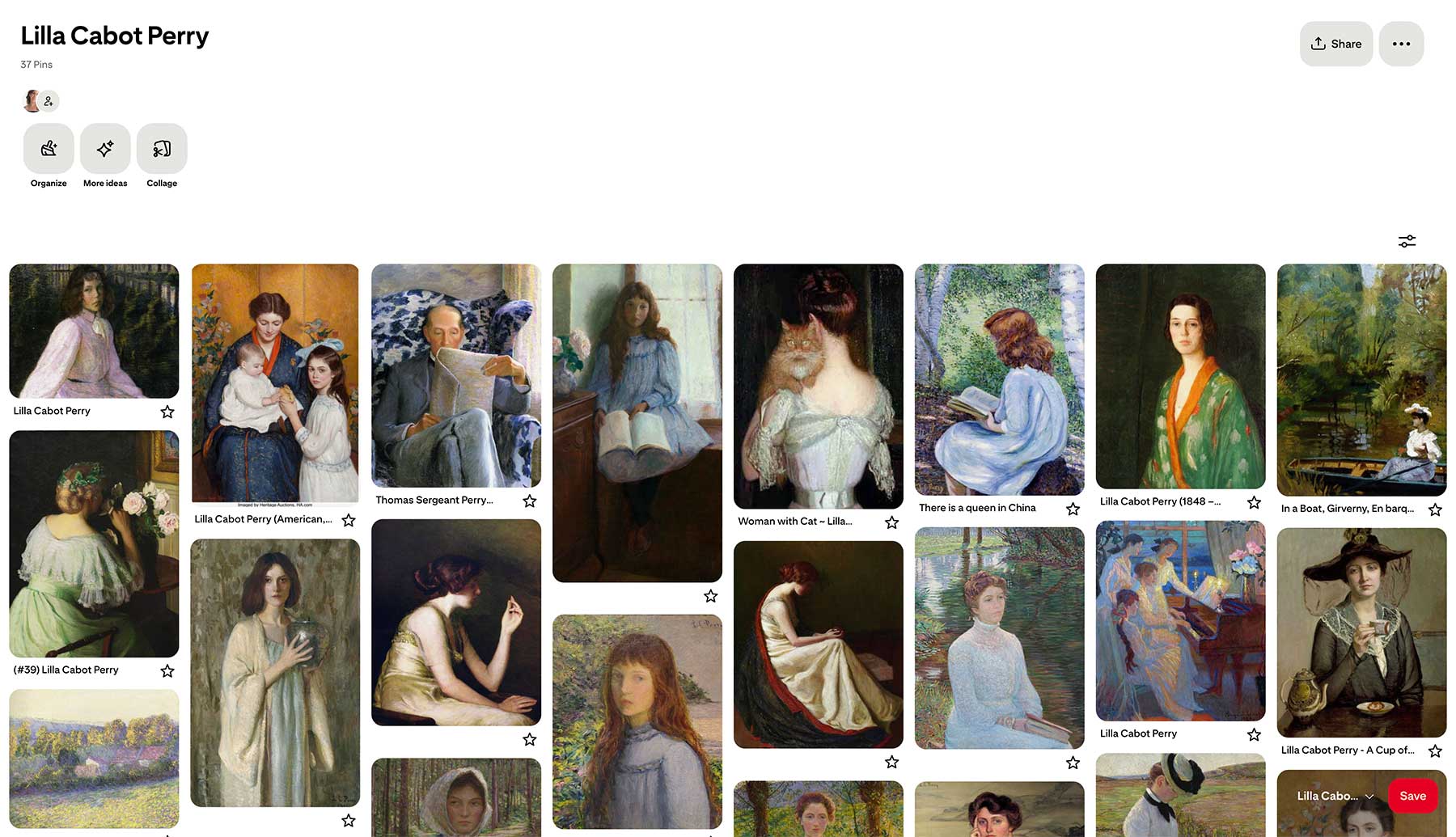
You can view our Pinterest board to see more of Lilla Cabot Perry's work:
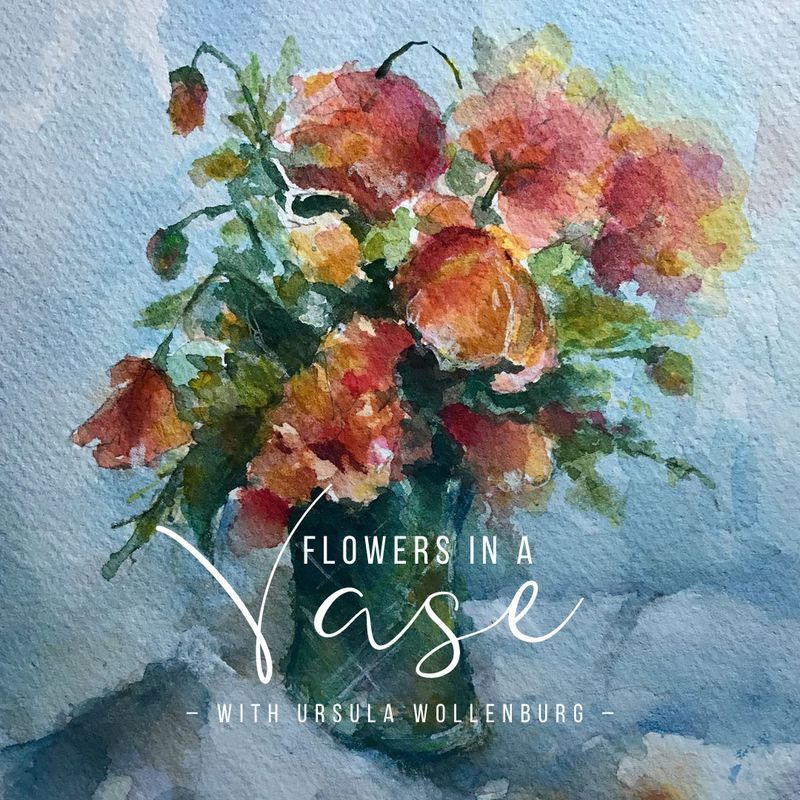
There is something about watercolor that refuses to be tamed, and that is exactly where its beauty lives. Light moves through each brushstroke, the paint finds its own way across the page, and the painting becomes something you make with the medium rather than to it.
In this class, we'll take inspiration from a luminous painting by Turner, borrowing his palette to create our own flowers in a vase. Watercolor will give the work a different kind of life, more fluid, more willing to surprise us. It's a quiet pleasure to see how the same subject shifts when carried into a new medium.
Come in without a fixed picture of how it should look. Let the paint flow. Let the color do what it wants to do. The goal is the experience of painting itself, the steady rhythm of brush and water and pigment, the small discoveries that only happen when you loosen your grip
You can also listen to this month’s issue of the Studioworks journal. I find I love listening to books, podcasts and music while I draw, paint or go on a long walk. Enjoy.


One of my favorite things to do is to curate inspiration. From Pinterest boards to books, resources, playlists and more - I love to share anything that might facilitate learning, expansion, and sparks of curiosity! Being an artist, we naturally crave these things so here are some of this month’s picks from me to you.
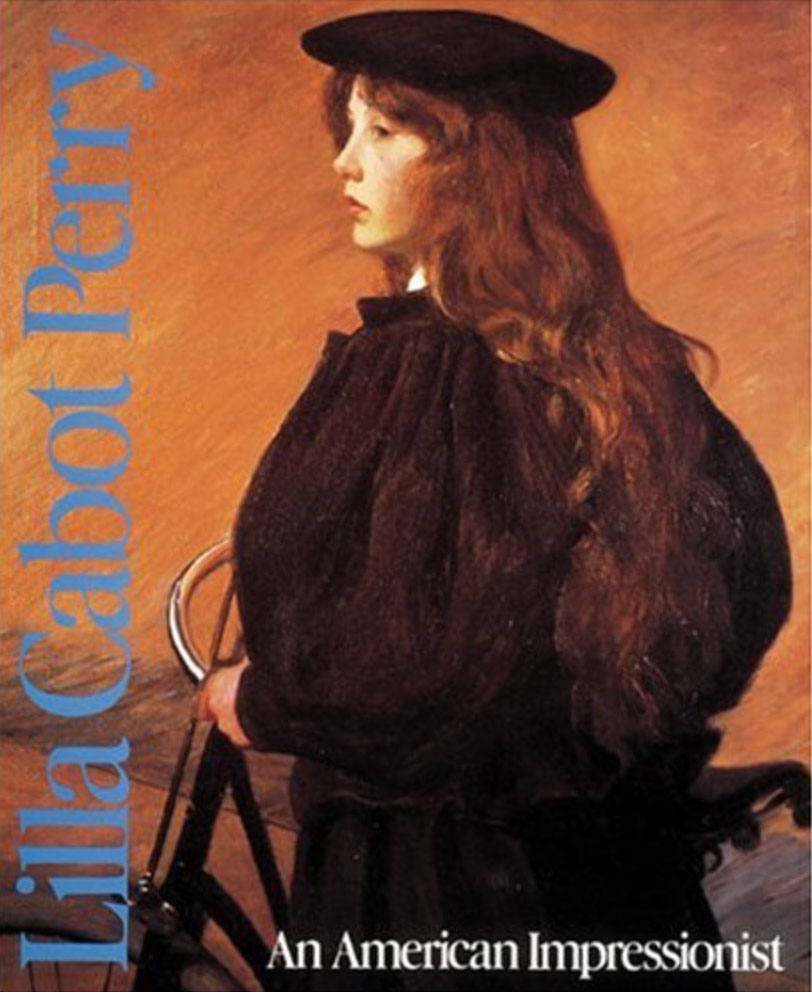
The only book devoted entirely to Perry's life and work, this is an intimate portrait of a woman who came to painting at 36, already a wife and mother, and never looked back. For anyone who has wondered whether it's too late to take your creative life seriously, her story answers that question quietly and completely.

Toko-pa Turner writes at the threshold where dreams, instinct, and the longing for home converge. This is a book for anyone who has ever felt the ache of not quite belonging and slowly, tenderly, learned to find their way back to themselves. For an issue rooted in what it means to claim a life, a place, and a creative identity as your own, it couldn't be more fitting.
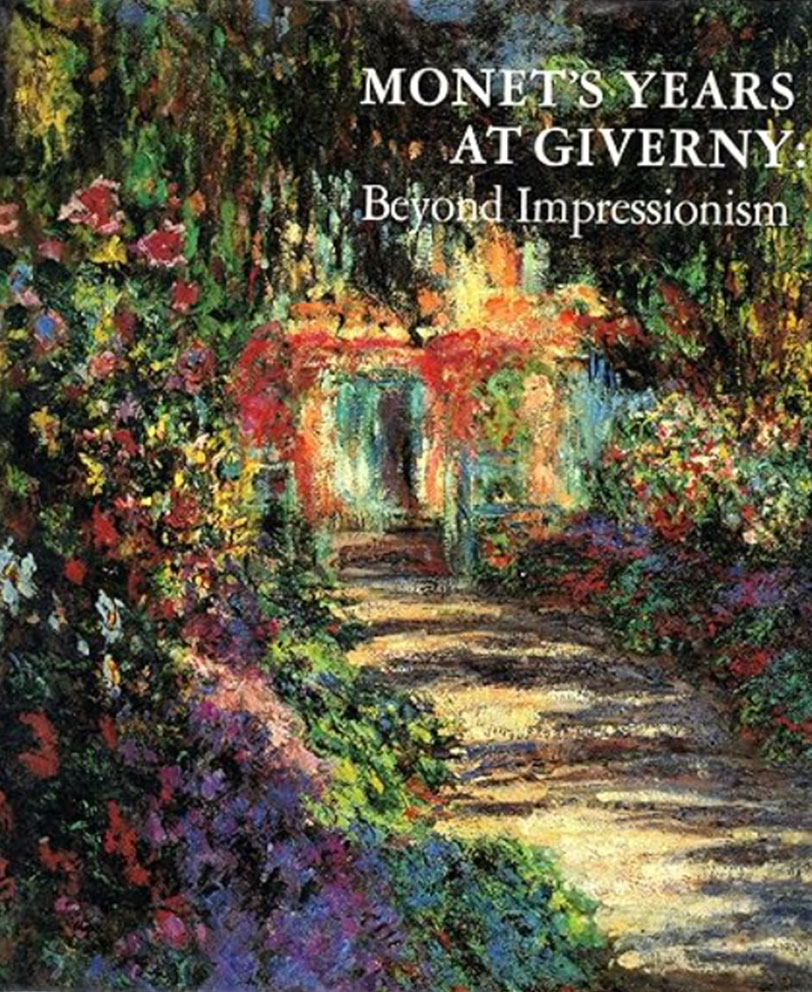
Eighty-one paintings from the forty years Monet spent at Giverny, tracing his quiet evolution from Impressionist to something closer to visionary. For anyone who has ever rooted their creative life in a single beloved place, this book understands that impulse completely.
I had so much fun curating this list. I hope you enjoy!!
Classes that pair well with this month’s theme in your Studioworks Creative Library